Introduction (Continue from Part 2)
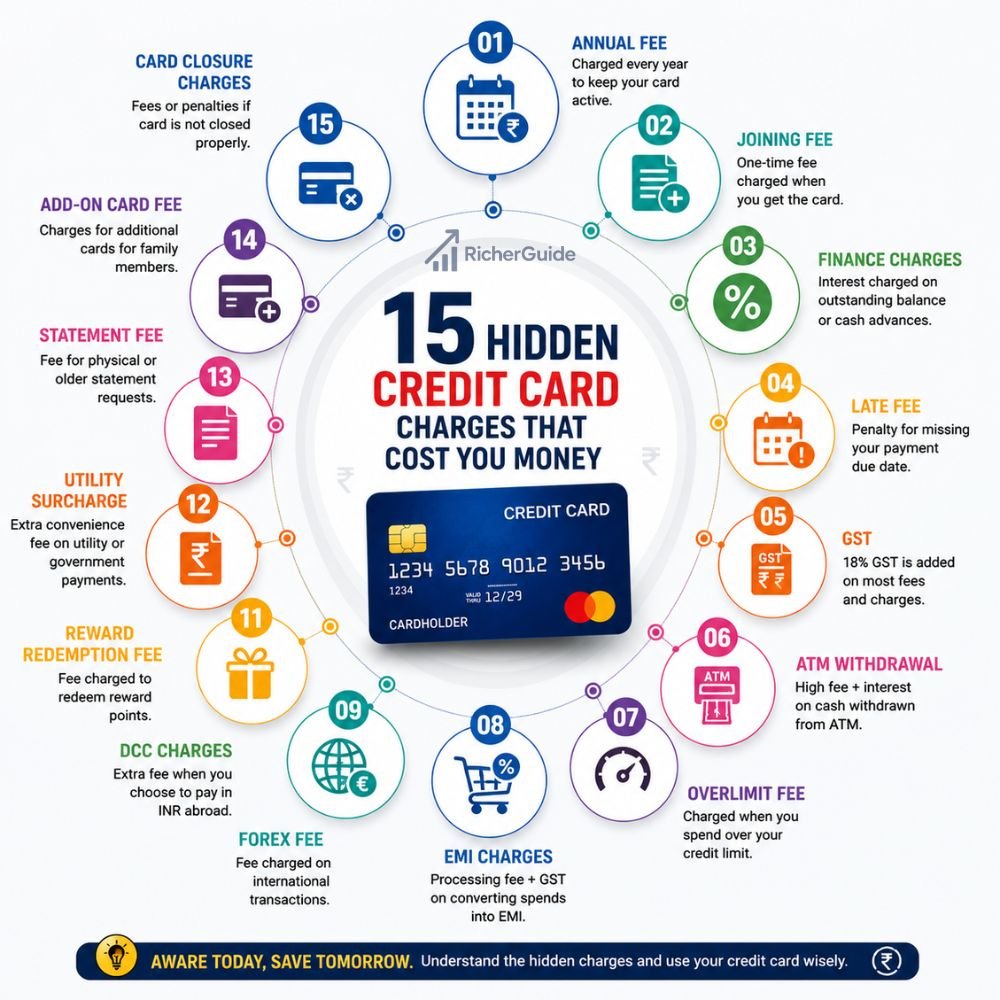
Welcome to the final part of our comprehensive guide on 15 Hidden Credit Card Charges Banks Don’t Tell You About.
If you’ve been following this series, you already know that many credit card fees are easy to overlook but can quietly cost you thousands of rupees every year.
In Part 1, we covered some of the most common hidden charges, including Annual Fee, Finance Charges, Late Payment Fees, Cash Withdrawal Charges, Foreign Transaction Fees, Overlimit Charges, EMI Processing Fees, and Card Replacement Fees. If you haven’t read it yet, we highly recommend starting there to understand the basics.
👉 Read Part 1:
https://richerguide.com/hidden-credit-card-charges-india-2026-part-1/
👉 Read Part 2:
https://richerguide.com/hidden-credit-card-charges-india-2026-part-2/
In Part 2, we uncovered four more hidden costs that many cardholders ignore, such as GST on Credit Card Charges, Dynamic Currency Conversion (DCC) Charges, Reward Redemption Fees, and Convenience Charges on Utility or Government Payments. These charges may seem small individually, but together they can significantly increase your annual credit card expenses.
Now, in Part 3, we’ll complete the series by covering the final three hidden credit card charges, along with a Credit Card Hidden Charges Calculator, comparison tables, infographic ideas, frequently asked questions, affiliate recommendations, and practical tips to help you avoid unnecessary fees.
By the end of this guide, you’ll understand all 15 hidden credit card charges, know which ones are avoidable, and learn simple habits that can help you save money while using your credit card wisely.
Let’s finish the journey and become a smarter, more informed credit card user.
Table of Contents
Hidden Charge 13 – Credit Card Statement Retrieval Charges
Most banks provide the latest credit card statements free through their mobile app or internet banking. However, if you request:
- Older statements
- Duplicate physical statements
- Archived records
the bank may charge a statement retrieval fee.
Typical Charges
- ₹50–₹200 per statement
- GST extra
Example
Rahul needed statements from two years ago while applying for a home loan.
The bank charged:
| Description | Amount |
|---|---|
| Statement Retrieval Fee | ₹150 |
| GST (18%) | ₹27 |
| Total | ₹177 |
How to Avoid
✔ Download your monthly statements regularly.
✔ Store PDF copies securely on your computer or cloud storage.
Hidden Charge 14 – Add-on Card Fees
Many banks offer free add-on cards for family members.
However, premium credit cards may charge:
- Add-on Card Joining Fee
- Annual Fee
- Replacement Fee
Some banks also charge for additional add-on cards beyond the free limit.
Example
Primary Card Annual Fee = ₹2,500
Add-on Card Fee = ₹500
GST = ₹90
Total Additional Cost = ₹590
Tips
- Confirm whether add-on cards are lifetime free.
- Check annual charges before requesting multiple family cards.
Hidden Charge 15 – Card Closure or Outstanding Balance Charges
Many people believe they can simply stop using a credit card.
Unfortunately, that’s not always enough.
If you:
- forget to pay pending dues,
- don’t redeem reward points before closure,
- fail to close the card properly,
you may continue receiving:
- Interest
- Late payment charges
- Annual fee
- Outstanding balance notices
Example
Neha stopped using her credit card for one year.
She never submitted a closure request.
At renewal, the bank charged:
- Annual Fee
- GST
Since she ignored the statement, late payment charges were added too.
Her ₹0 usage resulted in a bill of over ₹1,500.
How to Avoid
✔ Always request written confirmation after closing a credit card.
✔ Clear all outstanding dues.
✔ Redeem reward points before closing.
✔ Destroy the old card securely after closure.
Credit Card Hidden Charges Calculator
Use the following table to estimate how much hidden charges may cost you in a year.
| Charge | Your Cost (₹) |
|---|---|
| Annual Fee | _____ |
| Finance Charges | _____ |
| Late Payment Fees | _____ |
| Cash Withdrawal Charges | _____ |
| Foreign Transaction Charges | _____ |
| GST on Charges | _____ |
| EMI Processing Charges | _____ |
| Reward Redemption Fees | _____ |
| Utility Convenience Fees | _____ |
| Statement Charges | _____ |
| Card Replacement Fee | _____ |
| Overlimit Charges | _____ |
| Add-on Card Fees | _____ |
| Other Charges | _____ |
| Estimated Total Hidden Cost | ₹________ |
Example Calculation
| Charge | Amount |
|---|---|
| Annual Fee | ₹999 |
| Late Fee | ₹750 |
| Finance Charges | ₹3,200 |
| GST | ₹711 |
| EMI Charges | ₹299 |
| Cash Withdrawal Fee | ₹500 |
| Total Hidden Cost | ₹6,459 |
Imagine investing that ₹6,459 every year instead of paying unnecessary fees it could grow significantly over time.
Complete Comparison Table
| Hidden Charge | Typical Cost | Can You Avoid It? |
|---|---|---|
| Annual Fee | ₹500–₹5,000 | ✅ Yes |
| Finance Charges | Up to 48% yearly | ✅ Yes |
| Late Payment Fee | ₹100–₹1,300 | ✅ Yes |
| Cash Withdrawal Fee | 2.5–3% | ✅ Yes |
| Foreign Transaction Fee | 2–4% | ✅ Yes |
| Overlimit Fee | ₹500–₹1,000 | ✅ Yes |
| EMI Processing Fee | ₹199–₹999 | ✅ Yes |
| Card Replacement Fee | ₹100–₹500 | Mostly |
| GST on Charges | 18% | Partly |
| Dynamic Currency Conversion | 2–8% | ✅ Yes |
| Reward Redemption Fee | ₹99–₹299 | ✅ Yes |
| Utility Convenience Fee | 0.5–2% | ✅ Yes |
| Statement Retrieval Fee | ₹50–₹200 | ✅ Yes |
| Add-on Card Fee | ₹0–₹1,000 | Depends |
| Card Closure Charges | Varies | ✅ Yes |
Frequently Asked Questions (FAQs)
1. Are hidden credit card charges legal?
Yes. Banks disclose these charges in the card’s terms and conditions. They may seem “hidden” because many users don’t read the fee schedule before applying.
2. Which hidden charge is the most expensive?
Finance charges (interest) are usually the costliest. If you carry a balance, the annual interest rate can exceed 40%, making it one of the biggest avoidable expenses.
3. Is GST charged on every credit card transaction?
No. GST is generally applied to service-related charges such as annual fees, late payment fees, cash withdrawal fees, and processing fees not on your regular retail purchases.
4. Can I avoid paying the annual fee?
Many banks waive the annual fee if you meet the required yearly spending threshold. Some cards are also offered as lifetime free.
5. Should I use my credit card to withdraw cash?
Only in emergencies. Cash withdrawals usually attract an immediate cash advance fee and interest from the first day, with no interest-free period.
6. What happens if I pay only the minimum amount due?
You avoid being marked as a payment defaulter for that cycle, but interest continues to accrue on the remaining balance, making your debt more expensive.
7. How can I reduce hidden credit card charges?
- Pay the full bill on time.
- Avoid cash withdrawals.
- Stay within your credit limit.
- Read your monthly statement carefully.
- Understand the card’s fee structure before applying.
8. Which credit card is best for avoiding extra charges?
The best choice depends on your spending habits. Look for cards with low annual fees (or lifetime-free options), transparent fee structures, and benefits that match your lifestyle.
Conclusion
Credit cards are powerful financial tools that offer convenience, rewards, and flexibility but only when you understand their true costs.
Many hidden charges, such as finance charges, late payment fees, foreign transaction fees, and convenience charges, are entirely avoidable with responsible usage.
The key is to:
- Read the card’s terms and conditions.
- Pay your full bill before the due date.
- Avoid unnecessary fees like cash withdrawals and overlimit usage.
- Review your monthly statement regularly.
By following these simple habits, you can enjoy all the benefits of your credit card while keeping unnecessary costs under control.
A little financial awareness today can save you thousands of rupees every year.
Final Thoughts
Hidden credit card charges aren’t really “hidden” they’re usually mentioned in the card’s terms and conditions. The problem is that most people don’t read the fine print until an unexpected fee appears on their monthly statement.
The good news is that most of these charges are completely avoidable. Paying your bills on time, clearing the full outstanding balance, avoiding cash withdrawals, staying within your credit limit, and reviewing your monthly statement regularly can save you thousands of rupees every year.
Before applying for your next credit card, don’t focus only on cashback, reward points, or welcome offers. Take a few minutes to compare the annual fee, interest rate, foreign transaction charges, reward redemption fees, and other applicable charges. Choosing the right credit card based on your spending habits is just as important as using it responsibly.
Remember, a credit card should help you build wealth not quietly drain your money through unnecessary fees. The more informed you are, the smarter your financial decisions will be.
If this guide helped you understand the real cost of using a credit card, share it with your friends and family so they can avoid these expensive mistakes too. For more practical money tips, credit card guides, and personal finance insights, keep visiting RicherGuide.com and take one step closer to achieving financial freedom.
Disclaimer
The information in this article is intended for educational and informational purposes only and should not be considered financial, legal, tax, or investment advice.
Credit card fees, interest rates, annual charges, reward programs, foreign transaction fees, and other terms vary by bank, card issuer, and card type. Banks may update their charges and policies without prior notice.
Before applying for or using any credit card, always review the latest Schedule of Charges, Most Important Terms & Conditions (MITC), and official information provided by the card issuer.
RicherGuide.com and the author are not responsible for any financial decisions or losses resulting from the use of the information in this article. If you need advice tailored to your financial situation, consult a qualified financial advisor.