Credit cards can be useful financial tools but believing the wrong information about them can become expensive.
Many people hear statements such as:
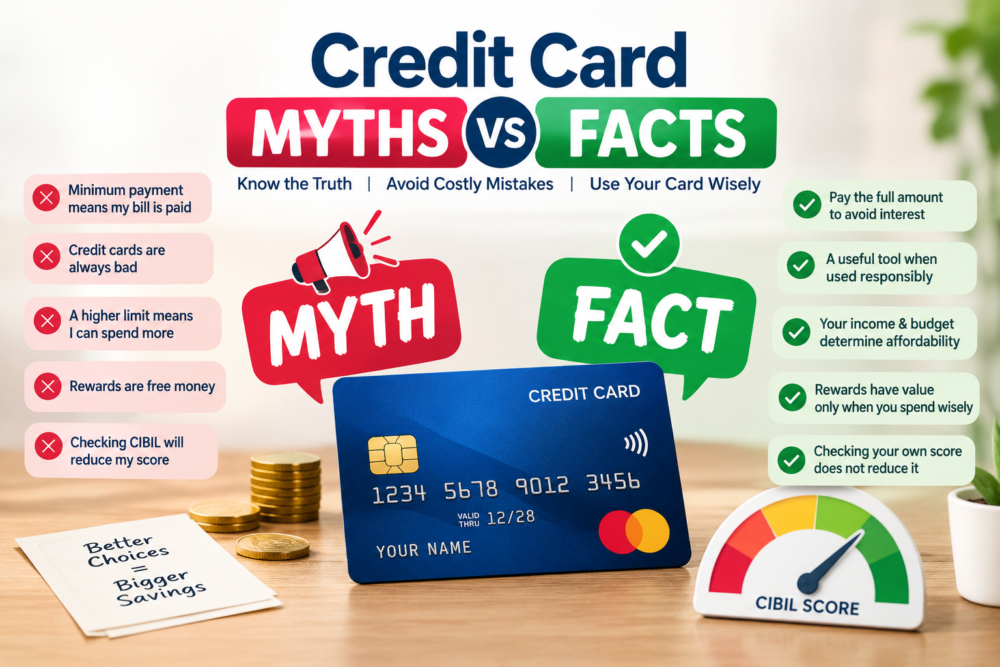
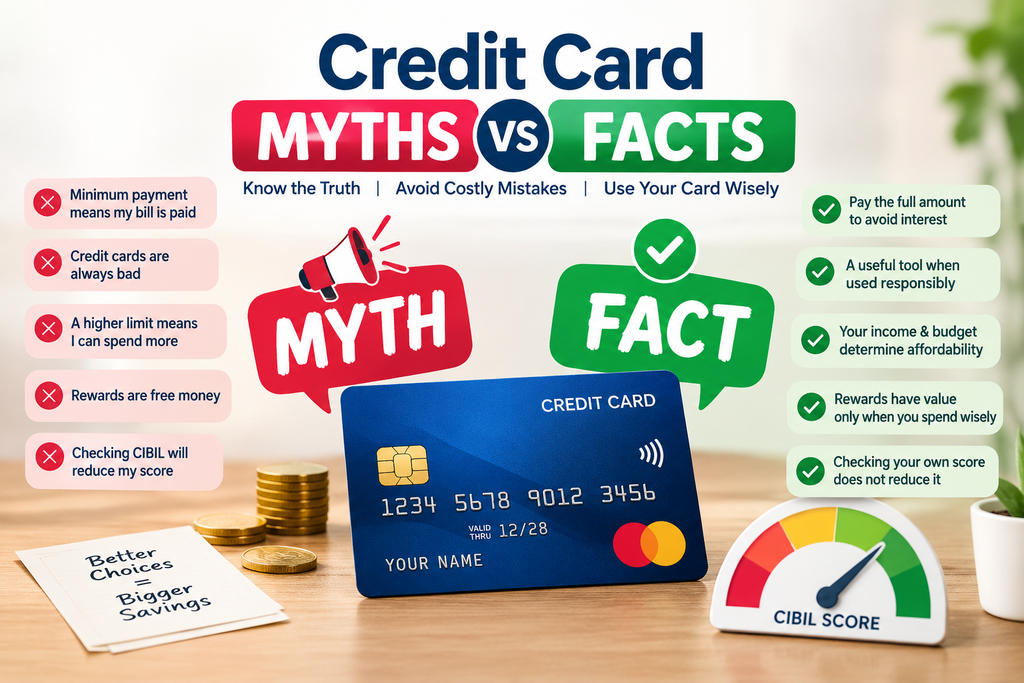
“Paying the minimum amount is enough.”
“Credit cards are bad for your credit score.”
“A higher credit limit means I can spend more.”
“Credit card rewards are free money.”
“Checking your CIBIL Score will reduce it.”
Some of these statements are completely wrong. Others contain only a small part of the truth.
These credit card myths can lead to unnecessary interest, late fees, poor financial decisions, overspending and avoidable damage to your credit profile.
In this guide, we will break down 15 common credit card myths in simple English and explain what Indian credit card users should actually know.
Table of Contents
Introduction
Credit cards have become a common part of modern financial life in India.
They can be used for online shopping, utility payments, travel bookings, subscriptions, emergency expenses and everyday purchases. Depending on the card, users may also receive rewards, cashback, discounts, airport benefits and other offers.
But a credit card is still a form of borrowing.
When you use a credit card, the issuer is effectively providing you with credit that you are expected to repay according to the card’s terms.
The problem begins when people misunderstand how credit cards work.
A person may think:
“I only need to pay the minimum amount.”
Another person may believe:
“My credit limit is ₹2 lakh, so I can comfortably spend ₹2 lakh.”
Someone else may avoid credit cards completely because they believe:
“Having a credit card automatically damages my CIBIL Score.”
These misunderstandings can be costly.
The Reserve Bank of India has specifically required card issuers to clearly explain important matters such as annualised interest rates, late-payment charges and the consequences of paying only the minimum amount due.
So, understanding the difference between myth and fact is important.
Why This Topic Matters
Credit card mistakes can affect two things at the same time:
1. Your money
Interest, late-payment charges, annual fees, cash-advance charges and other costs can reduce the value of the benefits you receive.
2. Your credit profile
Payment behaviour, outstanding balances and credit applications can influence how lenders view your credit history.
CIBIL explains that a CIBIL Score ranges from 300 to 900 and is based on information in your credit history, including payment behaviour, outstanding amounts and credit enquiries.
This means credit cards are neither automatically good nor automatically bad.
The way you use them matters.
A Simple Credit Card Flow
Before discussing the myths, understand this basic process:
YOUR INCOME
     ↓
CREDIT CARD APPLICATION
     ↓
BANK/ISSUER APPROVES CREDIT LIMIT
     ↓
YOU MAKE PURCHASES
     ↓
MONTHLY BILL IS GENERATED
     ↓
PAYMENT DUE DATE
     ↓
PAY FULL AMOUNT
     ↓
LESS CHANCE OF INTEREST ON PURCHASE BALANCE
If you do not clear the required amount according to the card’s terms, interest and other charges may apply.
RBI guidance also makes clear that when the total amount due is not cleared by the due date, the interest-free period can be lost and interest may be charged according to applicable terms.
MYTH 1: “Paying the Minimum Amount Means My Bill Is Fully Paid”
FACT: The minimum amount is not the same as the total amount due.
This is one of the most expensive credit card myths.
Your statement may show:
- Total amount due: ₹20,000
- Minimum amount due: ₹1,000
If you pay ₹1,000, you may avoid certain consequences associated with completely missing the minimum payment, but you have not cleared the ₹20,000 bill.
The remaining balance may attract interest according to your card’s terms.
RBI has specifically required card issuers to educate customers about the consequences of paying only the minimum amount due.
Example
Suppose you spend ₹20,000 and continuously pay only small minimum amounts.
The debt may take much longer to clear than expected, while interest continues to increase the total cost.
CIBIL has also highlighted that repeatedly making only minimum payments can make repayment stretch for years and significantly increase the total amount paid.
Better approach
Whenever possible:
Pay the total amount due by the due date.
MYTH 2: “Credit Cards Are Always Bad”
FACT: A credit card is a financial tool. Your behaviour determines whether it helps or hurts.
A credit card can be useful when:
- You pay bills on time.
- You understand the charges.
- You avoid unnecessary debt.
- You use rewards intelligently.
- You keep spending within your budget.
It becomes dangerous when:
- You spend beyond your income.
- You repeatedly revolve balances.
- You use one card to pay another card.
- You take cash advances unnecessarily.
- You ignore statements.
Simple rule
A credit card should be used as a payment tool not as extra income.
MYTH 3: “Having a Credit Card Automatically Improves My CIBIL Score”
FACT: Simply owning a card does not guarantee a higher score.
Your credit behaviour matters.
Responsible use may help build a positive credit history, while missed payments and poor debt management can hurt your credit profile.
CIBIL states that payment behaviour and outstanding amounts are important elements in the information used to calculate a person’s score.
Good credit behaviour includes:
- Paying on time
- Avoiding unnecessary debt
- Keeping balances manageable
- Monitoring your credit report
- Applying for credit responsibly
So:
Credit card + responsible repayment = potentially useful for building credit history.
MYTH 4: “Checking My Own CIBIL Score Will Reduce My Score”
FACT: Checking your own credit report is not the same as a lender making a hard enquiry.
CIBIL explains that when banks or lenders access your report as part of a credit application, the enquiry is reflected on the report. It also clarifies that consumers checking their own score does not work the same way.
This is important because monitoring your credit information can help you identify:
- Incorrect accounts
- Unrecognised enquiries
- Payment-status errors
- Outstanding amounts that you were unaware of
Practical tip
Review your credit report periodically rather than avoiding it because of this myth.
MYTH 5: “A Higher Credit Limit Means I Can Afford More”
FACT: Your credit limit is not your income.
Suppose your monthly income is ₹50,000.
Your credit card limit may be ₹2 lakh.
That does not mean you can safely spend ₹2 lakh.
Your credit limit is simply the maximum credit facility available under the card’s terms.
CIBIL also describes a credit limit as the maximum amount that can be spent or borrowed using the card.
Example
Monthly Income              ₹50,000
Credit Limit                ₹2,00,000

Available credit ≠ Affordable spending
Your personal budget should determine your spending—not the credit limit.
MYTH 6: “Credit Card Rewards Are Free Money”
FACT: Rewards have value only when you avoid unnecessary spending and costs.
Imagine your card gives you ₹1,000 worth of rewards.
But to earn those rewards, you spend an extra ₹20,000 that you didn’t need to spend.
That isn’t necessarily a financial win.
The same applies when rewards encourage you to carry a balance and pay interest.
Reward calculation
Suppose:
- Extra spending to earn rewards = ₹10,000
- Reward value = ₹200
- Additional cost/interest = ₹500
Your net result is:
₹200 − ₹500 = −₹300
The reward didn’t save you money.
Best practice
Use rewards for spending you would have made anyway.
MYTH 7: “0% EMI Means Absolutely No Cost”
FACT: “0% interest” does not necessarily mean “zero cost.”
Depending on the offer, there may be:
- Processing fees
- Taxes
- Foreclosure charges
- Loss of discounts
- Other applicable charges
The exact terms depend on the issuer, merchant and offer.
CIBIL has also advised consumers to read the fine print on zero-interest offers and check for charges such as annual, processing or transfer fees.
Before choosing an EMI, ask:
What is my total amount payable?
Don’t look only at:
Monthly EMI = ₹2,000
Instead calculate:
₹2,000 × number of months + applicable charges = total cost
MYTH 8: “If I Pay One Day Late, Nothing Serious Happens”
FACT: Even a small delay can create unnecessary costs and may affect your credit profile depending on how the account is reported.
A late payment can potentially involve:
- Late-payment charges
- Interest
- Loss of interest-free benefits
- Negative credit reporting consequences
CIBIL recommends paying credit card dues on time and explains that delayed payments can affect your credit profile.
Practical habit
Don’t wait until the final day.
Set:
Statement received → payment reminder → payment completed
MYTH 9: “Credit Card Interest Is Cheap Because It Is Short-Term”
FACT: Credit card interest can be expensive.
Credit card interest rates can be significantly higher than many ordinary borrowing products.
CIBIL notes that credit card interest can reach high annualised levels depending on the issuer and card.
Example
Suppose a hypothetical card charges 3% per month.
A rough annualised simple calculation would be:
3% × 12 = 36% per year
This is only a simplified illustration. Actual interest calculation depends on the card’s terms, transaction dates, payments and applicable methodology.
Lesson
Never assume:
“I will pay it later.”
Understand the cost first.
MYTH 10: “Cash Withdrawal From a Credit Card Is Just Like Using an ATM”
FACT: Credit card cash advances can have different and potentially expensive charges.
A credit card cash withdrawal is not the same as withdrawing money from your savings account.
Depending on the card, you may face:
- Cash advance fee
- Interest
- Taxes
- Different interest treatment
- No normal purchase grace period
Therefore, cash withdrawal should generally be treated as an emergency option rather than a regular source of cash.
Better alternative
Before withdrawing cash, check:
- Cash advance fee
- Interest rate
- Interest start date
- Other applicable charges
MYTH 11: “Closing an Old Credit Card Always Improves My Credit Score”
FACT: Closing a card is not automatically good or bad.
The impact depends on your overall credit profile.
For example, closing a card could reduce your total available credit.
Example
Before closure:
| Card | Limit |
|---|---|
| Card A | ₹1,00,000 |
| Card B | ₹1,00,000 |
| Total | ₹2,00,000 |
Suppose your outstanding balance is ₹40,000.
Your utilisation is:
₹40,000 ÷ ₹2,00,000 × 100 = 20%
Now you close Card B.
Available limit becomes ₹1,00,000.
Utilisation becomes:
₹40,000 ÷ ₹1,00,000 × 100 = 40%
The same ₹40,000 balance now represents a larger percentage of your available credit.
CIBIL notes that high credit utilisation can be a concern for your credit profile.
Lesson
Don’t close a card simply because someone says:
“Closing cards improves your CIBIL Score.”
Evaluate your complete situation first.
MYTH 12: “I Should Use 100% of My Credit Limit Because I Have It”
FACT: Your available limit is not a spending target.
Imagine:
Credit limit = ₹1,00,000
Spending:
₹95,000
Even if you can repay it, such high utilisation may make your credit profile look more stretched than moderate utilisation.
CIBIL has highlighted that a high credit utilisation ratio can negatively affect scores.
MYTH 13: “More Credit Cards Always Mean More Rewards”
FACT: More cards can also mean more fees, more statements and more chances of missing payments.
Having several cards is not automatically a problem.
But each card can bring:
- Annual fees
- Different due dates
- Different reward rules
- Different renewal conditions
- Different interest rates
- Different benefits
Example
Imagine someone owns five cards:
| Card | Annual Fee | Due Date |
|---|---|---|
| Card A | ₹0 | 5th |
| Card B | ₹999 | 10th |
| Card C | ₹499 | 15th |
| Card D | ₹1,499 | 20th |
| Card E | ₹999 | 28th |
If the person cannot manage five statements properly, the extra rewards may not be worth the complexity.
Better approach
Choose cards based on:
Need → Spending pattern → Benefits → Fees → Repayment ability
Not:
“I want as many cards as possible.”
MYTH 14: “Credit Card Companies Want Me to Pay the Full Bill”
FACT: The card issuer’s business model can involve multiple sources of revenue, but you should focus on your own financial benefit.
Some users believe that because credit cards are designed around borrowing, they should carry a balance.
That is not a good reason to pay interest.
If you have the money available and your card terms allow you to avoid purchase interest by paying the total amount due on time, doing so can be financially sensible.
RBI’s consumer guidance specifically emphasises the consequences of carrying unpaid balances and paying only the minimum amount.
Your goal should be:
Use benefits without unnecessarily paying expensive interest.
MYTH 15: “Credit Card Debt Can Be Ignored If the Amount Is Small”
FACT: Small debt can become a bigger problem when ignored.
Suppose you have an unpaid amount of only ₹5,000.
You think:
“It’s only ₹5,000. I’ll pay later.”
But delays can result in additional interest and charges according to your card’s terms.
Repeated missed payments can also create credit-report problems.
CIBIL notes that missed credit card payments can affect your credit profile.
Better rule
Never ignore a credit card statement.
Even if you cannot pay the entire amount during a genuine financial emergency, understand the minimum payment, charges and consequences and make a plan to clear the balance as quickly as possible.
Credit Card Myths vs Facts : Quick Comparison
| Myth | Reality |
|---|---|
| Minimum payment means bill is paid | It only covers the required minimum; remaining balance may attract interest |
| Credit cards are always bad | Responsible use can make them useful |
| Owning a card automatically improves CIBIL | Repayment behaviour matters |
| Checking your own score lowers it | Self-monitoring is different from lender enquiries |
| Higher limit means higher affordability | Your income and budget determine affordability |
| Rewards are free money | Rewards can be outweighed by unnecessary spending or interest |
| 0% EMI means zero cost | Other charges may apply |
| One-day delay doesn’t matter | Delays can create charges and credit consequences |
| Credit card interest is cheap | It can be expensive |
| Cash withdrawal is like an ATM withdrawal | Cash advances can have separate fees and interest |
| Closing a card always helps | The effect depends on your credit profile |
| Use the entire credit limit | High utilisation can create financial pressure |
| More cards are always better | More cards mean more complexity and potential fees |
| Carrying a balance is necessary | You don’t need to pay interest just to use a card |
| Small debt can be ignored | Ignoring debt can make the problem worse |
The Credit Card Cost Calculator
You don’t need a complicated calculator to understand whether a credit card purchase is affordable.
Use this simple framework:
Step 1: Calculate monthly income
Example:
Monthly income = ₹60,000
Step 2: Calculate essential expenses
Rent + groceries + bills + transport:
₹35,000
Step 3: Calculate existing financial commitments
EMIs + other obligations:
₹10,000
Step 4: Identify available surplus
₹60,000 − ₹35,000 − ₹10,000
= ₹15,000
Now ask:
Can I comfortably repay the planned credit card spending from this surplus?
If the answer is no, the purchase may not be affordable just because your card has enough credit limit.
Real-Life Indian Example
Consider Amit, who earns ₹55,000 per month.
He has a credit card with a ₹1,50,000 limit.
During a festive sale, he purchases:
- Smartphone: ₹45,000
- Headphones: ₹8,000
- Clothes: ₹7,000
- Restaurant and entertainment: ₹5,000
Total:
₹65,000
Amit thinks:
“My card limit is ₹1.5 lakh, so ₹65,000 is fine.”
But his monthly income is only ₹55,000.
He already has:
- Rent and household expenses: ₹25,000
- EMI: ₹10,000
- Other expenses: ₹12,000
Total existing expenses:
₹47,000
Available surplus:
₹8,000
Now the ₹65,000 credit card bill is a serious problem.
If Amit pays only the minimum amount and continues using the card, the balance can become expensive.
What was the real mistake?
It wasn’t having the credit card.
It was confusing:
Credit limit = affordability
when the correct idea is:
Income + budget + repayment capacity = affordability
Common Credit Card Mistakes to Avoid
1. Paying only the minimum amount repeatedly
This can keep you in debt for a long time.
2. Spending because of discounts
A ₹2,000 discount does not justify a ₹20,000 unnecessary purchase.
3. Ignoring annual fees
A card may look attractive until you calculate the yearly cost.
4. Missing due dates
Use reminders, auto-pay where appropriate, and regular account checks.
5. Taking cash advances casually
Check the fees and interest before withdrawing.
6. Applying for too many cards
Multiple applications can create unnecessary enquiries and financial complexity.
7. Using one card to cover another
This can become a dangerous debt cycle.
8. Ignoring statements
Review every transaction.
9. Sharing card details carelessly
Never share sensitive card information or OTPs with unknown callers.
10. Chasing rewards
A reward is useful only when the underlying spending is sensible.
Practical Tips for Smart Credit Card Use
Tip 1: Treat your card like cash
Before purchasing something, ask:
“Would I buy this if I had to pay from my bank account today?”
If the answer is no, think carefully.
Tip 2: Set a personal spending limit
Your bank may give you ₹2 lakh.
You may decide:
My personal monthly card budget = ₹25,000
This can create an important psychological barrier.
Tip 3: Pay the total amount due whenever possible
This is one of the strongest habits for avoiding unnecessary interest on regular purchases, subject to the terms of your card.
Tip 4: Track utilisation
Don’t wait until the bill arrives.
Check your card balance during the month.
Tip 5: Keep emergency cash separately
A credit card should not be your only emergency fund.
Tip 6: Read the Most Important Terms and Conditions
Check:
- Interest rate
- Annual fee
- Late-payment charges
- Cash advance charges
- Reward conditions
- EMI terms
- Foreign transaction charges
- Other applicable fees
RBI requires important credit-card terms and charges to be communicated clearly to customers.
Credit Card Pros and Cons
Advantages
| Pros | Why It Matters |
|---|---|
| Convenience | Easy online and offline payments |
| Rewards | Cashback, points or other benefits |
| Short-term payment flexibility | Useful when managed responsibly |
| Credit history | Responsible repayment can contribute to credit history |
| Purchase-related offers | Discounts and promotional benefits |
| Emergency payment option | Can be useful for genuine short-term needs |
Disadvantages
| Cons | Why It Matters |
|---|---|
| High interest | Revolving balances can become expensive |
| Overspending | Credit can create an illusion of extra income |
| Late fees | Missed payments may add costs |
| Annual fees | Some cards charge yearly fees |
| Complex reward rules | Benefits may have restrictions |
| Debt cycle | Minimum-payment behaviour can stretch repayment |
Credit Card Decision Checklist
Before applying for or using a credit card, ask:
Affordability
☐ Can I repay the bill?
☐ Does the purchase fit my monthly budget?
Charges
☐ What is the annual fee?
☐ What is the interest rate?
☐ What are the late-payment charges?
Rewards
☐ Do the rewards match my spending?
☐ Are there redemption restrictions?
Credit health
☐ Am I already carrying large balances?
☐ Am I applying for too many cards?
Safety
☐ Do I know how to block the card?
☐ Do I monitor transactions?
☐ Do I know the official customer-care channel?
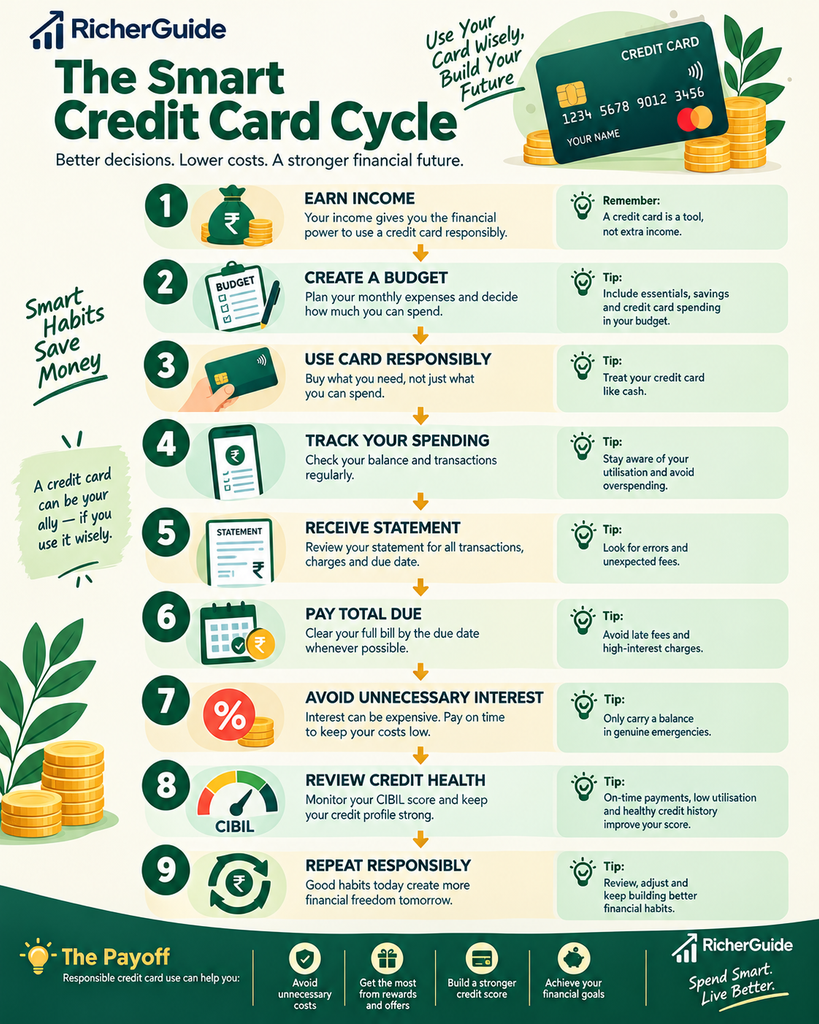
The “MYTH → FACT → ACTION” Formula
Whenever you hear credit card advice online, use this three-step test.
Action: Calculate the total payable amount before accepting the EMI.
How to Choose a Credit Card Wisely
Don’t ask:
“Which credit card is the best?”
Ask:
“Which credit card is best for my spending pattern?”
For frequent online shoppers
Look for relevant cashback or merchant benefits.
For frequent travellers
Look for travel rewards, miles or related benefits.
For fuel users
Check fuel-related benefits and surcharge terms.
For beginners
Prioritise:
- Low or manageable fees
- Simple rewards
- Easy-to-understand terms
- Good customer service
- Spending discipline
For financially disciplined users
Premium rewards may make sense but only when the benefits justify the fees.
Frequently Asked Questions
1. Is paying the minimum amount on a credit card enough?
It may satisfy the minimum payment requirement, but it does not mean the full bill has been paid. The remaining balance may attract interest according to the card’s terms.
2. Does owning a credit card reduce my CIBIL Score?
Not automatically. Credit behaviour such as payment history and outstanding balances matters more than simply owning a card.
3. Does checking my own CIBIL Score reduce it?
Checking your own credit information is different from a lender’s credit enquiry. CIBIL explains that lender enquiries are recorded as enquiries on the report.
4. Is a credit card better than cash?
Not necessarily. A credit card provides convenience and possible benefits, but cash or debit may be better for someone who tends to overspend.
5. Is a higher credit limit always better?
No. A higher limit can provide flexibility, but it does not increase your income or repayment capacity.
6. Are credit card rewards really worth it?
They can be valuable if they match your normal spending and you avoid unnecessary interest and fees.
7. Is 0% EMI really free?
Not necessarily. Check processing fees, taxes, discounts and other applicable terms before choosing an EMI.
8. Should I have multiple credit cards?
Multiple cards can be useful for some people, but only if they can manage the fees, statements, due dates and spending responsibly.
9. Can credit card debt affect future loans?
Yes. Credit card repayment behaviour and outstanding debt form part of your credit history and may influence how lenders evaluate future credit applications.
10. Should I close an unused credit card?
It depends. Consider annual fees, your overall credit profile, available limits and the card’s usefulness before closing it.
11. Is credit card cash withdrawal a good emergency option?
It can be expensive. Check cash advance fees and interest terms before withdrawing money.
12. What is the most important credit card rule?
Spend within your budget and pay your dues on time.
A 5-Minute Monthly Credit Card Check
Once a month, review:
1. Total spending
How much did you spend?
2. Unnecessary spending
Did you buy something only because of a discount?
3. Outstanding amount
How much do you owe?
4. Due date
When must the payment be made?
5. Fees
Were any unexpected charges added?
6. Rewards
Did you actually benefit from the rewards?
7. Credit health
Is your borrowing becoming difficult to manage?
This simple routine can prevent many expensive mistakes.
Credit Card Myth-Busting Chart
MYTH                         FACT
──────────────────────────────────────────────
Minimum payment = paid      Remaining balance may cost interest

Credit card = bad           Behaviour determines the outcome

High limit = high income    Limit is not income

Rewards = free money        Spending still costs money

0% EMI = zero cost          Check all applicable charges

More cards = better         More cards = more responsibility

Cash advance = ATM          Cash advances may be expensive

Late payment = harmless    Charges/credit impact may follow

Closing card = always good  Effect depends on your profile

Checking CIBIL = damage     Self-checking differs from lender enquiry
Final Takeaway
Credit cards are not inherently good or bad.
They are financial tools.
Used carefully, they can provide:
- Convenience
- Rewards
- Discounts
- Payment flexibility
- A way to build a positive credit history
Used carelessly, they can create:
- Expensive interest
- Late charges
- Overspending
- Debt cycles
- Credit-profile problems
The biggest danger is not the plastic card itself.
The biggest danger is misunderstanding how it works.
Don’t believe every credit card tip you hear from friends, social media or advertisements.
Instead:
Read the terms.
Check the charges.
Understand the interest.
Track your spending.
Pay your dues on time.
Use rewards intelligently.
And most importantly:
Never confuse your credit limit with your ability to afford something.
A ₹2 lakh credit limit does not mean you have ₹2 lakh to spend.
Your real financial power comes from your income, savings, budget and ability to repay—not from the amount a bank is willing to lend you.
Final RicherGuide Rule
Remember these five words:
SPEND → TRACK → PAY → REVIEW → REPEAT
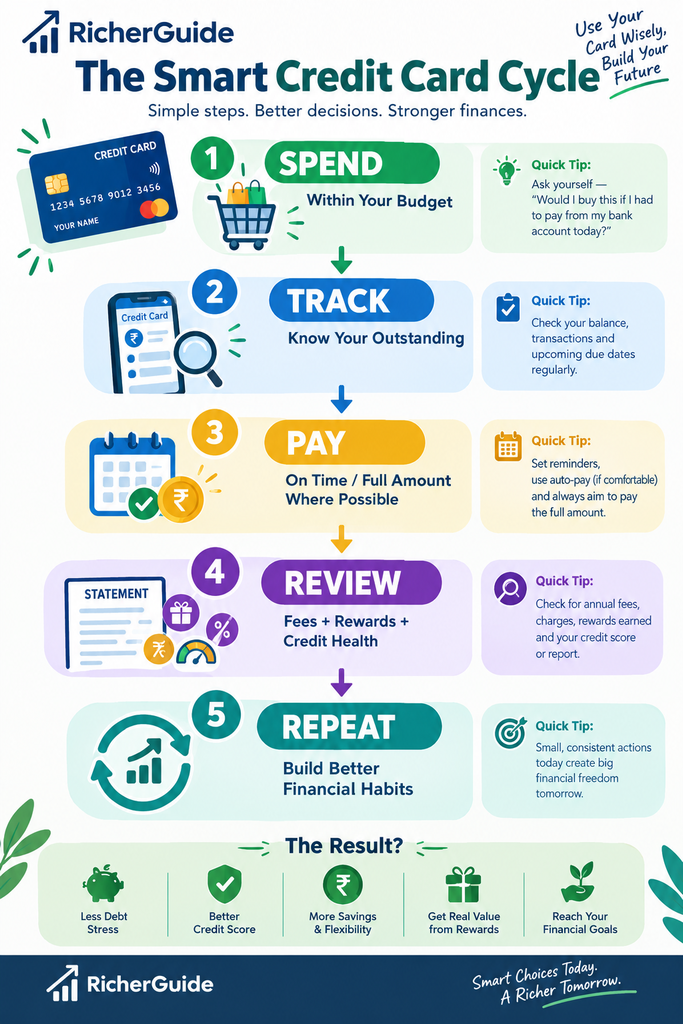
Understanding these credit card myths can help you avoid unnecessary costs and make better financial decisions.Your credit card should work for your financial goals not against them.
Disclaimer
This article is intended for educational and informational purposes only. It does not constitute financial, investment, legal or credit advice. Credit-card interest rates, fees, rewards, eligibility criteria, EMI conditions and other terms vary by issuer and may change over time. Always read the latest terms and conditions, Most Important Terms and Conditions (MITC), fee schedule and offer details provided by your card issuer before making a financial decision. Examples and calculations in this article are illustrations only and may not reflect the exact calculation method used by your card issuer. Readers should independently verify current information with the relevant bank, card issuer, RBI or credit bureau before acting.
RicherGuide does not guarantee approval, savings, rewards or any particular credit-score outcome from using a credit card.