
Introduction:
What Is Last-Minute Tax Planning?
Last-minute tax planning means trying to make all your tax-related decisions shortly before the financial year ends.
For example, imagine someone earning ₹12 lakh per year.
For the first 10 or 11 months, they do not check:
- How much tax they may owe
- How much TDS has been deducted
- What other income they have earned
- Whether their chosen tax regime is appropriate
- Which deductions may be available
- Whether they need to make advance-tax payments
- Whether their investment decisions are tax-efficient
- Whether they have all the necessary documents
Then March arrives.
Table of Contents
They suddenly try to solve everything.
This creates the wrong mindset:
“What can I buy to save tax?”
Instead, good tax planning asks:
“What is my overall financial position, and how can I manage my taxes efficiently while achieving my financial goals?”
That is a much healthier approach.
Why This Topic Matters
Tax is not an isolated part of personal finance.
It affects your:
- Salary
- Savings
- Investments
- Cash flow
- Retirement planning
- Insurance decisions
- Home-loan planning
- Capital gains
- Business income
- Financial goals
A mistake in tax planning can therefore affect your entire financial plan.
For example, suppose you invest ₹1,00,000 in a product only because someone tells you that it provides a tax benefit.
If you later discover that:
- The product does not suit your goals,
- Your money is locked in,
- The expected return is unsuitable,
- The tax benefit is not available under your chosen regime,
then the decision may have been financially inefficient.
The lesson is simple:
Tax saving should be part of financial planning—not a replacement for financial planning.
Why People Delay Tax Planning
“March is still far away”
At the beginning of the tax year, March feels very distant.
This creates a false sense of time.
You think:
“I have plenty of time.”
Then suddenly, there are only a few weeks left.
Tax rules seem complicated
Words such as:
- Tax regime
- Taxable income
- Deduction
- Exemption
- TDS
- Advance tax
- Capital gains
- Rebate
- Surcharge
- Cess
can make tax planning look difficult.
As a result, people avoid thinking about it.
People focus only on salary
A person may remember their salary but forget:
- Savings-account interest
- FD interest
- Rental income
- Freelance income
- Dividends
- Capital gains
- Other taxable income
The Income Tax Department specifically points out that income such as savings-account interest, fixed-deposit interest, rental income, bonds and capital gains can increase tax liability beyond what salary TDS may cover.
Tax planning becomes associated with investment buying
Many people think:
Tax planning = tax-saving investment
That is incorrect.
Tax planning is much broader.
It includes understanding:
Income + Tax Regime + Deductions + TDS + Tax Payments + Investments + Capital Gains + Documentation
Tax Planning vs Tax Saving
These terms are often confused.
Tax Saving
Tax saving generally refers to reducing tax payable using benefits permitted under applicable tax rules.
Tax Planning
Tax planning is the broader process of organizing your finances so that you:
- Understand your tax liability
- Use applicable provisions correctly
- Avoid unnecessary tax surprises
- Make suitable investment decisions
- Manage cash flow
- Maintain documentation
- Meet tax-payment and filing requirements
Simple example
Suppose you are considering an investment.
A tax-saving mindset asks:
“How much tax will this investment save?”
A tax-planning mindset asks:
“Do I need this investment? Does it suit my goals? What is the risk? What is the lock-in? What is the tax treatment? Does the benefit apply to my tax regime?”
The second approach is much stronger.
The Big Problem With Waiting Until March
Imagine two taxpayers.
Person A: Plans Throughout the Year
They check their tax position every few months.
Person B: Plans Only in March
They start from zero when the financial year is almost finished.
| Factor | Year-Round Planning | Last-Minute Planning |
|---|---|---|
| Time to decide | High | Very low |
| Cash-flow pressure | Lower | Higher |
| Investment decisions | More thoughtful | Often rushed |
| Document management | Easier | Difficult |
| Tax visibility | Better | Poor |
| Error risk | Lower | Higher |
| Stress | Lower | Higher |
| Opportunity to adjust | High | Limited |
The biggest advantage Person A has is time.
Time gives you the opportunity to compare options instead of choosing whatever appears first.
A Simple Tax Planning Flow
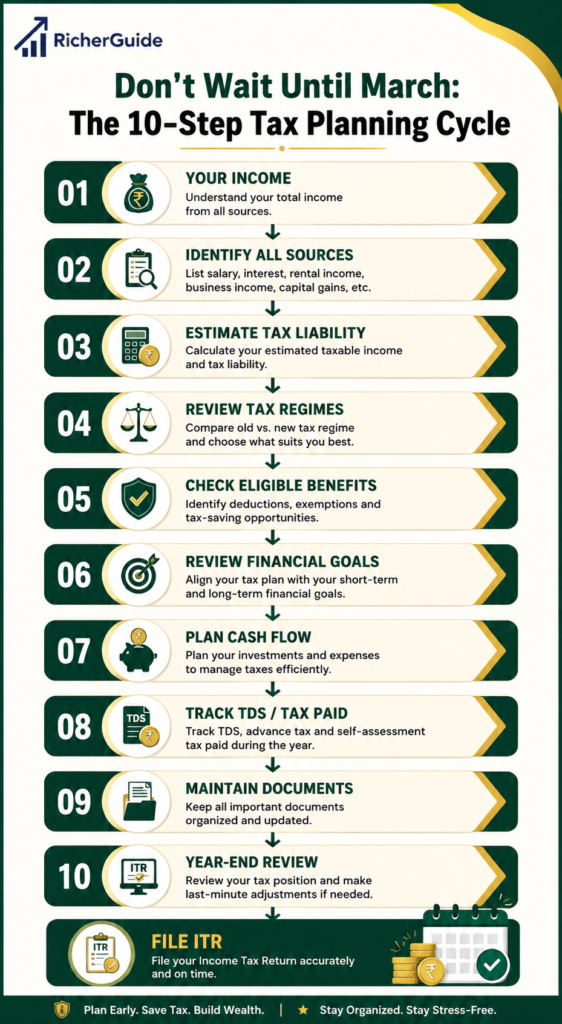
Understand the Current Tax Environment
Tax rules can change, so old articles and old social-media posts should not automatically be treated as current advice.
For AY 2026–27, the Income Tax Department lists the new-regime slabs as:
| Total Income | New-Regime Rate |
|---|---|
| Up to ₹4 lakh | Nil |
| ₹4–8 lakh | 5% |
| ₹8–12 lakh | 10% |
| ₹12–16 lakh | 15% |
| ₹16–20 lakh | 20% |
| ₹20–24 lakh | 25% |
| Above ₹24 lakh | 30% |
The Department also states that the Section 87A rebate under the new regime increased to ₹60,000 for eligible resident individuals with total income up to ₹12 lakh for AY 2026–27.
This illustrates why tax planning should use current-year information rather than simply copying a previous year’s tax-saving checklist.
Tax Regime Comparison Matters
One of the most important decisions for eligible taxpayers is understanding which tax regime is appropriate for their situation.
The new regime generally offers lower slab rates but restricts many deductions that taxpayers may know from the old regime.
For example, the Income Tax Department’s current guidance lists deductions such as Section 80C and Section 80D under the old regime, while certain deductions such as specified employer contributions under Section 80CCD(2) remain available under the new regime subject to conditions.
This means you should not automatically think:
“I have ₹1.5 lakh available under 80C, so I must invest ₹1.5 lakh.”
First ask:
Does this deduction apply to me under the tax regime I am using?
That single question can prevent a major planning mistake.
Real-Life Indian Example
Meet Amit, a 32-year-old salaried employee.
His annual salary is approximately:
₹15,00,000
Throughout the year, Amit does not review his taxes.
He invests occasionally and keeps the rest of his money in his bank account.
In February, his employer asks him for investment proofs.
Amit suddenly realizes:
- He has not reviewed his tax regime.
- He has FD interest.
- He has some investment gains.
- His TDS needs checking.
- He has not organized his documents.
- He is unsure which deductions apply.
A friend tells him:
“Just invest ₹1.5 lakh in a tax-saving product.”
Amit follows the advice without understanding the investment.
This solves one immediate problem but potentially creates another.
The product may not fit his:
- Risk profile
- Financial goals
- Liquidity needs
- Investment horizon
What should Amit have done?
Ideally:
April: Estimate income.
June: Review tax position.
September: Check TDS and additional income.
December: Compare tax options.
January: Finalize appropriate decisions.
March: Complete documentation and final review.
The difference is not complicated.
It is simply starting earlier.
How Much Can This Mistake Cost?
The cost of delaying tax planning can be divided into two categories.
Direct cost
Possible additional tax liability or interest/compliance consequences where applicable.
Indirect cost
Potentially:
- Poor investments
- Lock-in of money
- Lower liquidity
- Missed opportunities
- Financial stress
- Documentation errors
- Poor cash-flow management
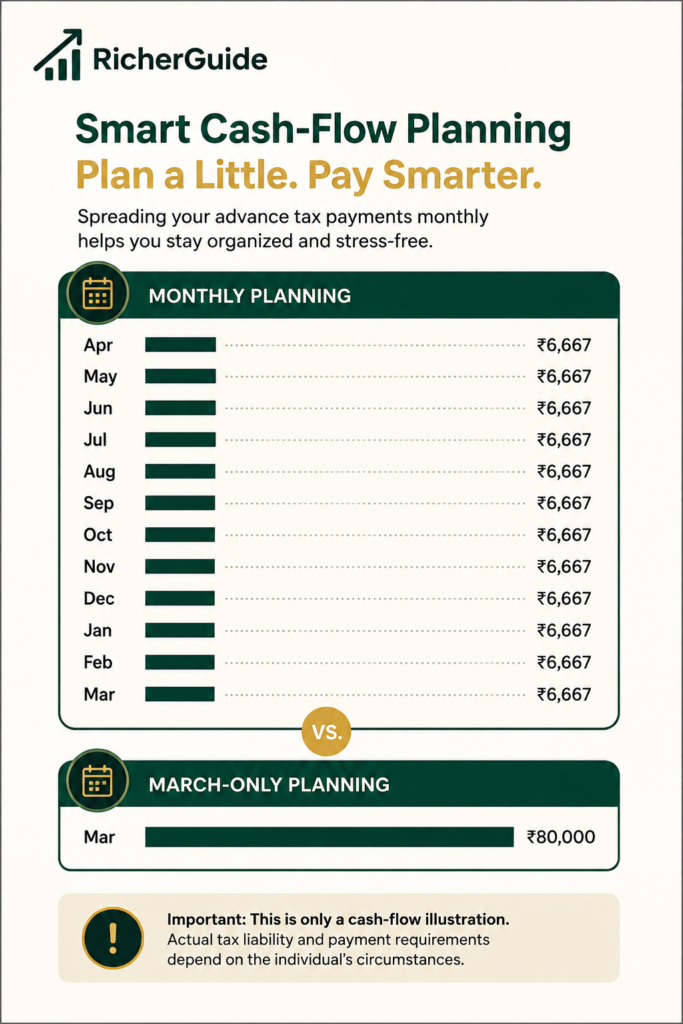
Let’s use a hypothetical example.
Suppose a taxpayer realizes in March that they may need to arrange:
₹80,000
for a tax-related payment.
If they had identified this requirement in April and spread the amount evenly over 12 months:
₹80,000 ÷ 12 = ₹6,667 per month approximately
Instead of suddenly finding ₹80,000, they could have planned around roughly ₹6,667 per month.
Calculator: Estimate Your Tax Planning Requirement
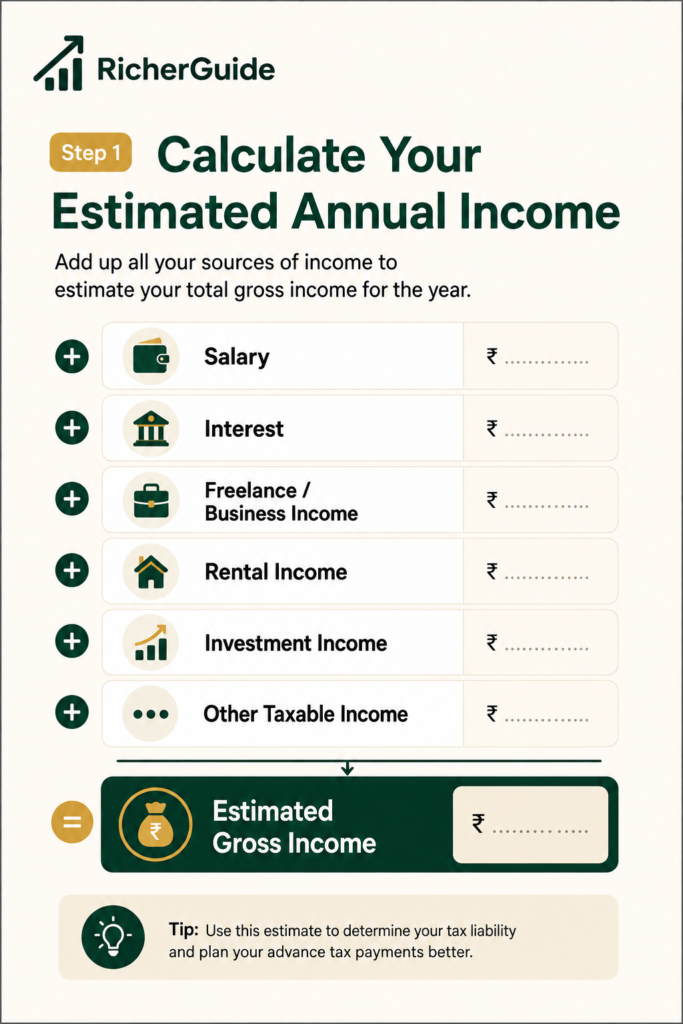
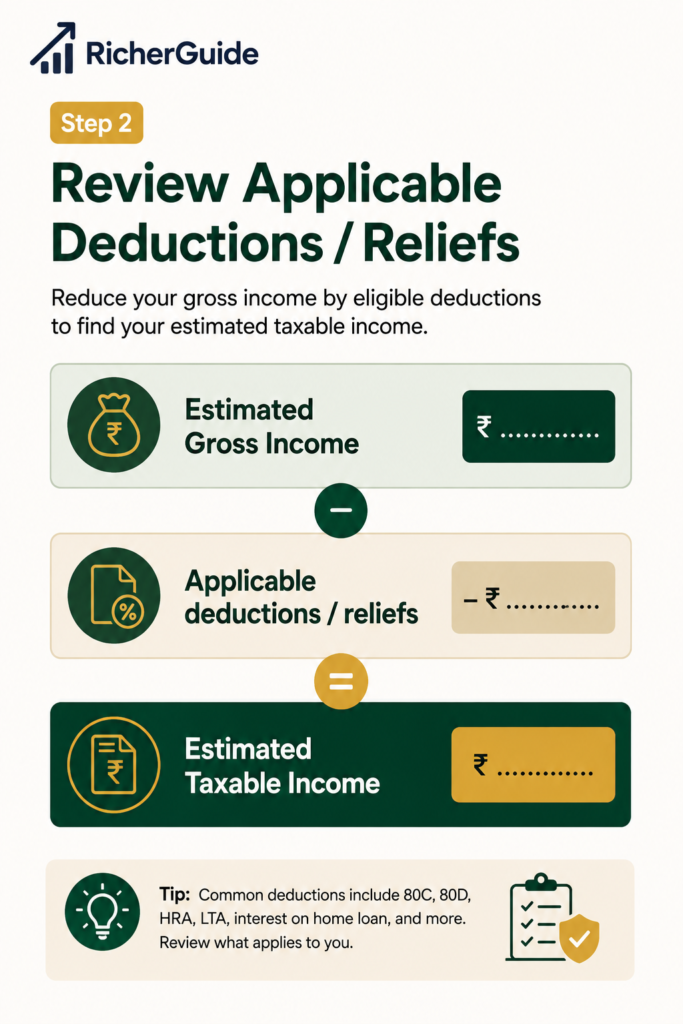
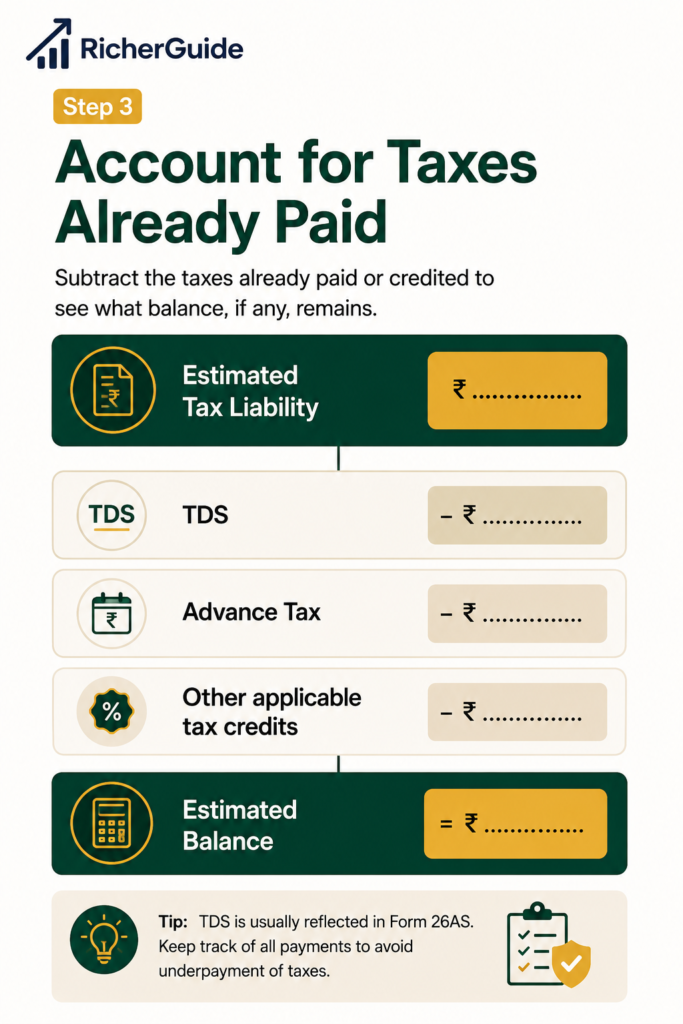
You can create a simple spreadsheet using the following formula.
Step 1: Calculate estimated annual income
Step 2: Review applicable deductions/reliefs
Step 3: Account for taxes already paid
Step 4: Calculate tax
Use the applicable tax regime and current-year rules.
Why TDS Does Not Always Mean “Everything Is Done”
Salaried employees often assume:
“My employer deducts TDS, so I don’t need to think about tax.”
That may not always be correct.
Suppose you earn:
- Salary
- FD interest
- Mutual fund capital gains
- Freelance income
Your employer may calculate TDS primarily based on the salary information available to them.
Additional income can change your final tax position.
The Income Tax Department explains that taxpayers with additional income may need to estimate their tax liability and, where applicable, pay advance tax.
Therefore:
Salary TDS ≠ complete tax planning
Advance Tax: Another Reason to Plan Early
Advance tax is particularly relevant for people whose tax liability is not sufficiently covered by TDS.
The Income Tax Department states that individuals may need to pay advance tax in instalments when their estimated tax liability exceeds ₹10,000, subject to applicable rules. The standard instalments are:
| Instalment | Cumulative Tax Target | Due Date |
|---|---|---|
| 1st | 15% | 15 June |
| 2nd | 45% | 15 September |
| 3rd | 75% | 15 December |
| 4th | 100% | 15 March |
This is another reason tax planning should not be a March-only activity.
If you have business, professional, freelance, rental, investment or other income, understand whether advance-tax rules apply to you.
Common Mistake: Buying Insurance Only to Save Tax
Insurance is primarily about financial protection.
A life-insurance policy should be evaluated based on your protection needs.
Health insurance should be evaluated based on healthcare and financial-risk protection.
Tax benefits may be relevant, but they should not be the only reason you buy insurance.
Wrong approach
“I need to save tax, so I will buy this policy.”
Better approach
“Do I need this insurance? Is the coverage appropriate? What is the cost? What are the terms? Then, what is its tax treatment?”
Common Mistake: Investing ₹1.5 Lakh Just Because of 80C
Section 80C is one of the most familiar tax provisions among Indian taxpayers.
The Income Tax Department currently lists several eligible items under Section 80C under the old regime, including specified life-insurance premiums, provident-fund contributions, tuition fees, National Savings Certificates and certain housing-loan principal payments, with a combined limit of ₹1.5 lakh for the listed provisions.
But remember:
A deduction limit is not an instruction to invest that amount.
If you already have eligible payments or investments, you may not need to make an additional investment.
And if you are using a regime where that deduction is not available, buying something solely for that deduction may not make sense.
Common Mistake: Ignoring Health Insurance Tax Treatment
Health insurance can serve two purposes:
- Financial protection against medical costs
- Potential tax benefit where applicable
The Income Tax Department’s guidance lists Section 80D deductions under the old regime for eligible health-insurance premiums and certain medical expenses, subject to specified limits and conditions.
But don’t buy health insurance merely because it offers a tax benefit.
The primary question should be:
“Does this policy provide adequate protection for my family?”
Tax treatment should come second.
Common Mistake: Forgetting Investment Income
Imagine your salary is:
₹10 lakh
But during the year you also earn:
- ₹40,000 FD interest
- ₹15,000 savings interest
- ₹30,000 dividends
- ₹70,000 capital gains
Ignoring these amounts during tax planning can create an incomplete picture.
Your tax planning should therefore include all relevant income sources, not just salary.
Common Mistake: Ignoring Capital Gains
Investors sometimes think:
“I didn’t withdraw the money, so there is no tax issue.”
That assumption can be wrong.
Selling investments can create taxable capital gains depending on the asset, holding period, transaction and applicable rules.
Therefore, investors should maintain records of:
- Purchase date
- Purchase value
- Sale date
- Sale value
- Relevant expenses
- Gains/losses
- Broker statements
- Mutual-fund statements
Do not wait until ITR filing season to reconstruct every transaction.
Common Mistake: Ignoring Documents
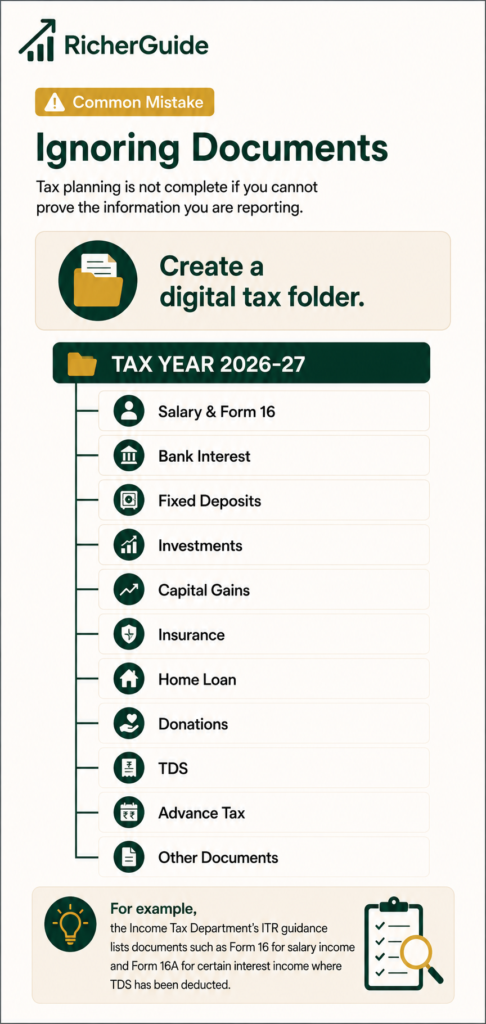
Tax planning is not complete if you cannot prove the information you are reporting.
Create a digital tax folder.
Seven Practical Ways to Avoid Last-Minute Tax Planning
1. Start in April
As soon as the tax year begins, estimate your income.
You don’t need perfect numbers.
A reasonable estimate is enough to begin.
2. Review Your Tax Position Every Quarter
Set four reminders:
June → September → December → March
At each review, check:
- Income
- TDS
- Interest
- Investments
- Capital gains
- Tax payments
- Eligible benefits
3. Maintain a Tax Spreadsheet
Your spreadsheet can contain:
| Item | Estimated | Actual | Difference |
|---|---|---|---|
| Salary | ₹12L | ₹12.2L | +₹20K |
| Interest | ₹40K | ₹48K | +₹8K |
| Capital gains | ₹50K | ₹70K | +₹20K |
| TDS | ₹1.5L | ₹1.6L | +₹10K |
This makes tax planning much easier.
4. Compare Tax Regimes
Don’t choose based on:
- Friend’s advice
- Social-media posts
- Office rumours
- Old tax articles
Compare your own situation using current rules.
5. Separate Tax Money From Spending Money
If you expect a tax payment, maintain a separate reserve.
This reduces the risk of spending money that may later be required for tax.
6. Track Investments Throughout the Year
Keep records of:
- Mutual funds
- Stocks
- Bonds
- FDs
- Dividends
- Capital gains
This also helps during ITR preparation.
7. Take Professional Help When Needed
Consider consulting a qualified tax professional when your situation includes:
- Business income
- Complex capital gains
- Multiple properties
- Foreign income/assets
- Large investment transactions
- Complicated deductions
- Tax notices
- Significant tax liability
A professional can help you understand the rules, but you should still maintain your own financial records.
Pros and Cons of Year-Round Tax Planning
| Pros | Cons |
|---|---|
| Less year-end stress | Requires regular tracking |
| Better financial visibility | Takes some discipline |
| More time to compare options | Tax rules still need monitoring |
| Better cash-flow management | May require a spreadsheet |
| Fewer rushed decisions | Professional advice may sometimes be needed |
| Better documentation | Requires keeping records updated |
| Easier year-end preparation | — |
For most people, the benefits outweigh the small amount of effort required.
Year-Round Planning vs March Planning
| Feature | Year-Round | March Only |
|---|---|---|
| Income tracking | Regular | Often incomplete |
| TDS review | Regular | Last-minute |
| Investment decisions | Goal-based | Tax-driven |
| Cash management | Planned | Sudden |
| Documentation | Organized | Rushed |
| Tax visibility | High | Low |
| Stress | Lower | Higher |
| Decision quality | Usually better | Can suffer |
| Flexibility | High | Limited |
A Simple Tax Planning Calendar
April: Start
Checklist
☐ Estimate income
☐ Review previous tax position
☐ Understand applicable tax regime
☐ Estimate TDS
☐ Identify financial goals
☐ Create tax folder
May-June: First Review
Check:
☐ Salary
☐ TDS
☐ Interest
☐ Additional income
☐ Advance-tax requirement
The first advance-tax instalment, where applicable, is generally due by June 15.
July-September: Update
Ask:
Has my income changed?
Did I receive a bonus?
Did I start freelance work?
Did I sell investments?
Is my TDS still appropriate?
October-December: Recalculate
This is the perfect time to review:
- Tax regime
- Income
- Investments
- Capital gains
- Deductions
- TDS
- Tax payments
The third advance-tax instalment is generally due by December 15 where applicable.
January-February: Final Planning
Now identify:
- Remaining eligible financial decisions
- Missing documents
- Expected tax liability
- Investment income
- Capital gains
- TDS differences
March: Complete
March should be about:
Final review → payments where required → documentation → employer proofs → preparation for filing
Not panic.
The “Don’t Buy Anything in a Hurry” Rule
When March arrives, give yourself a simple rule:
Never buy a financial product only because someone says, “It will save tax.”
Before investing, ask:
- 1. What is the purpose?
- 2. What is the expected holding period?
- 3. What is the risk?
- 4. Is there a lock-in?
- 5. Can I afford the investment?
- 6. What are the costs?
- 7. What is the tax treatment?
- 8. Is the tax benefit available to me?
- 9. Does it fit my financial goals?
If you cannot answer these questions, slow down.
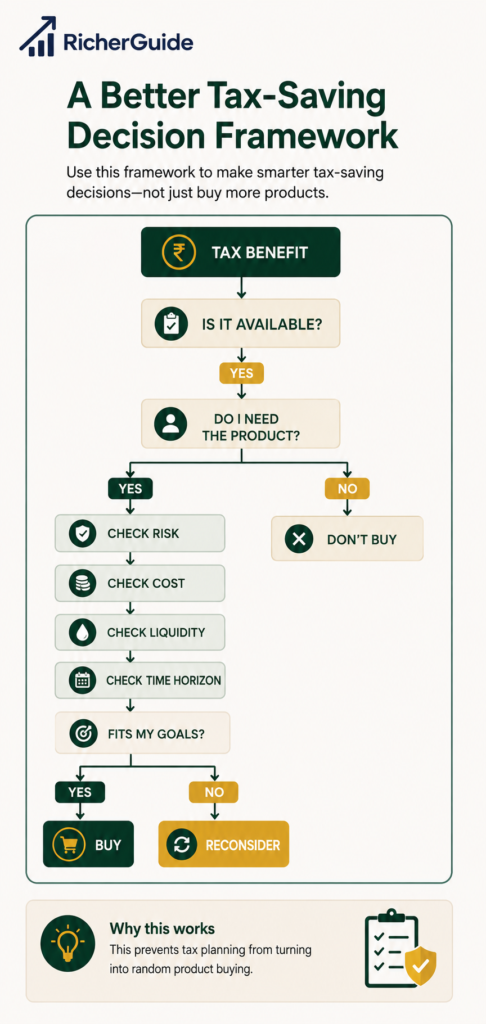
A Better Tax-Saving Decision Framework
Use this framework:
How Last-Minute Planning Can Hurt Your Budget
Suppose your monthly salary is:
₹75,000
You normally allocate:
| Category | Amount |
|---|---|
| Household expenses | ₹35,000 |
| Investments | ₹15,000 |
| Emergency savings | ₹5,000 |
| Lifestyle | ₹10,000 |
| Other | ₹10,000 |
Now imagine March brings an unexpected ₹1 lakh requirement.
Your regular budget may not be able to absorb it.
You may have to:
- Sell investments
- Use emergency savings
- Borrow money
- Delay financial goals
- Use credit cards
Early tax planning helps prevent this situation
Tax Planning Can Protect Your Emergency Fund
Your emergency fund exists for genuine emergencies.
If you fail to plan for a predictable tax payment, you may end up using your emergency savings for something that could have been anticipated.
That’s not ideal.
Better system
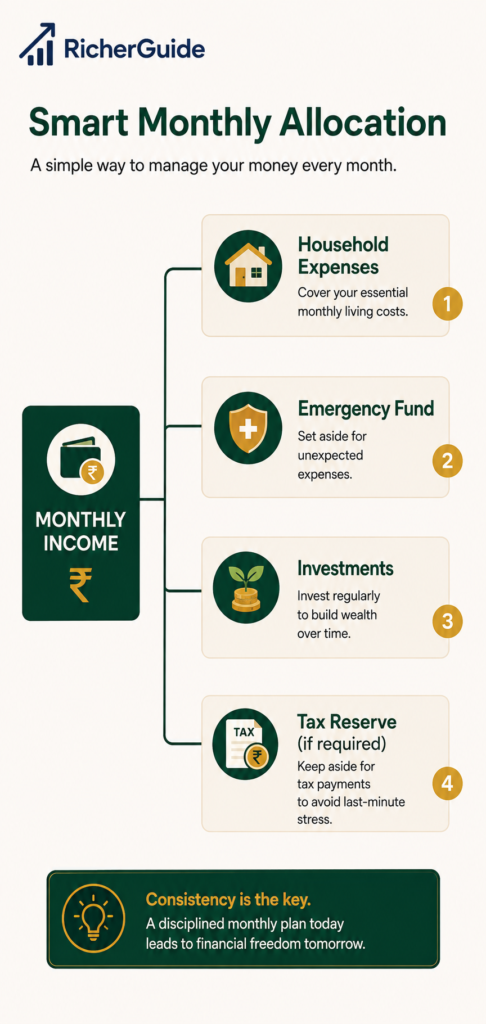
The exact allocation depends on your circumstances.
Tax Planning for Salaried Employees
If you are salaried, review these items:
Income
- Basic salary
- Allowances
- Bonus
- Incentives
- Other taxable income
Tax
- TDS
- Tax regime
- Eligible deductions
- Rebate eligibility
Investments
- Equity
- Mutual funds
- FDs
- PPF
- NPS
- Other investments
Documents
- Form 16
- Form 16A where applicable
- Investment statements
- Insurance documents
- Home-loan certificate
- Capital-gain statements
Tax Planning for Freelancers
Freelancers need extra discipline because income may vary significantly from month to month.
Suppose:
| Month | Income |
|---|---|
| April | ₹30,000 |
| May | ₹45,000 |
| June | ₹90,000 |
| July | ₹35,000 |
| August | ₹1,10,000 |
Instead of spending the entire high-income month’s earnings, keep track of the amount that may be required for taxes.
Also track eligible business expenses and applicable tax-payment obligations.
Tax Planning for Small Business Owners
Business owners should not wait until year-end.
Maintain records of:
- Revenue
- Business expenses
- TDS
- GST-related records where applicable
- Bank transactions
- Loans
- Investments
- Tax payments
Business taxation can be more complicated than salary taxation.
Professional assistance may be appropriate.
Tax Planning for Investors
Tax Planning for Investors
Investors should maintain an investment tax file.
INVESTMENTS
   │
   ├── Stocks
   ├── Mutual Funds
   ├── Bonds
   ├── FDs
   ├── Dividends
   └── Capital Gains
At the end of every quarter, update:
- Total investment income
- Realized gains
- Realized losses
- TDS
- Relevant statements
This can make tax filing significantly easier.
A Simple Tax Planning Dashboard
Create a dashboard like this:
| Area | Status |
|---|---|
| Annual income estimated | ✅ |
| Tax regime reviewed | ✅ |
| TDS checked | ✅ |
| Bank interest tracked | ✅ |
| Capital gains tracked | ⬜ |
| Tax documents collected | ⬜ |
| Eligible deductions reviewed | ⬜ |
| Advance tax reviewed | ⬜ |
| Tax reserve created | ⬜ |
| Year-end review completed | ⬜ |
You don’t need expensive software.
A spreadsheet can be enough for many beginners.
Seven Warning Signs You Are Delaying Tax Planning
You may have a tax-planning problem if:
1. You only think about tax in March.
2. You don’t know your TDS amount.
3. You don’t know your total annual income.
4. You don’t track bank interest.
5. You discover investment gains only during ITR filing.
6. You buy financial products because someone says they save tax.
7. You cannot find your tax documents quickly.
If you recognize yourself in several of these points, start a simple quarterly tax review.
A 30-Minute Quarterly Tax Review
You don’t need an entire weekend.
Set aside around 30 minutes every quarter.
10 minutes: Income
Check:
- Salary
- Interest
- Freelance income
- Investment income
- Other income
10 minutes: Tax
Check:
- TDS
- Advance tax
- Estimated liability
- Tax regime
10 minutes: Documents
Check:
- Statements
- Receipts
- Certificates
- Investment records
That’s it.
A small quarterly habit can prevent a major year-end headache.
Frequently Asked Questions
1. Is tax planning necessary if my employer deducts TDS?
Yes, it can still be useful.
TDS may cover salary-related tax, but additional income such as interest, rental income, freelance income or capital gains can affect your final liability.
2. Is March too late for tax planning?
March is not too late to start, but it is not ideal.
The problem is that you have less time to make thoughtful decisions.
3. When should I start tax planning?
Ideally, start near the beginning of the tax year and review your position at least quarterly.
4. Should I invest just to save tax?
No.
First determine whether the investment suits your financial goals, risk level, liquidity needs and investment horizon.
Then consider its tax treatment.
5. Is the new tax regime always better?
No.
The appropriate choice depends on your individual circumstances and applicable deductions/benefits.
Current Income Tax Department guidance shows that many deductions available under the old regime are restricted under the new regime.
6. What happens if I forget about interest income?
It can lead to an incomplete tax calculation.
Track interest from savings accounts, FDs and other relevant sources during the year.
7. Do investors need tax planning?
Yes.
Investment sales can result in capital gains or losses, so investors should maintain transaction records throughout the year.
8. What is advance tax?
Advance tax is tax paid during the year rather than waiting until the final return stage.
For eligible individuals, the Income Tax Department lists quarterly instalments, generally due in June, September, December and March.
9. Should I hire a Chartered Accountant for tax planning?
It depends on your situation.
Simple salary income may be manageable with careful record-keeping, while business income, substantial capital gains, multiple properties or foreign income can make professional advice more valuable.
10. Can tax planning help with budgeting?
Yes.
Estimating your tax liability early can help you reserve money throughout the year instead of facing a large unexpected payment.
11. What documents should I keep?
Depending on your circumstances, you may need documents such as Form 16, Form 16A, investment statements, interest certificates, insurance documents, home-loan certificates, capital-gain statements and tax-payment records.
12. Is tax planning the same as tax avoidance?
No.
Legitimate tax planning means using applicable tax rules correctly.
Tax evasion involves illegal actions such as hiding income or creating false information.
Never use false documents or conceal income to reduce tax.
Final Takeaway
Ignoring tax planning until the last month may seem like a small financial mistake.
But it can create a chain reaction.
You may face:
Less time → rushed decisions → cash-flow pressure → unsuitable investments → missing documents → tax stress
The solution is simple:
Start early.
You don’t need to become a tax expert.
You don’t need to check tax rules every day.
You simply need a system.
Remember this seven-step formula:
ESTIMATE → COMPARE → PLAN → TRACK → REVIEW → DOCUMENT → FILE
Start by estimating your income.
Then understand your applicable tax regime.
Track TDS and other income.
Review investments and tax-related decisions.
Keep documents organized.
And when March arrives, complete your plan instead of starting from zero.
The goal of tax planning is not to avoid paying tax.
The goal is to understand your tax liability, use legitimate provisions correctly, avoid unnecessary financial mistakes and keep your overall financial plan on track.
Don’t let March become your tax-planning emergency. Make tax planning a year-round money habit.
Disclaimer
This article is for general financial education and awareness only. It is not personal tax, investment, legal or financial advice.
Tax rules, tax rates, deductions, rebates, exemptions, filing requirements and payment requirements can change. The article uses examples for educational purposes and does not guarantee any specific tax saving or financial outcome.
Tax treatment depends on individual circumstances, income sources, applicable tax provisions and the relevant tax year. The current tax information referenced above is based on Income Tax Department guidance available for AY 2026–27 / Tax Year 2026–27. Always verify the latest rules through the Income Tax Department or consult a qualified Chartered Accountant/tax professional before making significant tax decisions.
RicherGuide does not guarantee any particular tax saving, investment return or financial result.