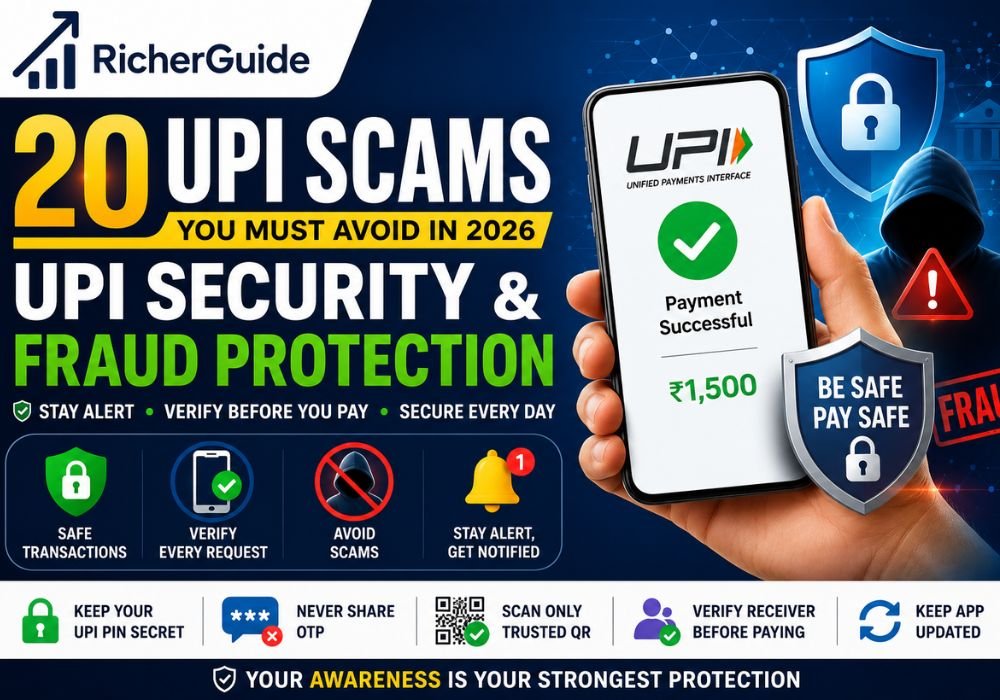
India has become one of the world’s biggest digital payment markets. Millions of people use UPI every day to pay bills, shop online, transfer money, and receive salaries.
While UPI has made payments faster and easier, cybercriminals have also become smarter. Every day, thousands of people lose money because of fake payment requests, phishing messages, QR code scams, screen-sharing apps, and social engineering.
The good news?
Most UPI frauds can be prevented if you know how scammers work.
This guide explains the 20 most common UPI scams, how to avoid them, RBI safety rules, recovery steps, and practical tips to protect your money.
Table of Contents
The Problem: Why UPI Frauds Are Increasing
Why scammers target UPI users
- Instant money transfer
- Large number of users
- Mobile-first banking
- Lack of awareness
- Fake customer support
- Social engineering tricks
Common reasons people lose money
| Reason | Risk Level |
|---|---|
| Sharing UPI PIN | Very High |
| Clicking fake links | Very High |
| Installing unknown apps | High |
| Fake customer care numbers | High |
| Accepting payment requests | High |
| Sharing OTP | Very High |
| QR code misunderstanding | High |
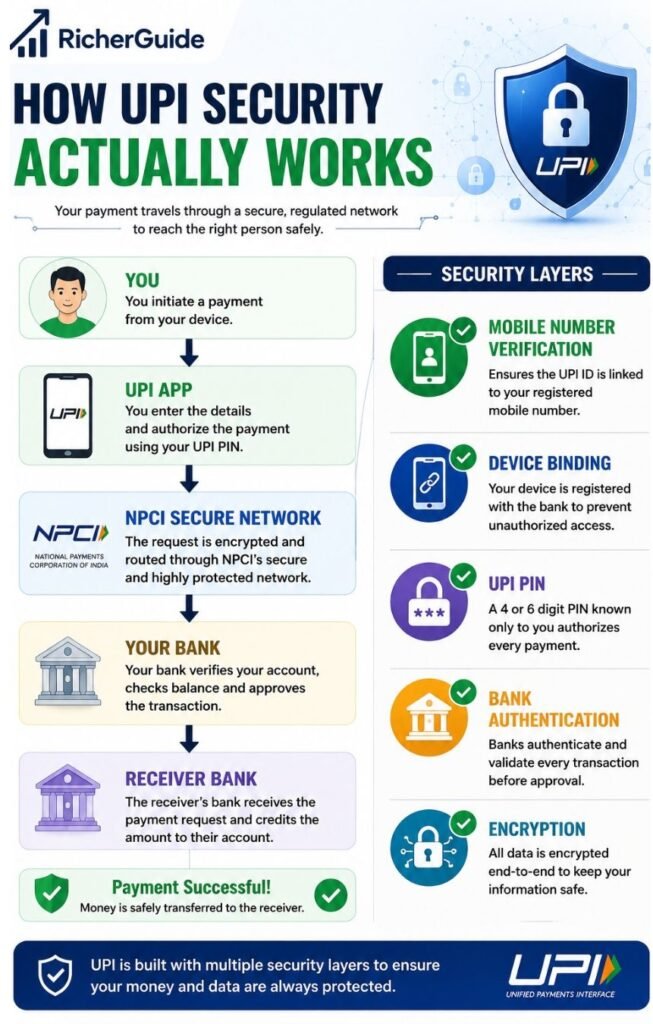
How UPI Security Actually Works
Remember:
UPI PIN is only used to SEND money—not to RECEIVE money.
20 UPI Scams You Must Avoid
1. Fake Payment Request Scam
How it works
Scammer sends a “Collect Request.”
You think you’re receiving money.
Instead, you’re authorizing payment.
Example
Selling an old phone online.
Buyer says:
“I’ve sent payment.”
Instead, they send a collect request.
You enter PIN.
Money leaves your account.
Prevention
✔ Read every request carefully.
✔ Never enter UPI PIN to receive money.
2. QR Code Scam
Scammer sends QR code claiming:
“Scan this to receive ₹5,000.”
Reality:
Scanning starts a payment process.
PIN completes payment.
Never scan unknown QR codes.
3. Fake Customer Care Numbers
Scammers post fake helpline numbers on Google or social media.
Victim calls.
They ask for:
- OTP
- UPI PIN
- Screen sharing
- Debit card details
Never trust unofficial customer support numbers.
4. Screen Sharing App Scam
Scammer asks you to install:
- AnyDesk
- TeamViewer
- QuickSupport
Once installed:
They remotely control your phone.
Never install remote access apps on someone else’s instruction.
5. Fake Cashback Scam
Message:
“You won ₹10,000 cashback.”
Click link.
Login.
Enter PIN.
Money stolen.
6. KYC Update Scam
Scammer says:
Your account will be blocked.
Update KYC immediately.
Fake website copies bank login page.
Credentials stolen.
7. Electricity Bill Scam
SMS:
“Electricity disconnected today.”
Urgent payment link included.
Actually:
Fraud website.
8. Investment Scam
Promises:
- Double money
- Guaranteed returns
- Crypto profits
Requests payment through UPI.
Money disappears.
9. Job Scam
“Earn ₹5,000 daily.”
Registration fee via UPI.
No job.
Money gone.
10. Fake Loan Approval
Instant loan approval.
Processing fee first.
Loan never comes.
11. Delivery Scam
Courier says:
Small payment pending.
Fake UPI request.
Money deducted.
12. Lottery Scam
“You won ₹25 lakh.”
Need “processing fee.”
Classic fraud.
13. Social Media Marketplace Scam
Buyer sends fake payment screenshot.
Seller ships product.
Payment never received.
Always verify your bank balance before dispatching.
14. WhatsApp Impersonation Scam
Scammer copies your relative’s profile photo.
Requests emergency money.
Always verify by calling.
15. Fake Bank SMS
Looks genuine.
Contains phishing link.
Never login through SMS links.
16. SIM Swap Scam
Fraudster duplicates your SIM.
Receives OTPs.
Takes control of banking.
Contact your telecom provider immediately if your SIM suddenly stops working.
17. Reward Points Scam
“Convert reward points.”
Fake website steals credentials.
18. Rental Deposit Scam
House owner requests booking amount.
Property doesn’t exist.
Always visit before paying.
19. Charity Scam
Fake disaster relief campaigns.
Verify NGOs before donating.
20. AI Voice Scam
Scammer uses AI-generated voice.
Pretends to be friend or family.
Requests urgent UPI transfer.
Always verify through a direct phone or video call.
Warning Signs of a UPI Scam
| Warning | What You Should Do |
|---|---|
| Urgent payment demand | Pause and verify |
| Too-good-to-be-true offer | Ignore |
| Asking UPI PIN | Never share |
| Asking OTP | Never share |
| Unknown QR Code | Don’t scan |
| Fake customer care | Verify official website |
| Remote access request | Reject |
Solution: 20 UPI Safety Tips
| Safety Tip | Benefit |
|---|---|
| Keep app updated | Better security |
| Use screen lock | Device protection |
| Enable biometric login | Extra safety |
| Verify recipient name | Avoid mistakes |
| Never share PIN | Prevent theft |
| Never share OTP | Secure transactions |
| Avoid public Wi-Fi | Safer payments |
| Enable SMS alerts | Instant notification |
| Review bank statements | Detect fraud early |
| Use strong phone password | Prevent unauthorized access |
| Lock SIM with PIN | Extra protection |
| Turn off NFC when not needed | Reduce risk |
| Check app permissions | Improve privacy |
| Report suspicious activity | Faster action |
| Keep contact details updated | Receive alerts |
| Avoid unofficial APK files | Prevent malware |
| Use official banking apps | Trusted source |
| Double-check UPI ID | Avoid wrong transfers |
| Educate family members | Reduce scam risk |
| Stay informed | Better awareness |
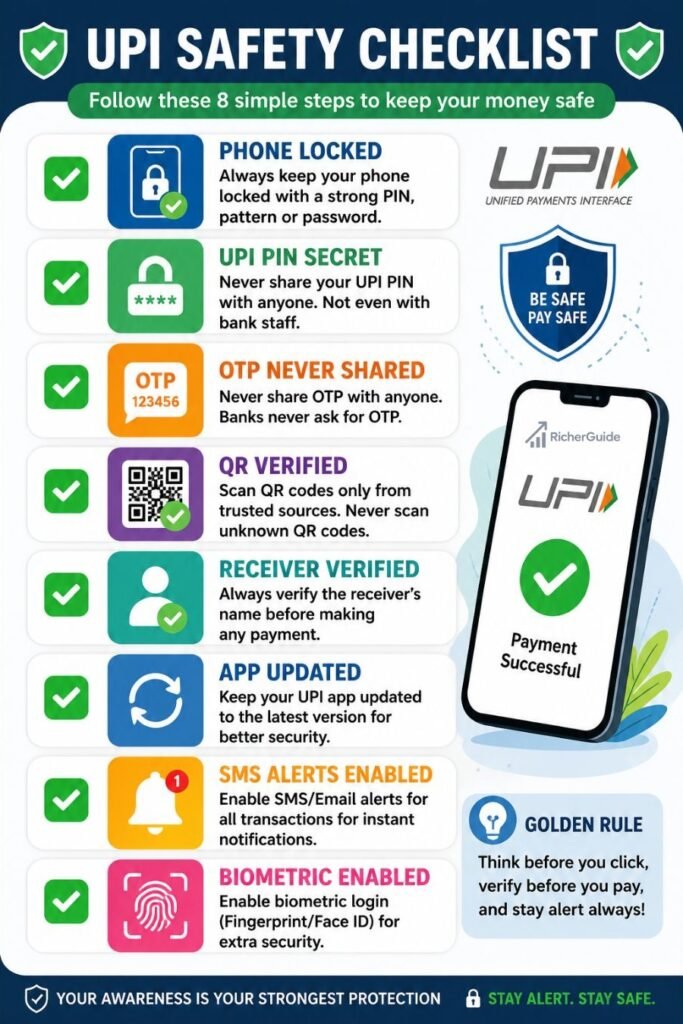
UPI Safety Checklist
What To Do Immediately After UPI Fraud
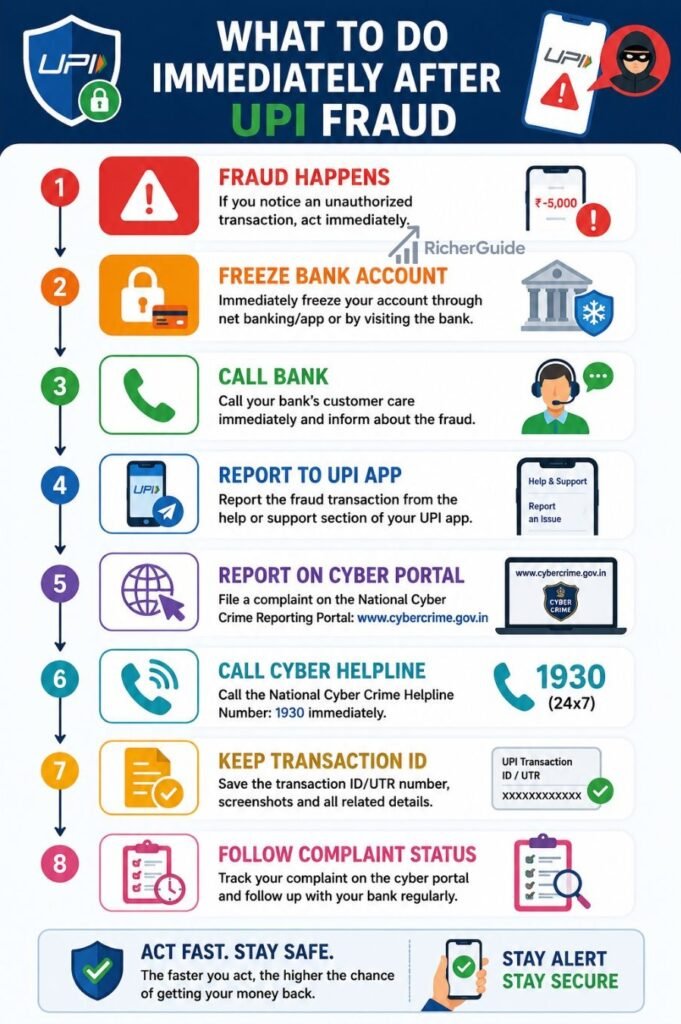
Money Recovery Chances
| Action Time | Recovery Probability |
|---|---|
| Within 30 minutes | Very High |
| Within 2 hours | High |
| Same day | Moderate |
| After several days | Low |
The faster you report the fraud, the better your chances of recovering funds.
UPI Security Score Calculator
Rate yourself:
| Question | Yes | No |
|---|---|---|
| Phone locked? | 5 | 0 |
| Biometric enabled? | 5 | 0 |
| Never share PIN? | 10 | 0 |
| Never share OTP? | 10 | 0 |
| Verify receiver? | 5 | 0 |
| App updated? | 5 | 0 |
| SMS alerts enabled? | 5 | 0 |
| Avoid unknown QR? | 10 | 0 |
| Verify payment requests? | 10 | 0 |
| Review transactions regularly? | 5 | 0 |
Score
- 55–70: Excellent security
- 40–54: Good, but improve weak areas
- 20–39: Moderate risk
- Below 20: High risk of fraud
RBI Safety Guidelines Every UPI User Should Follow
- Never share your UPI PIN with anyone.
- Never share OTPs.
- Verify the recipient before confirming a transaction.
- Use only official UPI applications.
- Report suspicious transactions immediately.
- Keep your registered mobile number active.
- Monitor your bank account regularly.
Real-Life Example
Rahul receives a call from someone claiming to be from his bank. The caller says Rahul’s UPI account will be blocked unless he updates KYC immediately.
Rahul is asked to install a remote access app and enter his UPI PIN.
Instead of following the instructions, Rahul disconnects the call, contacts his bank through the official app, and confirms it was a scam.
Because he verified the request before acting, he avoided losing his savings.
Frequently Asked Questions (FAQ)
Is it safe to use UPI every day?
Yes. UPI is secure when used through official apps and safe practices.
Can someone steal money using only my mobile number?
No. A mobile number alone is not enough. Fraud usually happens when users reveal their UPI PIN, OTP, or approve unauthorized requests.
Should I share my UPI PIN with bank staff?
Never. Banks will never ask for your UPI PIN.
Can I receive money without entering my UPI PIN?
Yes. Receiving money does not require entering your UPI PIN.
What should I do if I accidentally sent money to the wrong person?
Contact your bank and the UPI app immediately, raise a dispute, and provide the transaction ID as quickly as possible.
Is scanning every QR code safe?
No. Scan QR codes only from trusted merchants or verified individuals.
How often should I change my UPI PIN?
Change it periodically or immediately if you suspect it has been exposed.
Recommended Security Tools & Affiliate Opportunities
You can recommend products or services that help readers improve their digital security, such as:
| Category | Why It’s Useful |
|---|---|
| Password managers | Store strong, unique passwords securely |
| Mobile antivirus apps | Detect malware and suspicious apps |
| Identity theft protection services | Monitor for data misuse |
| Cybersecurity awareness courses | Improve scam recognition |
| Secure cloud backup solutions | Protect important documents and photos |
Choose reputable providers and clearly disclose affiliate relationships where applicable.
Key Takeaways
- UPI is safe when used responsibly.
- Never share your UPI PIN or OTP.
- Verify every payment request and QR code.
- Beware of urgency, fake customer care, and too-good-to-be-true offers.
- Report fraud immediately to improve the chances of recovering your money.
- Educating yourself and your family is the best defense against digital payment scams.
Conclusion
UPI has transformed digital payments by making transactions quick, convenient, and widely accessible. However, the same convenience attracts fraudsters who rely on deception rather than technical hacking.
By understanding common scam techniques, following basic security practices, and acting quickly if something goes wrong, you can use UPI with confidence. Stay alert, verify before you pay, and remember that no legitimate bank or payment provider will ever ask for your UPI PIN or OTP.
A few seconds of caution can save you from significant financial loss.
Final Thoughts
UPI has made digital payments faster, easier, and more convenient than ever before. However, with the growing popularity of UPI, fraudsters are constantly developing new ways to trick users. The best defense is not just technology it’s awareness.
Before every transaction, take a moment to verify the recipient, read payment requests carefully, and never share your UPI PIN or OTP with anyone. Remember, you never need to enter your UPI PIN to receive money. Staying informed about the latest scams and following basic security practices can protect both your money and your peace of mind.
Digital payments are meant to make life easier, not riskier. By practicing safe UPI habits and educating your family and friends, you can help create a safer digital payment ecosystem for everyone.
Stay alert. Think before you pay. Verify before you trust. Your awareness is your strongest protection against UPI fraud.
Disclaimer
Disclaimer: This article is for educational and informational purposes only. While every effort has been made to provide accurate and up-to-date information, UPI rules, banking procedures, and fraud reporting processes may change over time. Always verify the latest guidelines with your bank, your UPI service provider, and relevant regulatory authorities before making financial decisions. This article does not constitute legal, financial, or cybersecurity advice. If you suspect fraud, contact your bank and the appropriate cybercrime reporting channels immediately.