
Introduction
Have you ever reached the end of the month and wondered:
“Where did all my money go?”
Your salary came into your bank account. You paid your rent, electricity bill, EMIs, groceries and other expenses. You also ordered food, bought something online, paid for subscriptions and made a few UPI payments.
Nothing seemed too expensive individually.
But when you check your bank balance, much less money is left than expected.
This is one of the biggest problems with living without a budget.
A budget is not a punishment. It does not mean you cannot enjoy your money. A good budget simply tells your money where to go before you spend it.
Without a plan, money often disappears through small and unplanned expenses.
A ₹150 food delivery may not feel expensive.
A ₹299 subscription may not feel important.
A ₹500 online purchase may seem harmless.
But when these expenses happen repeatedly, they can become thousands of rupees every month.
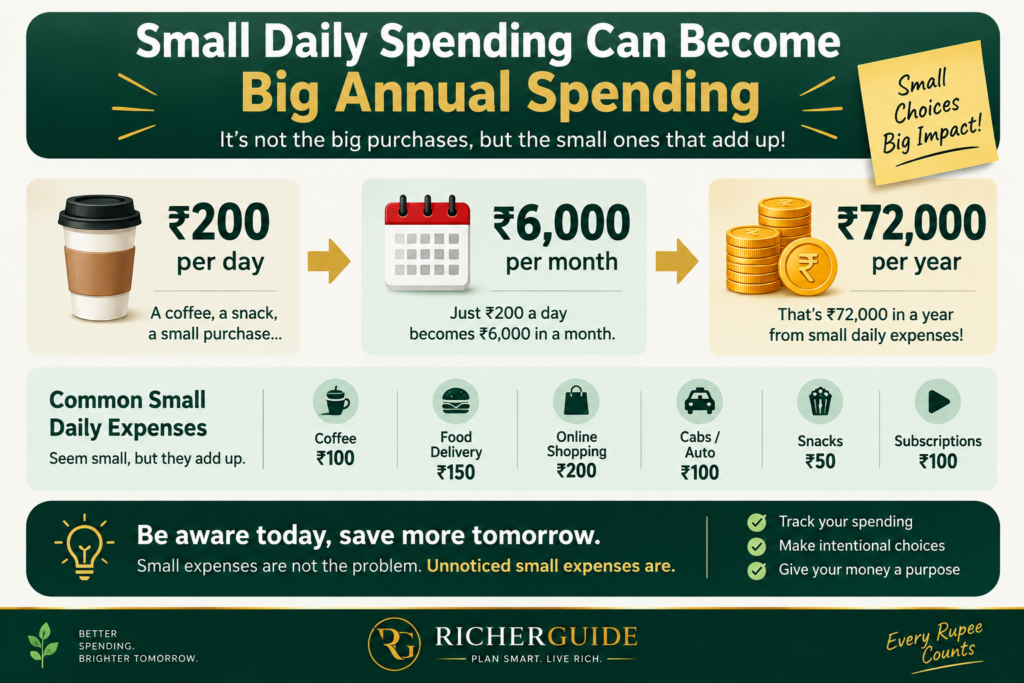
For example, if you spend just ₹200 extra per day on small purchases:
₹200 × 30 days = ₹6,000 per month
That is ₹72,000 in one year.
The real cost of living without a budget is not only the money you spend today. It is also the savings, emergency fund, investments and financial security you could have built with that money.
This guide explains why budgeting matters, how to create a simple monthly budget, where people commonly lose money, and how you can start controlling your finances without making your life boring.
Table of Contents
Why This Topic Matters
Money management becomes difficult when you do not know where your money is going.
Many people focus only on increasing their income.
Getting a better salary is useful, but income alone does not create financial security.
If your expenses increase every time your income increases, you may still struggle to save.
For example:
| Monthly Income | Monthly Expenses | Monthly Savings |
|---|---|---|
| ₹30,000 | ₹28,000 | ₹2,000 |
| ₹50,000 | ₹47,000 | ₹3,000 |
| ₹80,000 | ₹76,000 | ₹4,000 |
| ₹1,00,000 | ₹95,000 | ₹5,000 |
A higher income does not automatically mean better finances.
The important question is:
How much of your income are you intentionally keeping for your future?
A budget helps you answer that question.
What happens when you do not budget?
Without a budget, you may:
- Spend too much on unnecessary purchases
- Depend on credit cards for regular expenses
- Delay investing
- Have little or no emergency fund
- Miss bill-payment dates
- Pay unnecessary interest or late fees
- Overspend on food delivery and shopping
- Subscribe to services you rarely use
- Feel stressed before payday
- Struggle to achieve large financial goals
The biggest problem is that these costs often remain invisible because they happen in small amounts.
The Problem: How Living Without a Budget Costs You Money
1. Small Expenses Become Big Expenses
One of the biggest budgeting problems is the small-expense trap.
Consider these monthly expenses:
| Small Expense | Monthly Amount |
| Food delivery | ₹2,000 |
| Coffee/snacks | ₹1,500 |
| Shopping apps | ₹1,500 |
| Unused subscriptions | ₹800 |
| Cab/auto convenience | ₹1,200 |
| Other impulse purchases | ₹1,000 |
| Total | ₹8,000 |
₹8,000 may not look huge when divided across the month.
But:
₹8,000 × 12 = ₹96,000 per year
That is almost ₹1 lakh.
The problem is not that every expense is bad.
The problem is spending without awareness.
2. Lifestyle Inflation Eats Your Salary Increase
Imagine your salary increases from ₹40,000 to ₹50,000.
Instead of saving the additional ₹10,000, you start:
- Eating at better restaurants
- Buying expensive clothes
- Upgrading your phone
- Taking more cabs
- Increasing online shopping
- Adding new subscriptions
After a few months, your expenses may rise from ₹35,000 to ₹45,000.
Your income increased by ₹10,000.
Your lifestyle also increased by ₹10,000.
Your savings did not improve much.
This is called lifestyle inflation.
A budget helps you decide how much of every salary increase should go toward your future.
3. You May Depend Too Much on Credit Cards
Credit cards are useful financial tools when used responsibly.
But when there is no spending plan, credit cards can make overspending easier.
Suppose your monthly income is ₹60,000.
You spend:
- ₹20,000 on household expenses
- ₹10,000 on rent contribution
- ₹5,000 on transport
- ₹5,000 on shopping
- ₹5,000 on dining
- ₹5,000 on entertainment
- ₹10,000 on miscellaneous spending
You have spent the entire ₹60,000.
Then an unexpected ₹10,000 expense appears.
Without an emergency fund, you may put it on your credit card.
If the balance is not paid in full, interest and other applicable charges can increase the cost.
A budget cannot prevent every emergency, but it can help you build an emergency fund before an emergency happens.
4. You Delay Important Financial Goals
Without a budget, future goals often become:
“I will start saving next month.”
Next month becomes next year.
You may want to save for:
- Emergency fund
- Home down payment
- Higher education
- Marriage
- Child education
- Retirement
- Travel
- Starting a business
- A vehicle
- Financial independence
The problem is not always a lack of income.
Sometimes there is simply no planned allocation for the goal.
A budget changes:
“I will save whatever is left.”
into:
“I will save first, then spend what is available.”
5. You Lose Visibility Over Your Financial Life
Imagine having several bank accounts, UPI apps, credit cards, subscriptions and investment accounts.
Money moves everywhere.
Without tracking, you may not know:
- How much you spend each month
- How much you save
- How much debt you have
- How much you invest
- Which subscriptions you pay for
- How much you spend on food
- How much you spend on shopping
- Whether you are improving financially
A budget gives you a financial dashboard.
SOLUTION: Build a Simple Budget That Actually Works
The good news is that budgeting does not have to be complicated.
You do not need a complicated spreadsheet with hundreds of categories.
Start with a simple system.
Step 1: Calculate Your Monthly Take-Home Income
Use the money that actually reaches your bank account.
For example:
Monthly take-home salary = ₹50,000
If you have other regular income, such as freelance income, rental income or business income, include it carefully.
For irregular income, use a conservative estimate rather than assuming your best month will repeat.
Step 2: Separate Needs, Wants and Goals
A simple budget can divide money into three broad categories.
Needs
These are expenses that are important for basic living.
Examples:
- Rent
- Groceries
- Electricity
- Transportation
- Insurance
- Essential medicines
- School fees
- Necessary EMIs
Wants
These improve comfort or entertainment but are not essential.
Examples:
- Restaurant meals
- Movies
- Shopping
- Premium subscriptions
- Gaming
- Expensive gadgets
- Frequent cabs
Goals
These are expenses for your future financial security.
Examples:
- Emergency fund
- Investments
- Retirement savings
- Debt repayment
- Home down payment
- Education fund
The important principle is:
Every rupee should have a purpose.
Step 3: Try the 50/30/20 Budget as a Starting Point
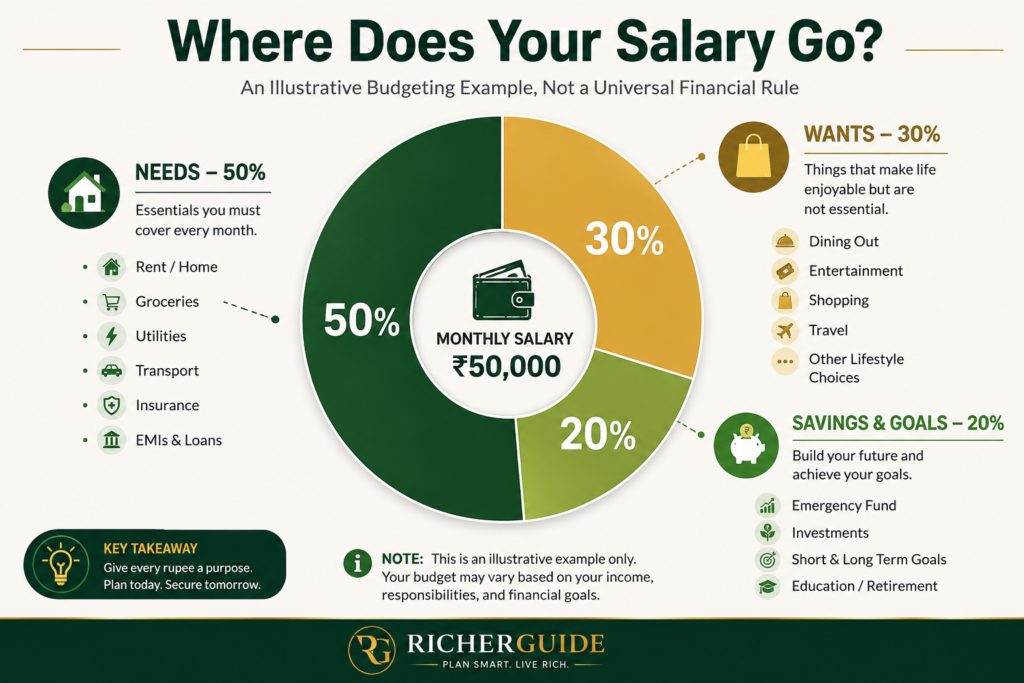
The popular 50/30/20 approach divides income approximately into:
- 50% Needs
- 30% Wants
- 20% Savings and financial goals
For a ₹50,000 monthly income:
| Category | Percentage | Amount |
| Needs | 50% | ₹25,000 |
| Wants | 30% | ₹15,000 |
| Savings/Goals | 20% | ₹10,000 |
| Total | 100% | ₹50,000 |
This is a framework, not a strict rule.
Someone living in a high-rent city may spend more than 50% on needs.
Someone with a low income may initially save less than 20%.
The goal is not perfection.
The goal is awareness and improvement.
Step 4: Create a “Money Before Spending” System
A useful strategy is to automate important financial goals.
For example, after receiving your salary:
Salary → Savings/Investment → Bills → Daily Spending
Instead of:
Salary → Spending → Spending → Spending → Whatever remains = Savings
This is often called paying yourself first.
If you receive ₹50,000 and want to save ₹7,500:
Set aside ₹7,500 early.
Then plan your remaining ₹42,500.
This reduces the chance that you will spend the money accidentally.
Step 5: Track Expenses for 30 Days
For one month, record everything.
Do not judge your spending initially.
Simply track it.
Example:
| Expense | Amount |
| Breakfast | ₹80 |
| Auto | ₹120 |
| Lunch | ₹180 |
| Online shopping | ₹699 |
| Coffee | ₹150 |
| Grocery | ₹1,200 |
| Subscription | ₹299 |
At the end of the month, group expenses into categories.
You may discover something surprising.
Perhaps you thought you spent ₹2,000 on eating outside.
Your actual spending could be ₹4,500.
Tracking turns assumptions into facts.
CALCULATOR: How Much Are Your Small Expenses Really Costing?
Use this simple formula:
Annual Cost
Monthly Expense × 12 = Annual Cost
Suppose you spend ₹300 per week on impulse purchases.
Approximate monthly cost:
₹300 × 4 = ₹1,200
Annual cost:
₹1,200 × 12 = ₹14,400
Now consider several categories:
| Expense | Monthly | Annual |
| Food delivery | ₹2,000 | ₹24,000 |
| Shopping | ₹1,500 | ₹18,000 |
| Subscriptions | ₹800 | ₹9,600 |
| Snacks/coffee | ₹1,000 | ₹12,000 |
| Other impulse spending | ₹1,200 | ₹14,400 |
| Total | ₹6,500 | ₹78,000 |
You may not need to eliminate all of these expenses.
Even reducing them by 30% could make a meaningful difference.
₹78,000 × 30% = ₹23,400
That money could instead go toward savings, debt repayment or investments.
REAL-LIFE INDIAN EXAMPLE
Meet Rahul
Rahul is 29 years old and works in a private company.
His monthly take-home salary is:
₹60,000
He does not maintain a formal budget.
At the beginning of every month, he feels financially comfortable.
By the last week, he often has very little money left.
Rahul’s Monthly Spending
| Category | Amount |
| Rent & household contribution | ₹18,000 |
| Groceries | ₹6,000 |
| Transport | ₹4,000 |
| Utilities | ₹2,500 |
| Eating out & delivery | ₹5,000 |
| Shopping | ₹4,000 |
| Entertainment | ₹2,500 |
| Subscriptions | ₹1,000 |
| Miscellaneous | ₹6,000 |
| Credit card spending | ₹7,000 |
| Total | ₹56,000 |
On paper, Rahul earns ₹60,000 and spends ₹56,000.
That leaves ₹4,000.
But he frequently has unexpected expenses.
So he saves very little.
Rahul’s Problem
Rahul does not necessarily have a spending problem.
He has a planning problem.
His spending is not assigned clear limits.
Rahul Creates a Budget
He decides to create these targets:
| Category | Budget |
| Essential expenses | ₹31,000 |
| Wants | ₹9,000 |
| Emergency fund | ₹5,000 |
| Investments | ₹5,000 |
| Flexible/miscellaneous | ₹5,000 |
| Total | ₹55,000 |
He also creates a ₹5,000 buffer.
Now his money has a purpose.
If he spends ₹4,500 on eating out, he knows that he has crossed his planned dining budget.
He can make a conscious decision rather than discovering the problem at the end of the month.
The ₹5,000 Problem
Many people think:
“It is only ₹5,000.”
But ₹5,000 every month is:
₹5,000 × 12 = ₹60,000 per year
Over five years:
₹60,000 × 5 = ₹3,00,000
This simple calculation shows why repeated small spending matters.
And this calculation does not even consider what that money might have earned if it had been saved or invested.
Budgeting Is Not About Saying “NO” to Everything
A common misconception is:
Budget = No fun.
That is not true.
A good budget should include money for enjoyment.
For example, suppose you earn ₹50,000.
You may allocate:
- ₹25,000 for needs
- ₹8,000 for savings
- ₹5,000 for investments
- ₹7,000 for wants
- ₹5,000 for flexible spending
Now you can enjoy ₹7,000 without feeling guilty.
The difference is that your entertainment spending has a limit.
You are spending intentionally rather than accidentally.
Common Mistakes to Avoid
Mistake 1: Making an Unrealistic Budget
If you normally spend ₹8,000 on food and suddenly set a budget of ₹2,000, you may fail within the first week.
Start realistically.
Reduce spending gradually.
Mistake 2: Tracking Only Large Expenses
People often track rent and EMIs but ignore:
- ₹100 snacks
- ₹200 delivery fees
- ₹150 coffee
- ₹300 online purchases
Small expenses can add up.
Track everything for at least one month.
Mistake 3: Forgetting Annual Expenses
Some expenses do not occur every month.
Examples:
- Insurance premiums
- School fees
- Annual subscriptions
- Vehicle servicing
- Festival shopping
- Travel
- Property-related expenses
Create a separate annual-expense category.
If you expect an annual expense of ₹24,000:
₹24,000 ÷ 12 = ₹2,000 per month
Set aside ₹2,000 each month.
When the bill arrives, it will be less stressful.
Mistake 4: Treating Credit Card Limit as Income
A credit card limit is not your salary.
If your card has a ₹2 lakh limit, that does not mean you have ₹2 lakh available to spend.
Your real spending capacity comes from your income and financial plan.
Mistake 5: Ignoring Irregular Income
If your income changes every month, avoid creating a budget based on your highest income.
Use a conservative average.
During high-income months, keep additional money for:
- Emergency fund
- Taxes, where applicable
- Debt repayment
- Investments
- Future expenses
Mistake 6: Giving Up After One Bad Month
Your budget will not be perfect every month.
You may overspend during:
- Festivals
- Weddings
- Holidays
- Medical emergencies
- Family events
- Unexpected repairs
The solution is not to abandon budgeting.
Review what happened and adjust next month’s plan.
Practical Tips and Best Practices
1. Use Separate Accounts or Buckets
You can mentally or practically divide your money into:
Bills → Savings → Investments → Spending
This makes money management easier.
2. Set a Weekly Spending Limit
Instead of thinking only about monthly spending, create a weekly limit.
Suppose your discretionary budget is ₹8,000 per month.
You could aim for approximately:
₹8,000 ÷ 4 = ₹2,000 per week
This makes overspending easier to identify.
3. Have a 24-Hour Rule for Impulse Purchases
Before buying something non-essential, wait 24 hours.
Ask:
- Do I need it?
- Do I already own something similar?
- Can I afford it without using credit?
- Will I still want it tomorrow?
- Does it fit my monthly budget?
This simple pause can prevent many impulse purchases.
4. Review Subscriptions Every Three Months
Make a list of your subscriptions.
Ask:
“Did I use this service enough to justify its cost?”
Cancel services you no longer need, while checking their cancellation terms.
5. Review Your Budget Monthly
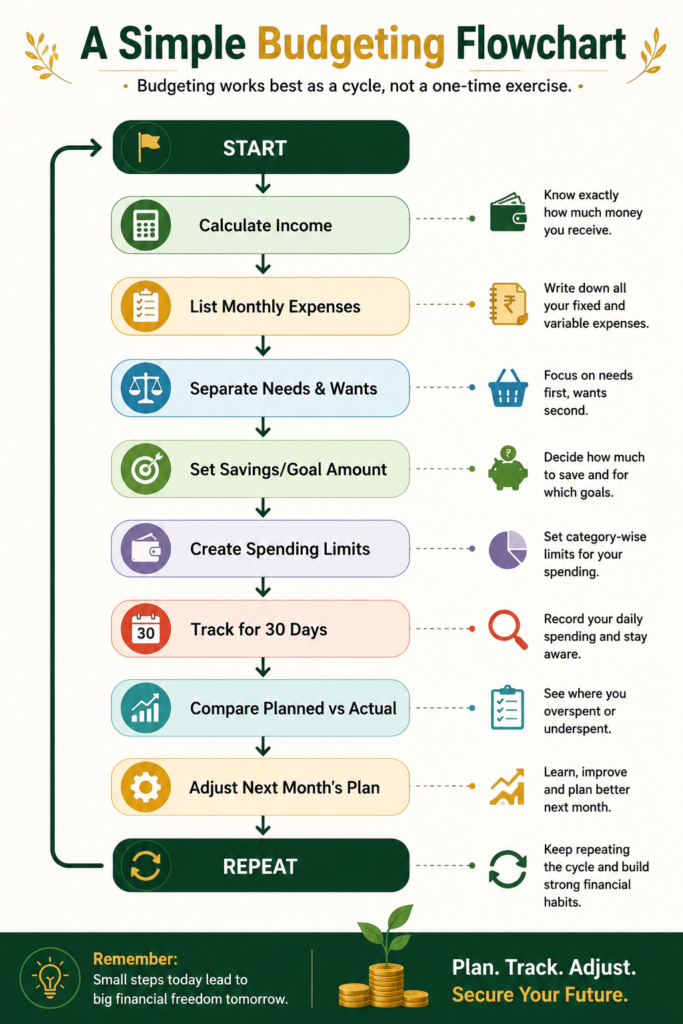
Budgeting is not a one-time activity.
At the end of every month, compare:
Planned spending vs Actual spending
Example:
| Category | Planned | Actual | Difference |
| Food | ₹5,000 | ₹6,000 | +₹1,000 |
| Shopping | ₹3,000 | ₹2,000 | -₹1,000 |
| Transport | ₹3,000 | ₹3,500 | +₹500 |
| Entertainment | ₹2,000 | ₹1,500 | -₹500 |
The goal is not to make every number perfect.
The goal is to understand your behavior.
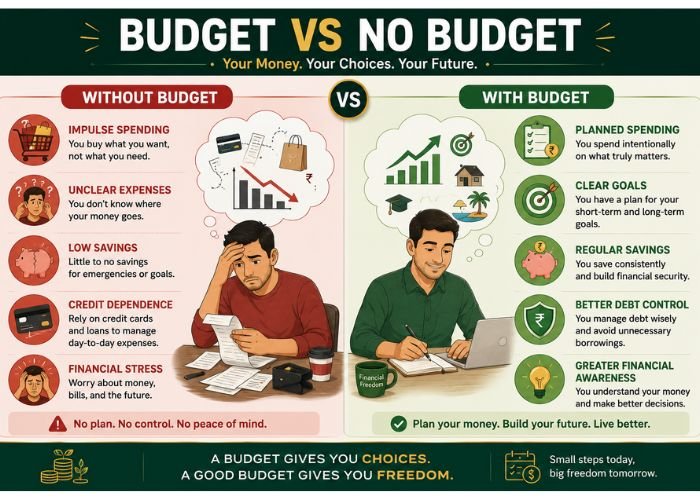
Budget vs No Budget
| Factor | Without Budget | With Budget |
| Spending control | Low | Higher |
| Financial awareness | Low | High |
| Saving consistency | Often irregular | More consistent |
| Goal planning | Difficult | Easier |
| Emergency preparation | Often weak | Easier to build |
| Impulse spending | More likely | Easier to control |
| Financial stress | Can be higher | Can be lower |
| Flexibility | May feel flexible but unpredictable | Planned flexibility |
Pros and Cons of Budgeting
Pros
Better spending awareness
You know where your money goes.
Improved savings
You intentionally allocate money toward future goals.
Less financial stress
Unexpected expenses become easier to manage when you have a buffer.
Better debt management
A budget can help you identify how much you can realistically allocate toward debt.
More control
You make financial decisions before spending rather than after.
Cons
Requires discipline
You need to track and review your money.
Can feel restrictive initially
Some people may feel that budgeting reduces freedom.
Needs regular updates
Your budget should change when your income, family situation or expenses change.
Unexpected expenses can disrupt it
A budget cannot predict every emergency.
The answer is not to create a perfect budget.
It is to create a flexible budget with a buffer.
A Simple Monthly Budget Template
You can start with this structure:
| Category | Planned Amount | Actual Amount |
| Monthly income | ₹_____ | ₹_____ |
| Rent | ₹_____ | ₹_____ |
| Groceries | ₹_____ | ₹_____ |
| Utilities | ₹_____ | ₹_____ |
| Transport | ₹_____ | ₹_____ |
| Insurance | ₹_____ | ₹_____ |
| EMI/debt | ₹_____ | ₹_____ |
| Food outside | ₹_____ | ₹_____ |
| Shopping | ₹_____ | ₹_____ |
| Entertainment | ₹_____ | ₹_____ |
| Savings | ₹_____ | ₹_____ |
| Investments | ₹_____ | ₹_____ |
| Emergency fund | ₹_____ | ₹_____ |
| Miscellaneous | ₹_____ | ₹_____ |
At the end of the month:
Income − Expenses − Savings/Investments = Remaining Money
If the result is consistently negative, your spending plan needs adjustment.
The “Zero-Based” Budget Concept
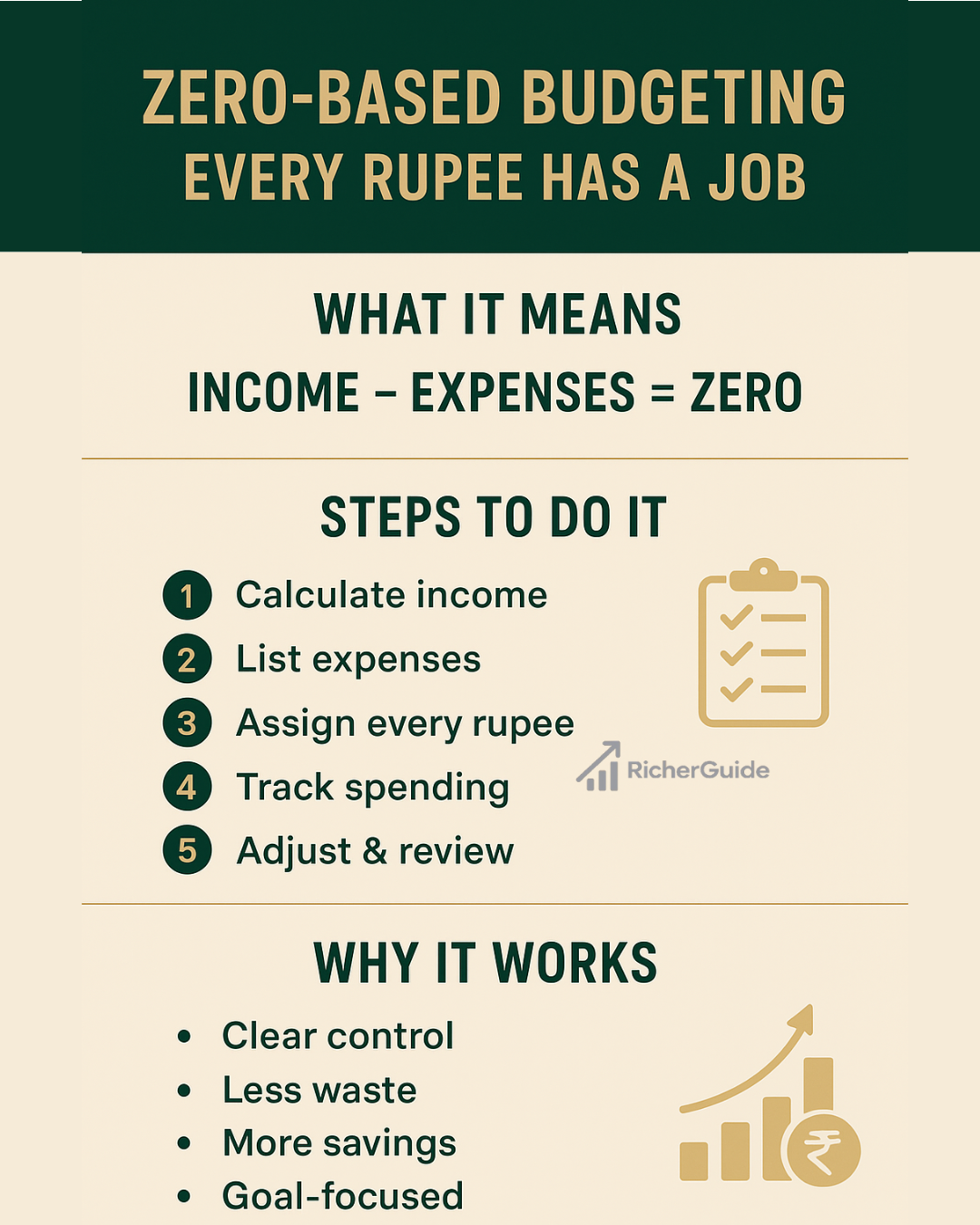
Another useful budgeting method is a zero-based budget.
This does not mean you should spend all your money.
It means every rupee is assigned a purpose.
For example:
Income = ₹50,000
You may assign:
- Needs = ₹25,000
- Savings = ₹8,000
- Investments = ₹5,000
- Wants = ₹7,000
- Emergency/irregular expenses = ₹5,000
Total:
₹25,000 + ₹8,000 + ₹5,000 + ₹7,000 + ₹5,000 = ₹50,000
Nothing is left without a job.
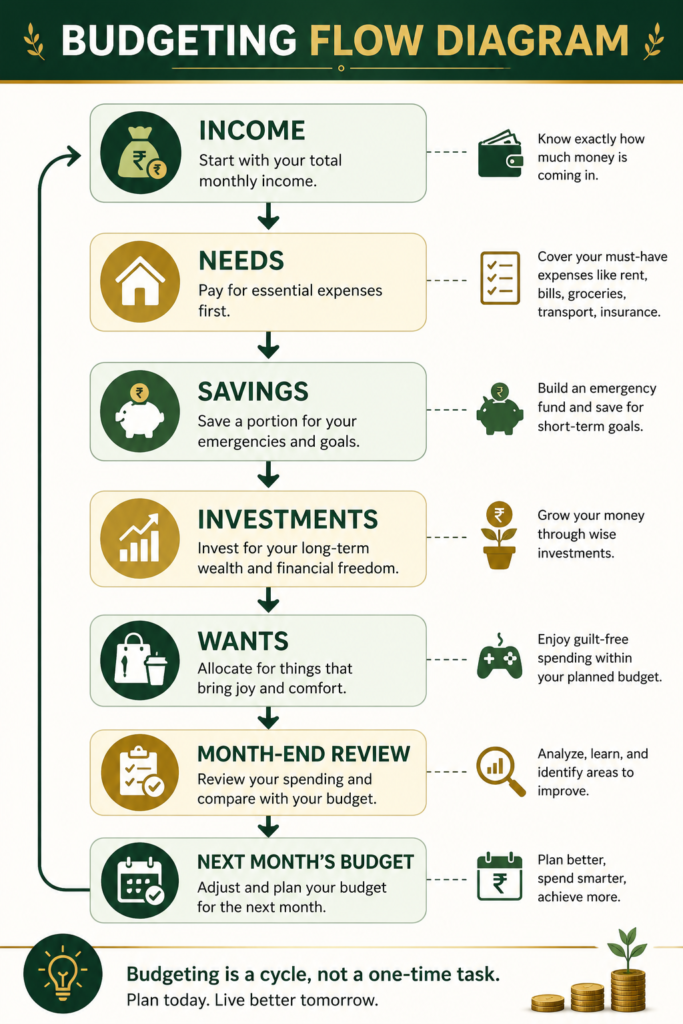
A Simple Budgeting Flowchart
What Should You Do With the Money You Save?
Once you identify unnecessary spending, do not simply let the money disappear into another spending category.
Give the saved money a purpose.
A sensible priority can include:
- Build a basic emergency fund
- Pay down expensive debt
- Maintain appropriate insurance
- Invest according to your financial goals and risk profile
- Save for short- and medium-term goals
Your exact priorities will depend on your financial situation.
How Much Should You Save?
There is no single percentage that works for everyone.
However, you can use a target-based approach.
Suppose your monthly income is ₹50,000.
If you save:
10%
₹50,000 × 10% = ₹5,000
Annual savings:
₹60,000
20%
₹50,000 × 20% = ₹10,000
Annual savings:
₹1,20,000
30%
₹50,000 × 30% = ₹15,000
Annual savings:
₹1,80,000
The right target depends on your income, expenses, debt, responsibilities and financial goals.
Even starting with a small amount is better than waiting for the “perfect” time.
The Hidden Cost of “I Will Start Next Month”
One of the most expensive sentences in personal finance is:
“I will start next month.”
If you delay saving ₹5,000 every month for one year, that is:
₹60,000 not saved.
But the cost can be larger because you also lose time that money could have spent building your financial foundation.
The earlier you create a system, the easier it becomes to develop good financial habits.
30-Day Budget Challenge
If you currently do not follow a budget, try this simple challenge.
Week 1: Track
Record every expense.
Do not try to change everything yet.
Week 2: Identify
Find your top five unnecessary or avoidable spending categories.
Week 3: Reduce
Choose two categories to reduce.
For example:
- Food delivery
- Impulse shopping
Week 4: Redirect
Move the money you saved toward a financial goal.
For example:
₹2,000 saved → Emergency fund
₹2,000 saved → Debt repayment
₹1,000 saved → Investment goal
This creates a visible connection between reducing spending and improving your financial future.
FAQs
1. Is budgeting really necessary if I earn a good salary?
Yes. A high income does not guarantee financial security. Without a plan, expenses can increase along with income. Budgeting helps you decide how much to save, invest and spend.
2. Is budgeting only for people with low income?
No. Budgeting can be useful at every income level. In fact, people with higher incomes may benefit from budgeting because they often have more spending choices and larger financial goals.
3. How much money should I save every month?
There is no universal number. A 10%–20% savings target can be a useful starting point for some people, but your target should depend on your income, expenses, debt and goals.
4. What if my expenses are already higher than my income?
First identify the categories causing the deficit. Separate essential expenses from discretionary spending. Look for areas that can be reduced and consider whether your income needs to increase.
5. Should I stop eating out to follow a budget?
Not necessarily. Budgeting does not mean eliminating enjoyment. Instead, set a realistic dining-out budget and stay within it.
6. Is the 50/30/20 rule compulsory?
No. It is simply a budgeting framework. Your personal budget may look very different depending on rent, family responsibilities, debt and income.
7. Should I use a budgeting app?
You can, but you do not have to. A notebook, spreadsheet or simple expense-tracking method can work well. Choose the method you will actually use consistently.
8. How often should I review my budget?
A monthly review is a good starting point. You should also update your budget when your income, rent, EMIs, family responsibilities or major financial goals change.
9. Can budgeting help me pay off credit card debt?
Yes. A budget can show how much money is available for debt repayment and help reduce unnecessary spending. Avoid treating your credit limit as additional income.
10. What is the biggest benefit of budgeting?
The biggest benefit is control. You know where your money is going and can make decisions based on your priorities instead of wondering where your money disappeared.
11. What if I fail to follow my budget one month?
Do not give up. Review what caused the overspending and adjust your next month’s budget. A budget should be a tool for learning, not a reason to feel guilty.
12. Can a budget help me become financially independent?
A budget can support financial independence by helping you control expenses, increase savings, reduce unnecessary debt and consistently allocate money toward long-term goals. However, investment returns and financial outcomes are never guaranteed.
Final Takeaway
Living without a budget can cost you far more than you realise.
The biggest financial leaks are often not one huge purchase.
They are the small expenses that happen repeatedly:
₹100 + ₹200 + ₹300 + ₹500 + ₹1,000…
Over time, these amounts can become thousands of rupees every month.
A budget helps you see those leaks.
More importantly, it gives your money a purpose.
You do not need a complicated financial system.
Start with five simple steps:
1. Know your income
Understand exactly how much money comes into your account.
2. Track your expenses
Record your spending for at least 30 days.
3. Separate needs from wants
Know which expenses are essential and which are optional.
4. Save before spending
Give savings and financial goals a place in your monthly plan.
5. Review and adjust
A budget should change as your life changes.
Remember:
A budget is not about restricting your life. It is about making sure your money supports the life you want.
You work hard to earn your money.
Give that money a plan.
Where Does Your Salary Go?
The Small Expense Trap
Budgeting Flow Diagram
Graphic 4: Budget vs No Budget
Conclusion
Living without a budget can quietly cost you more than you realise. The biggest problem is not always a single large purchase. It is the repeated small expenses, impulse purchases, unused subscriptions, unnecessary debt and missed savings opportunities that slowly reduce your financial progress.
A budget gives you visibility and control over your money. It helps you understand how much you earn, where your money goes, how much you can spend, and how much you should keep aside for future goals.
You do not need a complicated budgeting system. Start by tracking your expenses, separating needs from wants, setting aside savings, controlling discretionary spending and reviewing your budget at the end of every month.
Remember that budgeting is not about removing all enjoyment from your life. It is about spending intentionally. When you know what you can afford, you can enjoy your money without constantly worrying about your bank balance.
Even saving an additional ₹2,000–₹5,000 every month can make a meaningful difference over time. The important thing is to start and remain consistent.
Final Thought
Your salary is not the problem if you do not know where your money is going the absence of a plan may be.
Every rupee you earn has a choice: it can disappear through unplanned spending, or it can help build your emergency fund, reduce debt, support your goals and create a stronger financial future.
You do not have to become perfect with money overnight.
Track it. Plan it. Spend it wisely. Save it consistently.
A budget does not tell you how to live. It helps you make sure your money supports the life you want to live.
Start with your next salary. Give every rupee a purpose.
Disclaimer
This article is for educational and informational purposes only. It is not financial, investment, tax, legal or credit advice. Financial decisions should be based on your individual income, expenses, financial goals, risk tolerance and circumstances. Before making investment or financial decisions, consider consulting a qualified financial professional. Any examples, calculations or percentages in this article are illustrative only. Investment returns are subject to market risks, and past performance does not guarantee future results.
© RicherGuide.com. All rights reserved.