RBI Credit Card Rules 2026: Interest, Billing, Minimum Due, Credit Limits, Fraud, Closure & Consumer Rights
Credit cards can be useful financial tools when used carefully. They can help you manage short-term expenses, earn rewards, build a credit history and handle emergencies.
But a credit card is also a form of credit. If you misunderstand the billing cycle, minimum amount due, interest charges, late payment rules or card closure process, a small mistake can become an expensive financial problem.
The Reserve Bank of India (RBI) has issued detailed rules governing credit card issuers in India. These rules are designed to improve transparency, protect customers from unfair practices and give cardholders important rights.
This guide explains the RBI credit card rules every Indian cardholder should know, using simple English and practical Indian examples.
Important: RBI rules can change. This article is based on the RBI Master Direction – Credit Card and Debit Card – Issuance and Conduct Directions, 2022, including the amendment dated March 7, 2024, and related RBI FAQs available at the time of writing. Always check the latest RBI circulars and your card issuer’s terms before taking an important financial decision.
Table of Contents
Introduction
Credit cards have become a common payment method in India.
You may use a credit card for:
- Online shopping
- Grocery purchases
- Travel bookings
- Utility payments
- Restaurant bills
- Emergency expenses
- EMI transactions
- Subscription payments
- Reward points and cashback
- Building a credit history
However, many cardholders focus only on rewards and discounts.
They often do not read:
- Annual fees
- Interest rates
- Cash advance charges
- Late payment charges
- Billing cycle
- Minimum amount due
- Credit limit
- Over-limit rules
- Card closure conditions
- Fraud reporting procedures
This is where RBI’s rules become important.
RBI requires credit card issuers to follow various customer-protection and transparency requirements. For example, issuers must provide important information about pricing, charges and terms, and customers have specific rights relating to billing, unauthorized transactions, card closure and other issues.
Why This Topic Matters
Imagine this situation.
Rahul has a credit card with a ₹1,00,000 credit limit.
He spends ₹45,000 during the month.
His statement shows:
Total Amount Due: ₹45,000
Minimum Amount Due: ₹2,250
Rahul thinks:
“I only need to pay ₹2,250. The rest can wait.”
He pays the minimum amount.
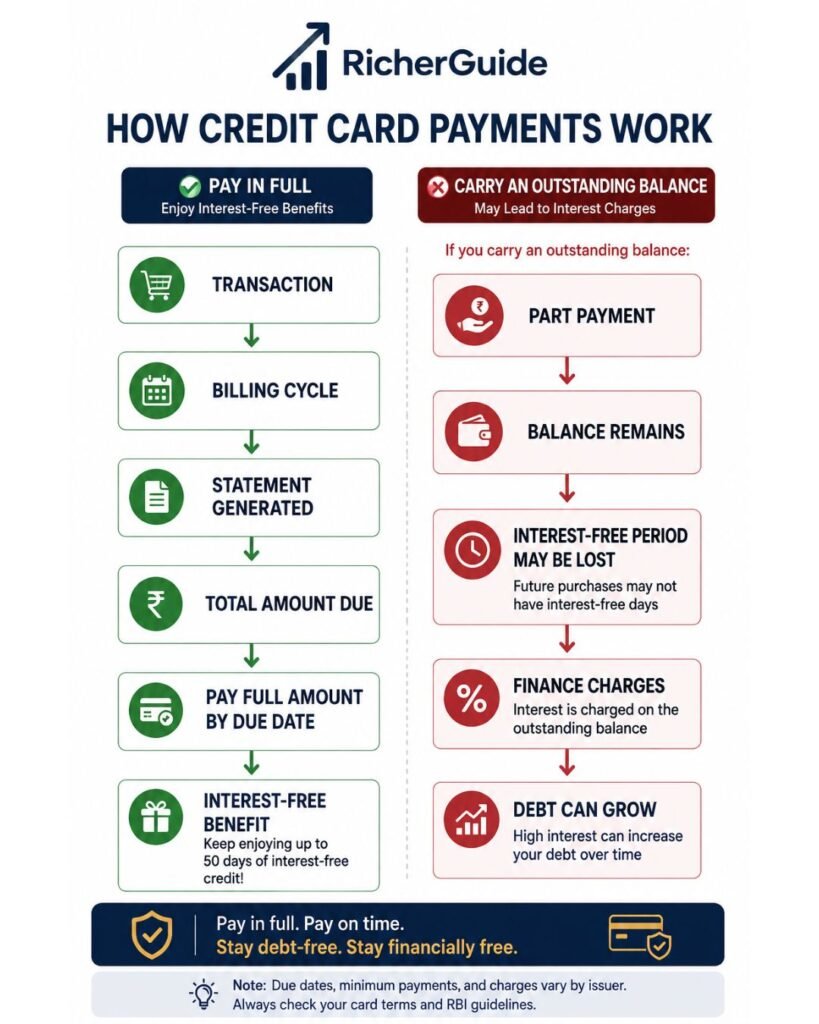
The payment may prevent the bill from immediately being treated as unpaid in the normal sense, but the remaining balance can attract interest, and the interest-free period can be lost when the previous balance is not fully cleared.
RBI specifically requires card issuers to warn customers that making only the minimum payment can stretch repayment over months or years with consequential interest. RBI also states that the interest-free credit period is suspended when a previous month’s balance remains outstanding.
The lesson is simple:
Knowing the RBI rules can help you avoid unnecessary costs and understand your rights as a cardholder.
Key RBI Credit Card Rules You Should Know
Your Credit Card Should Not Be Issued Without Your Consent
One important customer-protection rule is that card issuers cannot simply send you an unsolicited credit card and expect you to accept it.
RBI requires prior and explicit consent for issuing a credit card.
If an unsolicited card is received, RBI advises the customer not to activate it or provide consent through OTP or another method.
If the customer does not provide consent for activation, the issuer is required to close the account without cost to the customer within seven working days from the date of seeking confirmation, and inform the customer about the closure.
Example
Suppose you receive a credit card from a bank that you never applied for.
Do not:
- Activate it
- Share the OTP
- Share card details
- Use the card
Instead, contact the issuer through its official customer-care channel and ask for clarification.
Practical Tip
Never activate a card simply because someone tells you:
“It is a free card. Just activate it once.”
Always verify the card’s origin and terms.
Banks Must Give You Important Card Information
Before accepting a credit card, you should be able to understand its major costs and terms.
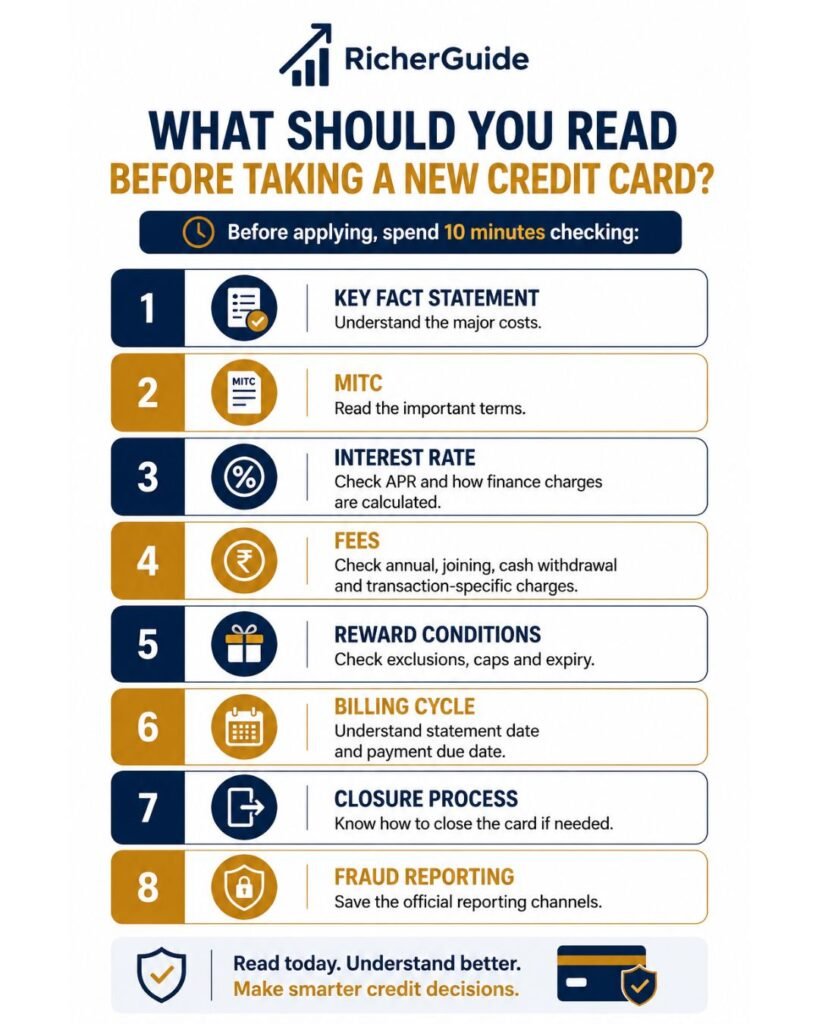
RBI’s directions require card issuers to provide a one-page Key Fact Statement with the credit card application containing important aspects such as the interest rate and charges.
The issuer must also provide the Most Important Terms and Conditions (MITC) at the appropriate stage.
Check These Before Accepting a Card
| Item | What You Should Check |
|---|---|
| Joining fee | Is there a one-time fee? |
| Annual fee | Is it free or paid? |
| Interest rate | What APR/finance charge applies? |
| Late fee | How is it calculated? |
| Cash advance fee | What does ATM withdrawal cost? |
| Foreign transaction fee | Important for international spending |
| Reward rules | Expiry, exclusions and redemption |
| Minimum due | How much must be paid? |
| Credit limit | What is your approved limit? |
| EMI charges | Processing fee and interest |
| Other fees | Check the complete fee schedule |
Do not choose a credit card only because someone says:
“It gives 5% cashback.”
The right question is:
“What is the total cost of using this card?”
Credit Card Charges Must Be Transparent
RBI says card issuers should not levy a charge that was not explicitly indicated to the cardholder at the time of issue without obtaining the customer’s explicit consent, subject to applicable statutory charges.
The details of charges associated with cards must also be displayed on the issuer’s website.
This is important because credit cards can have many different charges.
Common Charges
- Joining fee
- Annual fee
- Cash withdrawal fee
- Finance charges
- Late payment fee
- Foreign currency transaction fee
- EMI processing fee
- Balance transfer charges
- Certain transaction-specific fees
- Taxes applicable to charges
Best Practice
Before applying for a card, download or read the issuer’s:
MITC + Fee Schedule + Key Fact Statement
Do not rely only on advertisements.
Minimum Amount Due Is NOT the Same as Full Payment
This is one of the most important credit card rules to understand.
Your monthly statement can show:
Total Amount Due
and
Minimum Amount Due
They are not the same thing.
The minimum amount due is the minimum amount required under the card’s terms to avoid the bill being treated as overdue immediately.
But paying only the minimum amount does not mean your entire balance has been paid.
RBI specifically requires issuers to warn cardholders about the consequences of repeatedly paying only the minimum amount due.
Example
Suppose:
- Total bill = ₹50,000
- Minimum due = ₹2,500
You pay ₹2,500.
Remaining amount:
₹50,000 − ₹2,500 = ₹47,500
Interest and applicable charges may then apply according to your card’s terms.
The Golden Rule
If possible, pay the Total Amount Due by the due date.
Do not make “minimum payment” your normal repayment strategy.
Interest-Free Period Can Be Lost
Many people think:
“Credit cards always give me 40–50 days interest-free.”
That is not necessarily true.
The interest-free credit period is subject to payment of the entire outstanding amount by the due date.
RBI states that when a previous month’s balance remains outstanding, the interest-free credit period is suspended.
Practical Tip
If you cannot afford to pay the full statement amount, reconsider making a large discretionary purchase on the credit card.
Interest Should Be Calculated on the Applicable Outstanding Amount
RBI’s directions state that interest should be levied only on the outstanding amount, adjusted for payments, refunds and reversed transactions.
This is an important protection.
Suppose:
- Credit card bill = ₹60,000
- You make a payment of ₹20,000
- Remaining outstanding = ₹40,000
The applicable interest calculation should take relevant payments, refunds and reversed transactions into account rather than simply ignoring them.
The exact calculation method can vary according to the card issuer’s terms.
Therefore, always check the finance-charge calculation shown on your statement.
RBI Requires APR Disclosure
APR means:
Annual Percentage Rate
Credit card issuers must disclose APR for different situations where applicable, such as:
- Retail purchases
- Balance transfers
- Cash advances
- Non-payment of minimum amount due
- Late payment
The method of calculation should also be explained with examples.
Why APR Matters
A card advertised as “low monthly interest” may sound inexpensive.
But suppose a card charges 3% per month.
A simple annualised figure would be:
3% × 12 = 36% per year
The actual effective cost can be different because of compounding and the issuer’s calculation method.
So don’t compare credit cards only by monthly rates.
Credit Card Statements Must Provide Important Information
RBI requires issuers to provide billing statements and sufficient time for customers to make payment.
The directions state that cardholders should have at least a fortnight before interest starts being charged, subject to the applicable terms and payment conditions.
Your statement should help you understand:
- Total Amount Due
- Minimum Amount Due
- Payment Due Date
- Transaction details
- Interest/finance charges
- Late charges, if applicable
- Credit limit
- Available credit
- Payment options
- Customer-care information
Best Practice
Read your credit card statement every month.
Don’t just look at the final amount.
Check every transaction.
You Can Dispute an Incorrect Bill
What if your statement contains a transaction you did not make?
Or what if the bill contains an error?
RBI requires issuers to address billing complaints and provide an explanation and, wherever applicable, documentary evidence within a maximum of 30 days from the complaint.
What You Should Do
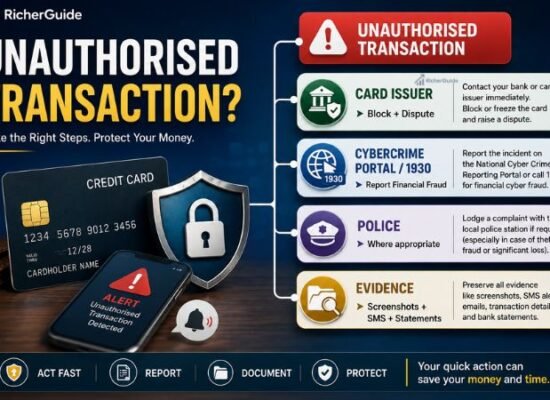
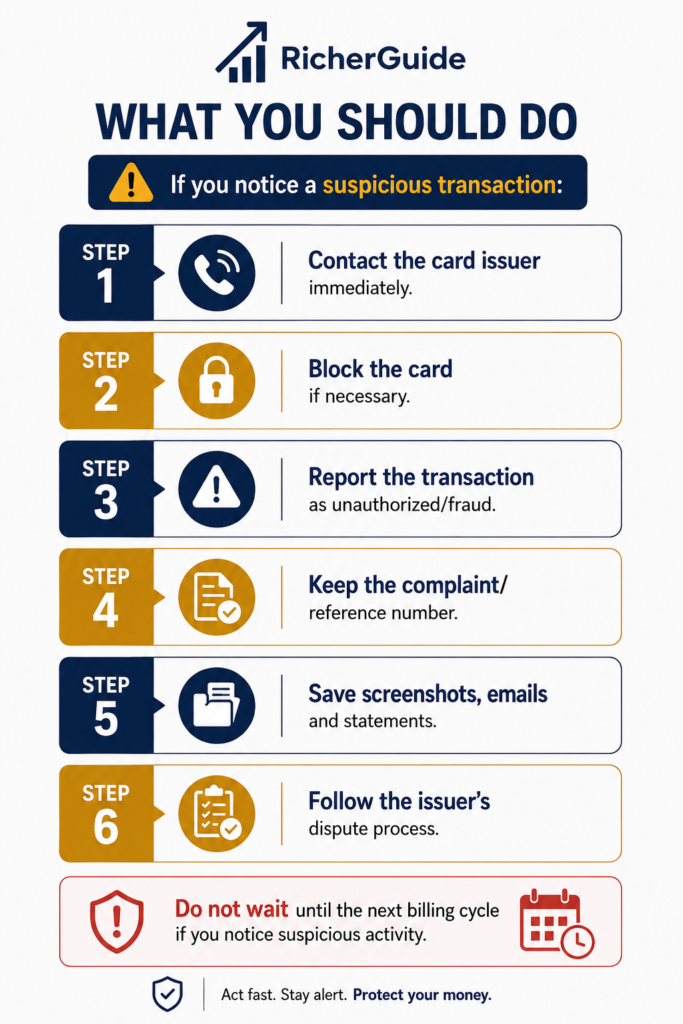
If you notice a suspicious transaction:
STEP 1: Contact the card issuer immediately.
STEP 2: Block the card if necessary.
STEP 3: Report the transaction as unauthorized/fraud.
STEP 4: Keep the complaint/reference number.
STEP 5: Save screenshots, emails and statements.
STEP 6: Follow the issuer’s dispute process.
Do not wait until the next billing cycle if you notice suspicious activity.
Fraud-Disputed Transactions Have Special Protection
RBI’s directions state that no charges should be levied on transactions disputed as fraud by the cardholder until the dispute is resolved.
This does not mean every disputed transaction will automatically be cancelled.
The dispute still needs to be investigated and resolved.
Example
Suppose you see:
₹18,500 — Unknown Online Merchant
You did not make the transaction.
Immediately report it as an unauthorized/fraud transaction.
Keep evidence of your complaint.
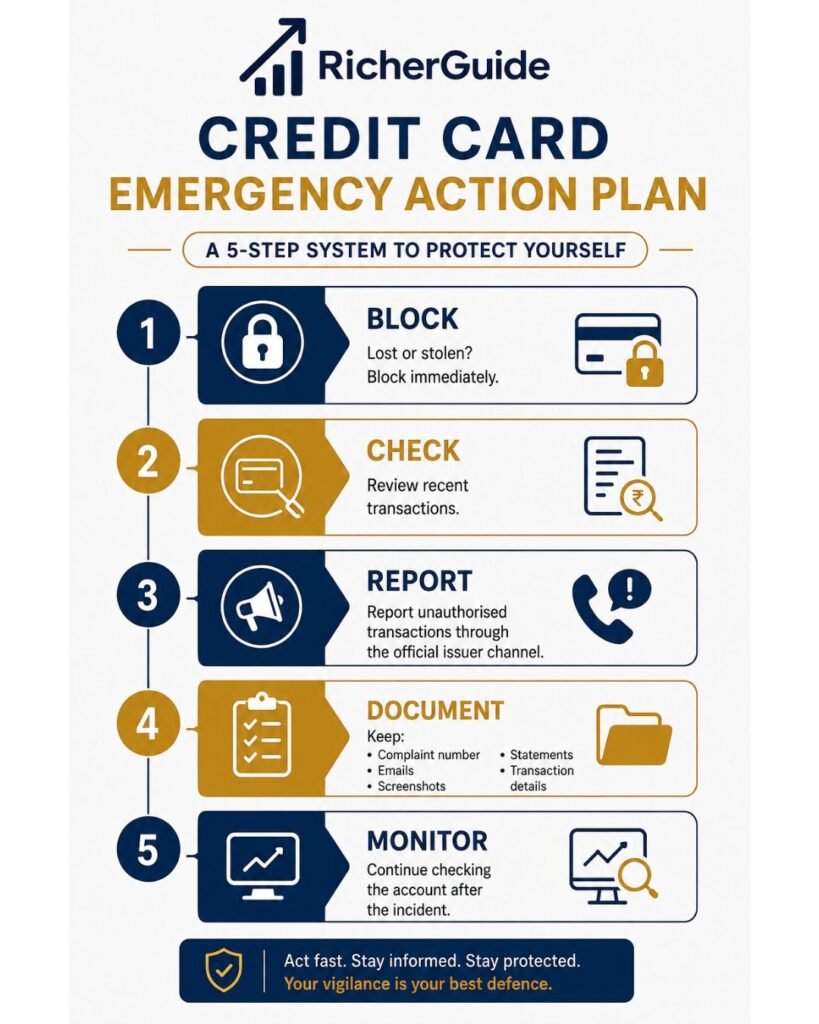
Lost or Stolen Cards Must Be Blocked Quickly
If your credit card is lost or stolen, don’t wait.
RBI requires card issuers to block a lost card immediately after being informed by the cardholder.
Issuers must also provide multiple channels for reporting loss, theft or unauthorized use, including options such as helplines, email, internet banking and mobile applications, and these services are to be available on a 24×7 basis.
Golden Rule
Block first. Investigate later.
You Can Request a Change in Billing Cycle
Different credit cards may have different billing dates.
RBI requires cardholders to be provided an option to modify the billing cycle at least once.
The RBI FAQ further explains that the cardholder should be given an option to choose the starting or closing day of the billing cycle at least once.
Why This Is Useful
Suppose your salary arrives on the 1st of every month.
Your credit card due date is currently around the 5th.
You may find it difficult to manage cash flow.
If your issuer provides the relevant option, changing the billing cycle can make the payment schedule more convenient.
Practical Tip
Try to align your card’s payment cycle with your income cycle.
Over-Limit Transactions Require Your Consent
Suppose your credit limit is:
₹1,00,000
Can the issuer simply allow you to spend ₹1,05,000 and charge an over-limit fee?
RBI’s FAQ says usage beyond the sanctioned credit limit requires prior explicit consent from the cardholder.
Cardholders should also have an option to enable or disable the over-limit facility through the issuer’s transaction-control mechanisms.
Why This Matters
Keeping over-limit transactions disabled can be useful for controlling spending and reducing unexpected charges.
Credit Limit Changes Should Not Be Forced on You
A credit limit is not free money.
If a bank increases your credit limit from:
₹1 lakh → ₹3 lakh
that does not mean you should increase your spending.
RBI’s customer-protection framework requires consent for relevant changes and does not allow unilateral enhancement of credit facilities without the required customer consent. RBI also specifically addresses credit-limit changes in its FAQs.
Important Difference
Higher limit ≠ higher income
Your spending capacity should be based on your income and repayment ability, not simply the available credit limit.
Refunds and Reversed Transactions Must Be Handled Properly
Credit card payments can sometimes involve:
- Failed transactions
- Reversed transactions
- Cancelled orders
- Merchant refunds
RBI has specific provisions for handling credit amounts arising from refunds, failed or reversed transactions.
Where a refund/credit arises before the due date and payment has not yet been made, it can be adjusted against the payment due and the customer should be notified.
Where the cardholder has already paid and the refund falls under the applicable provision, explicit consent may be required for adjustment beyond the specified threshold; otherwise, the amount may be credited to the customer’s bank account as applicable.
Example
You purchase a laptop for:
₹70,000
You later cancel the order.
The merchant processes a refund.
Do not assume the refund has been adjusted automatically.
Check your credit card statement and bank account.
You Have the Right to Close Your Credit Card
Sometimes you may decide that a credit card is no longer useful.
Perhaps:
- Annual fee is too high
- Rewards are not useful
- You have too many cards
- You want to simplify finances
- You no longer use the card
RBI requires card issuers to provide a closure process.
Under the applicable directions, if the cardholder requests closure and there are no outstanding dues, the issuer is required to complete the closure within seven working days.
Failure to complete closure within seven working days can result in a penalty of ₹500 per day of delay, payable to the cardholder until closure, provided there is no outstanding amount.
Important
Before requesting closure:
- Pay all outstanding dues.
- Redeem important reward points if applicable.
- Cancel recurring subscriptions.
- Download statements.
- Request formal closure.
- Keep the closure confirmation.
Changes in Charges Should Be Communicated
Credit card charges do not always remain the same forever.
However, RBI requires changes in charges to be made prospectively with prior notice.
The directions state that changes in charges should generally be communicated with at least one month’s notice. If a customer wants to surrender the card because of an adverse change in charges, the customer should be permitted to close it without an additional closure charge, subject to payment of dues.
What You Should Do
Don’t ignore emails from your credit card issuer.
Important changes may be communicated through:
- Statement
- SMS
- App notification
- Website
Read them.
Credit Card Issuers Must Provide Authorized Payment Modes
RBI requires issuers to provide a list of authorised payment modes on their websites and billing statements.
Customers are also advised to exercise caution and avoid making payments through unauthorised modes.
Scam Warning
Never make a credit card payment to a random UPI ID simply because someone calls you and says:
“Your card payment is overdue.”
Always verify the payment method through the official bank app or official customer-care channel.
Recovery Agents Cannot Harass Customers
Debt recovery can be stressful.
But financial institutions and their recovery agents are expected to follow applicable RBI requirements.
RBI instructions prohibit intimidation and harassment and protect the privacy of customers and their families. The RBI’s broader recovery-agent framework also prohibits inappropriate messages, threatening or anonymous calls, and certain unreasonable calling practices.
If You Have a Genuine Outstanding Balance
Do not ignore it.
Instead:
- Contact the issuer.
- Understand the outstanding amount.
- Ask about repayment options.
- Keep communication records.
- Use the issuer’s grievance mechanism if necessary.
At the same time, do not assume that a threatening caller automatically represents your bank.
Verify independently.
Your Card Terms Should Be Written Clearly
RBI requires card terms and conditions to be expressed clearly and in simple language that the cardholder can understand.
The directions also state that terms should preferably be available in English, Hindi and the local language.
This is important because financial documents can be complicated.
Before accepting a card, understand:
Fees + Interest + Rewards + Restrictions + Closure Rules
What Is the Difference Between Total Amount Due and Minimum Amount Due?
| Feature | Total Amount Due | Minimum Amount Due |
| Meaning | Full amount payable | Minimum required payment |
| Best option | Yes, when affordable | Not ideal for regular repayment |
| Interest-free benefit | Generally maintained when paid fully by due date | May be lost if balance remains |
| Remaining balance | ₹0 | Balance continues |
| Long-term cost | Usually lower | Can become significantly higher |
| Recommended habit | Pay this amount | Use only when necessary |
RBI requires issuers to warn customers about the long-term consequences of repeatedly paying only the minimum amount.
Credit Card Interest Calculator
You can use this simple calculation to understand why revolving credit can become expensive.
Simple Monthly Interest Estimate
Estimated Interest = Outstanding × Monthly Interest Rate
For example:
Outstanding:
₹40,000
Illustrative monthly rate:
2.5%
Calculation:
₹40,000 × 2.5% = ₹1,000
So the illustrative monthly finance charge would be:
₹1,000
Taxes and other applicable charges may be additional, and actual card calculations can differ depending on the issuer’s methodology and transaction dates.
Important
This is an educational example, not a substitute for the finance-charge calculation shown in your card statement.
RBI requires issuers to disclose the applicable APR and calculation methodology.
Real-Life Indian Example
Example: Priya’s ₹60,000 Credit Card Bill
Priya uses her credit card for:
- Shopping: ₹25,000
- Travel: ₹15,000
- Groceries: ₹10,000
- Restaurants: ₹5,000
- Online subscriptions: ₹5,000
Total:
₹60,000
Her statement shows:
Total Amount Due = ₹60,000
Minimum Amount Due = ₹3,000
Priya pays only ₹3,000.
She still owes:
₹57,000
Because the entire previous balance was not cleared, the interest-free benefit can be suspended under RBI’s rules and the applicable card terms. Interest can then be charged according to the issuer’s disclosed methodology.
Better Strategy
If Priya cannot afford ₹60,000, she should first consider whether the original purchases were necessary.
If the spending was unavoidable, she should review the issuer’s repayment options and avoid repeatedly carrying balances.
Lesson
A credit card should be used as a payment tool, not as a permanent source of expensive borrowing.
Common Credit Card Mistakes to Avoid
1: Paying Only the Minimum Due
This can keep the account from immediately becoming overdue but can leave a large balance attracting interest.
Better approach:
Pay the total amount due whenever possible.
2: Ignoring Small Transactions
Scammers sometimes test cards with small transactions.
Better approach:
Review every transaction.
3: Sharing OTPs
No genuine bank representative should need your card OTP for a suspicious “verification” process.
Better approach:
Never share OTP, PIN, CVV or passwords with callers.
4: Using the Credit Limit as a Spending Target
A ₹5 lakh credit limit does not mean you should spend ₹5 lakh.
Better approach:
Set your own spending limit.
5: Ignoring Annual Fees
A card with excellent rewards may still be expensive if you don’t use its benefits enough.
Better approach:
Calculate annual value before renewing.
6: Taking Cash From a Credit Card Without Understanding the Cost
Cash advances can have separate fees and interest terms.
Better approach:
Check the card’s cash withdrawal charges and APR before using the facility.
7: Closing a Card Without Checking Automatic Payments
Subscriptions may continue to fail after card closure.
Better approach:
Move recurring payments first.
Practical Credit Card Best Practices
Use this monthly checklist:
- Check every transaction.
- Check the Total Amount Due.
- Check the Minimum Amount Due.
- Pay the Total Amount Due whenever possible.
- Check the payment due date.
- Review interest and fees.
- Check reward points and expiry rules.
- Look for unfamiliar transactions.
- Check available credit limit.
- Review important issuer notifications.
- Keep card details secure.
- Report lost cards immediately.
- Keep complaint/reference numbers.
- Avoid unauthorised payment channels.
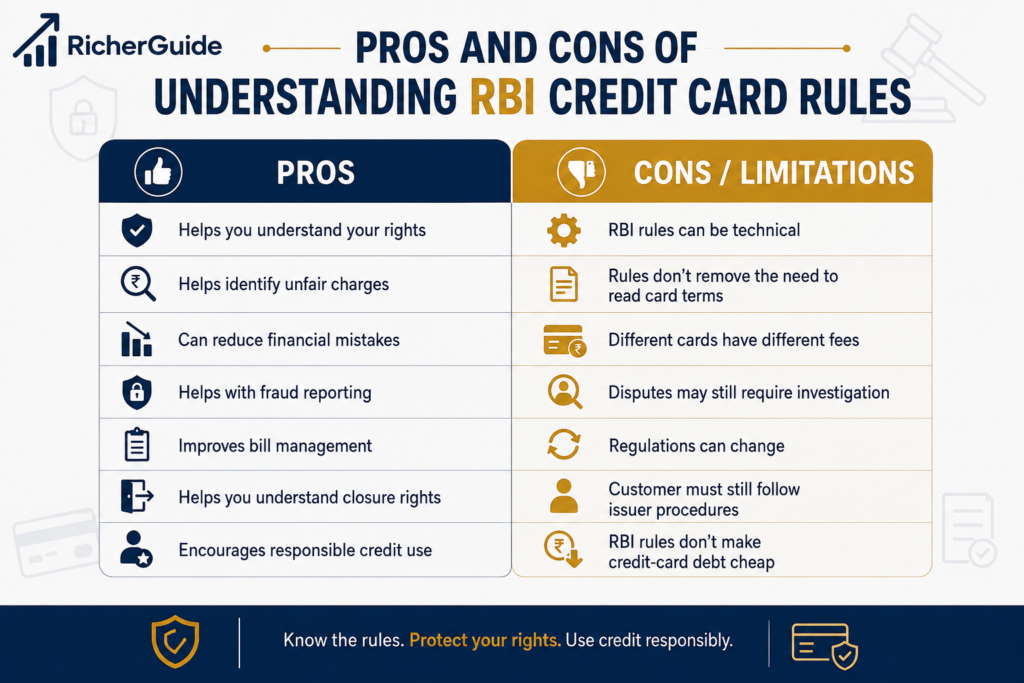
RBI Rules vs Your Card’s Terms
One common misunderstanding is:
“RBI has rules, so every credit card must have the same charges.”
Not necessarily.
RBI provides regulatory requirements and customer protections, but individual card issuers can have different commercial terms within the applicable regulatory framework.
For example:
| Feature | RBI Framework | Individual Card |
| Customer consent | Required in applicable situations | Issuer-specific process |
| Interest disclosure | Required | Rate differs |
| Annual fee | Must be disclosed | Depends on card |
| Credit limit | Subject to applicable rules | Depends on issuer |
| Rewards | No universal reward structure | Card-specific |
| Billing cycle | Modification option required at least once | Exact process varies |
| Closure | Regulatory timeline applies | Process varies |
| Fraud reporting | Customer-protection rules apply | Exact channels vary |
Therefore:
RBI rules + your card’s MITC = the complete picture.
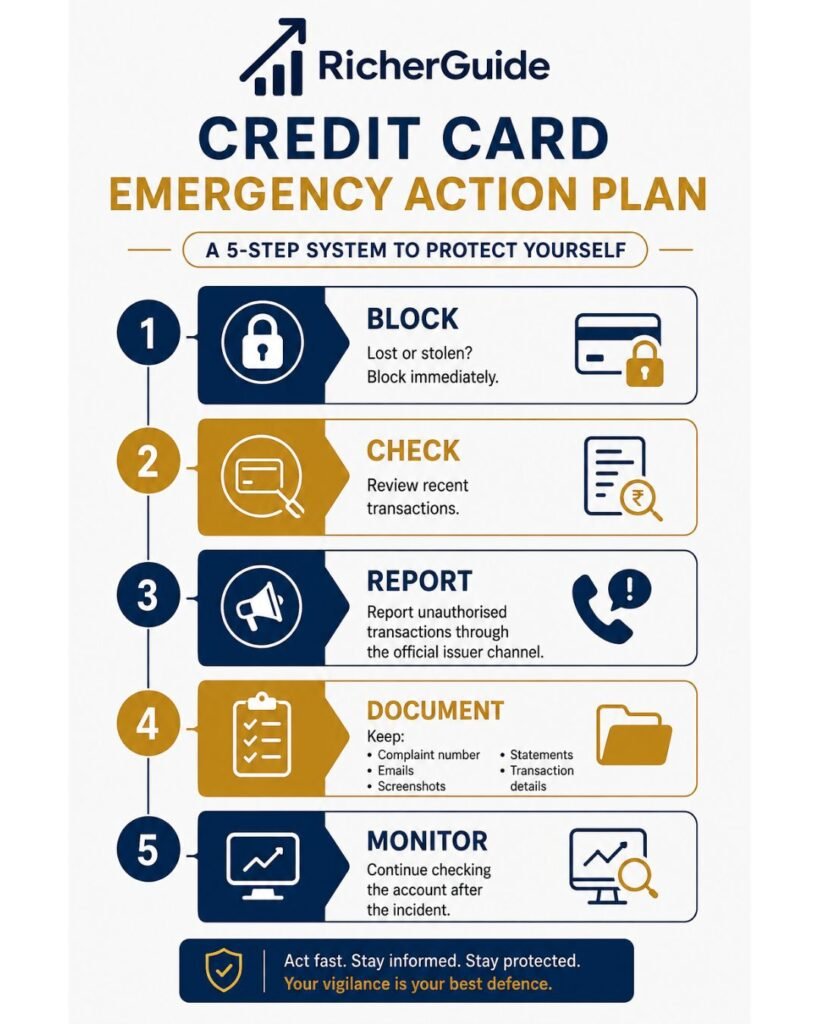
Credit Card Emergency Action Plan
Use this five-step system:
BLOCK → CHECK → REPORT → DOCUMENT → MONITOR
1. BLOCK
Lost or stolen?
Block immediately.
2. CHECK
Review recent transactions.
3. REPORT
Report unauthorised transactions through the official issuer channel.
4. DOCUMENT
Keep:
- Complaint number
- Emails
- Screenshots
- Statements
- Transaction details
5. MONITOR
Continue checking the account after the incident.
Frequently Asked Questions
1. Can a bank send me a credit card without my consent?
RBI prohibits unsolicited credit cards and requires prior and explicit consent for issuing a credit card. If an unsolicited card is received, RBI advises customers not to activate it or provide consent through OTP or another method.
2. Is paying the minimum amount due enough?
It may satisfy the minimum payment requirement, but it does not clear the entire balance. If the full outstanding is not paid, interest may apply and the interest-free period can be lost according to the applicable rules and card terms.
3. Can a credit card issuer charge interest on the entire original bill after I make a payment?
RBI requires interest to be levied on the outstanding amount after adjusting for relevant payments, refunds and reversed transactions. The exact calculation depends on the issuer’s disclosed methodology.
4. Can I change my credit card billing cycle?
Yes. RBI requires cardholders to be provided an option to modify the billing cycle at least once. The RBI FAQ states that the customer should have an option to choose the starting or closing day of the billing cycle at least once.
5. Can a bank allow spending above my credit limit?
Usage beyond the sanctioned credit limit requires prior explicit consent from the cardholder under RBI’s framework. Cardholders should also have an option to enable or disable over-limit usage through suitable transaction controls.
6. What should I do if my credit card is lost?
Contact your card issuer immediately and request blocking of the card. RBI requires issuers to provide multiple channels for reporting lost, stolen or unauthorised use and to block a lost card immediately after being informed.
7. Can I dispute an incorrect credit card bill?
Yes. Contact the issuer and raise a formal complaint. RBI requires issuers to provide an explanation and, wherever applicable, documentary evidence within a maximum of 30 days from the complaint.
8. Can a credit card be closed if I don’t want it anymore?
Yes, subject to settlement of outstanding dues. RBI requires the issuer to complete closure within seven working days after a valid closure request where there is no outstanding amount. A delay can attract ₹500 per day payable to the cardholder, subject to the regulatory conditions.
9. Can the bank change my credit card charges?
Charges can be changed subject to applicable RBI requirements. RBI’s directions require prospective changes with prior notice, including at least one month’s notice for applicable changes.
10. Are credit card recovery agents allowed to threaten customers?
No. RBI’s recovery-agent framework prohibits intimidation, harassment, threatening or anonymous calls, inappropriate communications and intrusion into customer privacy.
11. Should I keep multiple credit cards?
There is no universal right number.
Multiple cards can be useful when they serve different purposes, but too many cards can make tracking fees, due dates and spending difficult.
Choose cards based on your actual spending pattern.
12. Does RBI decide the rewards and cashback on every credit card?
No. Rewards, cashback, fees and other commercial features can differ between cards, subject to applicable regulations.
Always read the specific card’s terms before applying.
A Simple Monthly Credit Card Formula
Use this formula to keep your credit card under control:
Credit Card Health Check
Monthly Card Cost = Interest + Fees + Taxes − Rewards/Benefits
For example:
Interest:
₹0
Annual-fee equivalent:
₹150/month
Other applicable charges:
₹50/month
Rewards:
₹400/month
Approximate net value:
₹400 − ₹150 − ₹50 = ₹200 positive value
But if you carry a large balance and pay significant interest, the calculation can quickly become negative.
The Most Important Formula
Total Amount Due − Payment Made = Remaining Balance
Your goal should generally be:
Remaining Balance = ₹0
when you can safely afford to pay the full bill.
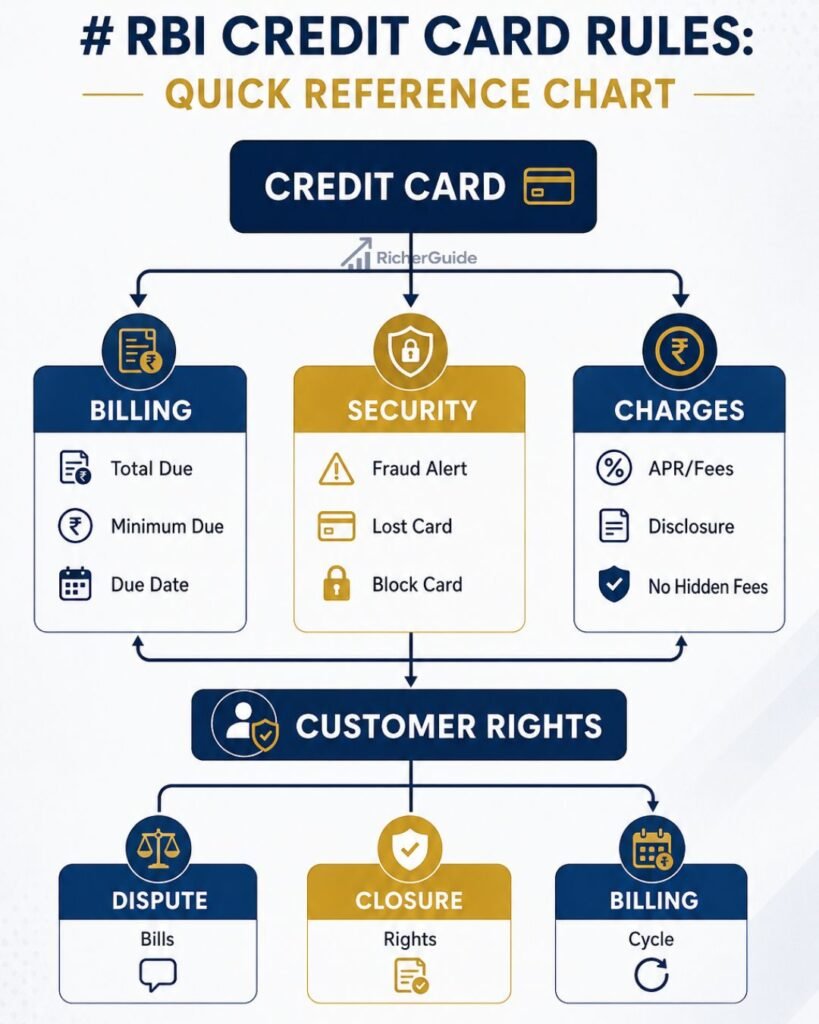
RBI Credit Card Rules: Quick Reference Chart
The 10 Golden Rules Every Cardholder Should Remember
Rule 1
Never activate an unsolicited credit card.
Rule 2
Read the Key Fact Statement and MITC.
Rule 3
Know your Total Amount Due.
Rule 4
Do not make minimum payment a habit.
Rule 5
Pay the full statement amount whenever possible.
Rule 6
Report fraud immediately.
Rule 7
Block a lost or stolen card immediately.
Rule 8
Check every transaction.
Rule 9
Understand fees before accepting a card.
Rule 10
Remember that your credit limit is borrowed money, not income.
Final Takeaway
Credit cards are neither good nor bad.
The result depends on how you use them.
If you understand your billing cycle, pay your bills on time, avoid unnecessary interest, monitor transactions and know your rights, a credit card can become a useful financial tool.
RBI’s credit card framework provides important protections around areas such as customer consent, billing transparency, interest disclosure, fraud disputes, lost cards, billing-cycle changes, over-limit transactions and card closure.
But regulations alone cannot protect you from every financial mistake.
You also need good credit-card habits.
The simplest habit is:
Spend only what you can repay, check your statement every month, and pay the Total Amount Due whenever possible.
Before taking any new credit card, compare the complete cost not just cashback, rewards or promotional offers.
And if something looks wrong, don’t ignore it.
Read the terms. Ask questions. Keep records. Use official channels. Know your rights.
Disclaimer
This article is for educational and informational purposes only and should not be considered financial, legal or investment advice.
RBI rules, bank policies, credit-card fees, interest rates, rewards and eligibility criteria may change. The information in this article is based on RBI material available at the time of writing, including the Master Direction Credit Card and Debit Card Issuance and Conduct Directions, 2022, updated through the March 7, 2024 amendment.
Readers should verify the latest information directly from the Reserve Bank of India and the respective credit-card issuer before making financial decisions.
RicherGuide does not guarantee approval, rewards, savings, credit-score improvement or any specific financial outcome from using a credit card.
Use credit responsibly. Never borrow more than you can comfortably repay.