Introduction (Continue from Part 1)
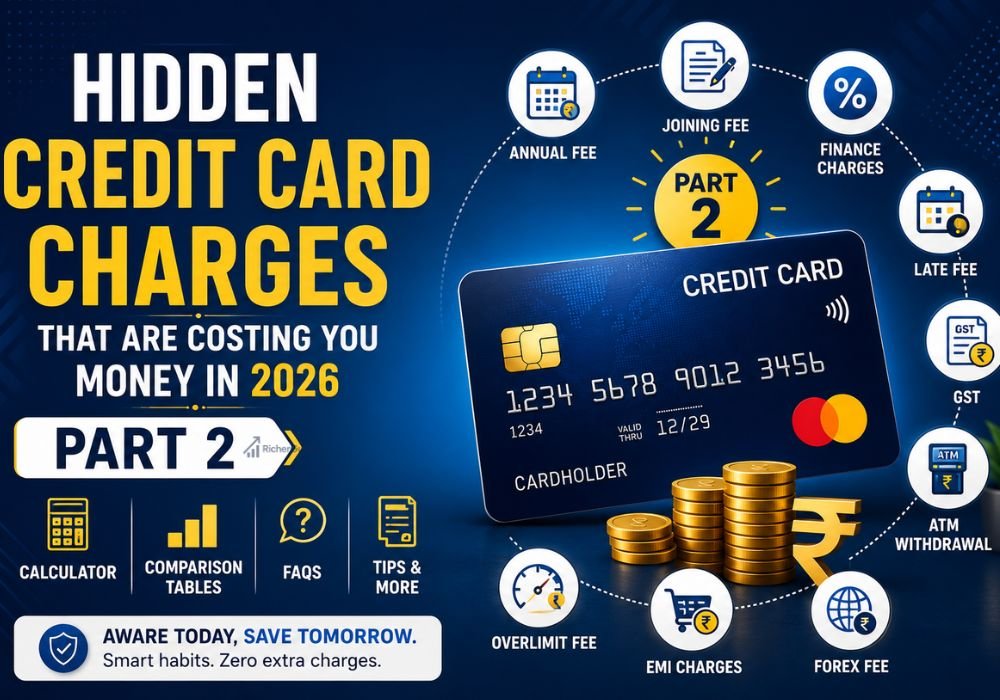
If you have already read Part 1, you now know about some of the most common hidden credit card charges, including annual fees, finance charges, late payment fees, ATM withdrawal fees, foreign transaction fees, overlimit charges, EMI processing fees, and card replacement fees.
👉 Missed Part 1? Read it here first:
https://richerguide.com/hidden-credit-card-charges-india-2026-part-1/
But that’s not the complete story.
Many credit card users are still paying additional charges without realizing it. These lesser-known fees can quietly increase your monthly bill and reduce the value of your rewards, cashback, or savings.
In this second part, we’ll uncover seven more hidden credit card charges that every cardholder should know. We’ll also show you practical ways to avoid these charges and keep more money in your pocket.
Table of Contents
Hidden Charge 9 – GST on Credit Card Charges
Many people believe they only pay the fee shown on their credit card statement. However, almost every applicable credit card fee attracts 18% GST, making the total cost even higher.
GST is not charged on your purchases but on many service-related fees, such as:
- Annual Fee
- Late Payment Fee
- Cash Withdrawal Fee
- EMI Processing Fee
- Card Replacement Fee
- Foreign Transaction Charges (on applicable fees)
Example
| Description | Amount |
|---|---|
| Late Payment Fee | ₹750 |
| GST (18%) | ₹135 |
| Total | ₹885 |
Although ₹135 may seem small, repeated GST charges throughout the year can significantly increase your total credit card costs.
How to Avoid
- Avoid triggering chargeable events like late payments or cash withdrawals.
- Review your monthly statement carefully to understand the fees applied.
Hidden Charge 10 – Dynamic Currency Conversion (DCC) Charges
When you’re shopping abroad or making payments on an international website, the merchant may ask:
“Would you like to pay in Indian Rupees?”
It sounds convenient but choosing INR often means accepting a poor exchange rate through Dynamic Currency Conversion (DCC).
Instead of your card issuer using the Visa or Mastercard exchange rate, the merchant’s payment processor applies its own, often less favorable, rate.
Example
Hotel Bill: USD 200
- Pay in USD → Better exchange rate
- Pay in INR → Higher converted amount due to DCC
You could end up paying several hundred rupees more for the same purchase.
Tips to Avoid
- Always choose to pay in the local currency when using your credit card overseas.
- Check your bank’s foreign transaction fee before traveling.
Hidden Charge 11 – Reward Point Redemption Fees
Reward points feel like free money but redeeming them isn’t always free.
Some banks charge a Reward Redemption Fee whenever you convert points into vouchers, cashback, or products.
Typical redemption charges range from ₹99 to ₹299 plus GST, depending on the bank and card type.
Example
Suppose you redeem reward points worth ₹1,000.
| Description | Amount |
|---|---|
| Reward Value | ₹1,000 |
| Redemption Fee | ₹99 |
| GST | ₹18 |
| Net Benefit | ₹883 |
How to Avoid
- Choose cards that offer free reward redemption.
- Redeem larger amounts at once to reduce the impact of the fee.
- Compare redemption options before using your points.
Hidden Charge 12 – Credit Card Surcharge on Utility or Government Payments
Not every payment made with a credit card is treated equally.
Some merchants and service providers charge an additional convenience fee or surcharge when you use a credit card.
Examples include:
- Electricity Bills
- Water Bills
- Gas Bills
- Property Tax
- Government Services
- Education Fees
- Insurance Premiums
Example
Insurance Premium: ₹20,000
Convenience Fee: 1%
Additional Charge = ₹200
GST on Convenience Fee = ₹36
Total Extra = ₹236
How to Avoid
- Check the payment gateway before making payment.
- Compare UPI, debit card, and bank transfer options.
- Use credit cards only where rewards outweigh the surcharge.
Comparison Table: Hidden Charges 9–12
| Hidden Charge | Typical Cost | Can You Avoid It? | Best Practice |
|---|---|---|---|
| GST on Charges | 18% of applicable fees | ✅ Yes | Avoid fee-triggering transactions |
| Dynamic Currency Conversion | 2–8% extra through poor exchange rates | ✅ Yes | Always pay in local currency |
| Reward Redemption Fee | ₹99–₹299 + GST | ✅ Yes | Redeem strategically or choose cards with free redemption |
| Utility/Government Payment Surcharge | 0.5%–2% | ✅ Yes | Compare payment methods before paying |
Real-Life Example
Rohan’s International Trip
Rohan traveled to Singapore and used his credit card for shopping, dining, and hotel bookings.
He unknowingly:
- Accepted Dynamic Currency Conversion (DCC) instead of paying in SGD.
- Redeemed reward points and paid a redemption fee.
- Paid an insurance premium using his credit card with a convenience fee.
- Paid GST on multiple service charges.
By the end of the trip, he had spent over ₹3,500 in additional charges that could have been avoided with better awareness.
Lesson: Small charges may seem insignificant individually, but together they can make a noticeable difference to your annual expenses.
Frequently Asked Questions (FAQs)
1. Are hidden credit card charges legal?
Yes. Banks disclose these charges in the card’s terms and conditions. They may seem “hidden” because many users don’t read the fee schedule before applying.
2. Which hidden charge is the most expensive?
Finance charges (interest) are usually the costliest. If you carry a balance, the annual interest rate can exceed 40%, making it one of the biggest avoidable expenses.
3. Is GST charged on every credit card transaction?
No. GST is generally applied to service-related charges such as annual fees, late payment fees, cash withdrawal fees, and processing fees—not on your regular retail purchases.
4. Can I avoid paying the annual fee?
Many banks waive the annual fee if you meet the required yearly spending threshold. Some cards are also offered as lifetime free.
5. Should I use my credit card to withdraw cash?
Only in emergencies. Cash withdrawals usually attract an immediate cash advance fee and interest from the first day, with no interest-free period.
6. What happens if I pay only the minimum amount due?
You avoid being marked as a payment defaulter for that cycle, but interest continues to accrue on the remaining balance, making your debt more expensive.
7. How can I reduce hidden credit card charges?
- Pay the full bill on time.
- Avoid cash withdrawals.
- Stay within your credit limit.
- Read your monthly statement carefully.
- Understand the card’s fee structure before applying.
8. Which credit card is best for avoiding extra charges?
The best choice depends on your spending habits. Look for cards with low annual fees (or lifetime-free options), transparent fee structures, and benefits that match your lifestyle.
Conclusion
Credit cards are powerful financial tools that offer convenience, rewards, and flexibility but only when you understand their true costs.
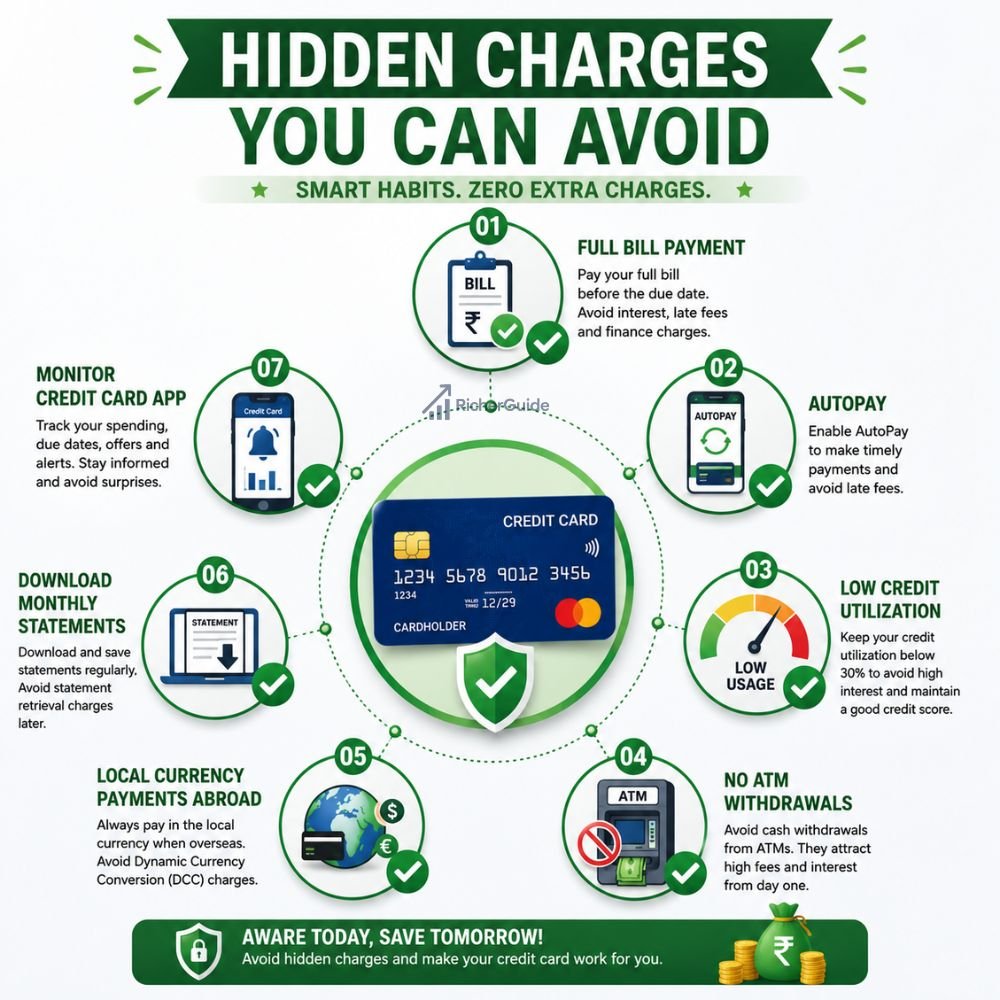
Many hidden charges, such as finance charges, late payment fees, foreign transaction fees, and convenience charges, are entirely avoidable with responsible usage.
The key is to:
- Read the card’s terms and conditions.
- Pay your full bill before the due date.
- Avoid unnecessary fees like cash withdrawals and overlimit usage.
- Review your monthly statement regularly.
By following these simple habits, you can enjoy all the benefits of your credit card while keeping unnecessary costs under control.
A little financial awareness today can save you thousands of rupees every year.
Disclaimer
The information in this article is intended for educational and informational purposes only and should not be considered financial, legal, tax, or investment advice.
Credit card fees, interest rates, annual charges, reward programs, foreign transaction fees, and other terms vary by bank, card issuer, and card type. Banks may update their charges and policies without prior notice.
Before applying for or using any credit card, always review the latest Schedule of Charges, Most Important Terms & Conditions (MITC), and official information provided by the card issuer.