Introduction
Welcome to Part 3 of our Credit Card Habits That Can Improve Your Credit Score Fast series.
If you haven’t read the previous parts, we highly recommend starting there:
- Part 1: Covered the foundation of a healthy credit score, including paying bills on time, keeping balances low, and monitoring your credit report.
- Part 2: Focused on avoiding common credit card mistakes, limiting unnecessary applications, maintaining old accounts, and using automatic payments effectively.
Now it’s time to explore the final three habits that can strengthen your credit profile and help you build long-term financial credibility.
Let’s dive into the final habits that can help you become a smarter and more responsible credit card user.
Table of Contents
The Problem
Many credit card users reach a “good” credit score but struggle to move into the excellent category.
Why?
Because they often:
- Have only one type of credit
- Keep low credit limits despite responsible usage
- Spend more just to earn reward points
- Ignore long-term credit management strategies
These habits can prevent your credit profile from reaching its full potential.
Fortunately, the solutions are simple and they’re all within your control.
Habit 8: Maintain a Healthy Mix of Credit
Why Your Credit Mix Matters
Many people think only paying bills on time improves their credit score. While payment history is the biggest factor, lenders also like to see that you can manage different types of credit responsibly.
A healthy credit mix shows that you have experience handling different borrowing products.
A balanced credit profile may include:
- Credit Cards
- Personal Loan
- Home Loan
- Car Loan
- Education Loan
- Consumer Durable Loan
You don’t need every type of loan. The goal is to demonstrate responsible credit management over time.
How Credit Mix Helps Your Credit Score
Suppose two people have the same income and payment history.
Person A
- 3 Credit Cards
- No loans
Person B
- 2 Credit Cards
- 1 Home Loan
- 1 Car Loan
Most lenders will consider Person B slightly less risky because they have successfully managed both revolving and installment credit.
Good vs Poor Credit Mix
| Healthy Credit Mix | Poor Credit Mix |
|---|---|
| 2 Credit Cards + Home Loan | 6 Credit Cards Only |
| Credit Card + Car Loan | Multiple Personal Loans |
| Credit Card + Education Loan | Payday Loans |
| Long repayment history | Many new loans together |
Tips to Maintain a Healthy Credit Mix
✅ Don’t take loans only to improve your credit score.
✅ Manage existing credit responsibly.
✅ Avoid taking several loans at the same time.
✅ Keep old credit accounts active if possible.
✅ Only borrow when necessary.
Example
Rahul
- One Credit Card
- Pays full bill every month
Score: 760
Priya
- Credit Card
- Home Loan
- Car Loan
- Excellent repayment history
Score: 810
Although both are responsible borrowers, Priya has a more diversified credit profile.
Habit 9: Increase Your Credit Limit Responsibly
Why Increasing Your Credit Limit Helps
One of the easiest ways to improve your credit score is to reduce your credit utilization ratio.
Increasing your credit limit can lower your utilization provided your spending stays the same.
Example
Before Limit Increase
Credit Limit = ₹1,00,000
Monthly Spending = ₹40,000
Credit Utilization
= 40%
After Limit Increase
Credit Limit = ₹2,00,000
Monthly Spending = ₹40,000
Credit Utilization
= 20%
Same spending.
Lower utilization.
Better credit score potential.
Benefits
- Lower credit utilization
- Better credit score
- Higher purchasing flexibility
- Better chances of loan approval
- More emergency spending capacity
Important Rule
Increasing your credit limit is helpful only if you don’t increase your spending.
Many people receive a higher limit and immediately spend more.
That defeats the purpose.
When Should You Request a Limit Increase?
Ask your bank if:
- Your salary has increased.
- You’ve been paying on time for 6–12 months.
- Your credit score is above 750.
- You have low outstanding balances.
Mistakes to Avoid
❌ Using the entire increased limit
❌ Taking multiple limit increases within a short period
❌ Applying to several banks at once
❌ Missing payments after receiving a higher limit
Habit 10: Use Reward Programs Wisely Without Overspending
Reward Points Are a Bonus Not a Reason to Spend
Many credit card users fall into a common trap:
“I’ll buy this because I’ll earn reward points.”
This mindset often leads to unnecessary spending and higher debt.
Remember:
Reward points should reward your existing spending not encourage extra spending.
Smart Ways to Earn Rewards
Use your credit card for planned expenses like:
- Grocery shopping
- Fuel
- Utility bills
- Online shopping
- Insurance premiums
- Flight bookings
- Hotel reservations
These are expenses you would make anyway.
Poor Reward Strategy
Buying a ₹30,000 smartphone you don’t need to earn ₹300 worth of reward points.
You spend ₹30,000 to earn benefits worth only 1%.
Not smart.
Good Reward Strategy
Monthly grocery spending
₹12,000
Rewards
2%
Monthly reward value
₹240
Annual reward value
₹2,880
Without spending extra.
Reward Program Best Practices
✔ Redeem points before expiry.
✔ Understand the reward redemption value.
✔ Use category-specific cards.
✔ Avoid annual fees that exceed reward benefits.
✔ Never carry a balance just to earn points.
Cashback vs Reward Points
| Cashback | Reward Points |
|---|---|
| Direct money back | Redeem for gifts or travel |
| Easy to understand | Redemption value varies |
| Best for most users | Better for frequent travelers |
| Immediate benefit | Long-term benefit |
Real-Life Credit Score Improvement Example
Amit’s Journey
Starting Credit Score
670
Problems
- Paid bills late
- Used 90% of credit limit
- Applied for multiple cards
- Ignored reward redemption
Changes Made
✅ Paid bills on time
✅ Increased credit limit
✅ Reduced utilization to 20%
✅ Stopped unnecessary applications
✅ Used rewards wisely
After 10 Months
Credit Score
670 → 790
Loan Approval
✅ Personal Loan Approved
Interest Rate Reduced
Saved approximately ₹85,000 over the loan tenure.
Credit Score Improvement Checklist
| Habit | Done |
|---|---|
| Pay bills before due date | ☐ |
| Keep utilization below 30% | ☐ |
| Check credit report | ☐ |
| Avoid multiple loan applications | ☐ |
| Maintain credit mix | ☐ |
| Increase limit responsibly | ☐ |
| Keep old accounts active | ☐ |
| Redeem rewards wisely | ☐ |
| Avoid unnecessary spending | ☐ |
| Review score every month | ☐ |
Credit Score Improvement Calculator
Formula
Credit Utilization (%) =
(Total Credit Used ÷ Total Credit Limit) × 100
Example
| Total Credit Limit | Total Outstanding | Utilization | Rating |
|---|---|---|---|
| ₹50,000 | ₹10,000 | 20% | Excellent |
| ₹1,00,000 | ₹25,000 | 25% | Very Good |
| ₹2,00,000 | ₹60,000 | 30% | Good |
| ₹1,00,000 | ₹45,000 | 45% | Needs Improvement |
| ₹80,000 | ₹64,000 | 80% | High Risk |
Interpretation
- Below 10%: Excellent
- 10%–30%: Ideal
- 30%–50%: Acceptable, but improve if possible
- Above 50%: High utilization; may negatively affect your credit score
Credit Utilization Calculator
Use this simple formula to calculate your credit utilization:
Credit Utilization (%) =
(Current Outstanding Balance ÷ Total Credit Limit) × 100
Example 1
Credit Limit: ₹1,50,000
Outstanding Balance: ₹30,000
Utilization:
(30,000 ÷ 1,50,000) × 100 = 20%Result: Excellent utilization.
Example 2
Credit Limit: ₹75,000
Outstanding Balance: ₹45,000
Utilization:
(45,000 ÷ 75,000) × 100 = 60%Result: Too high. Paying down the balance can help improve your credit score.
Conclusion
Your credit score is not built overnight, and it isn’t determined by a single financial decision. Instead, it reflects the habits you practice every month. The good news is that improving your credit score doesn’t require complex strategies or a high income it simply requires consistency and responsible credit card usage.
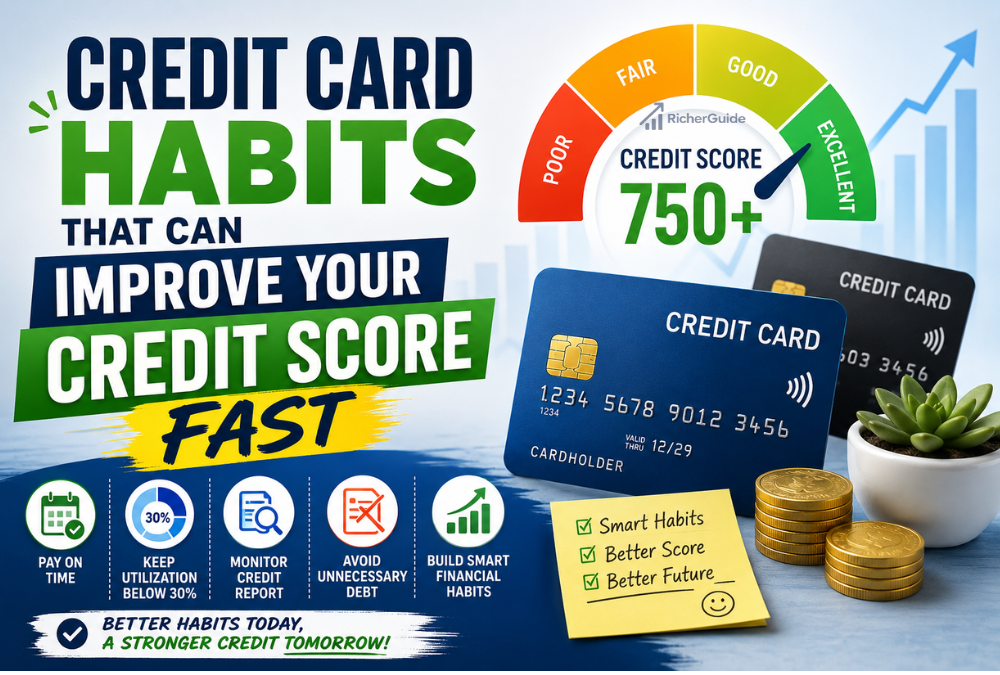
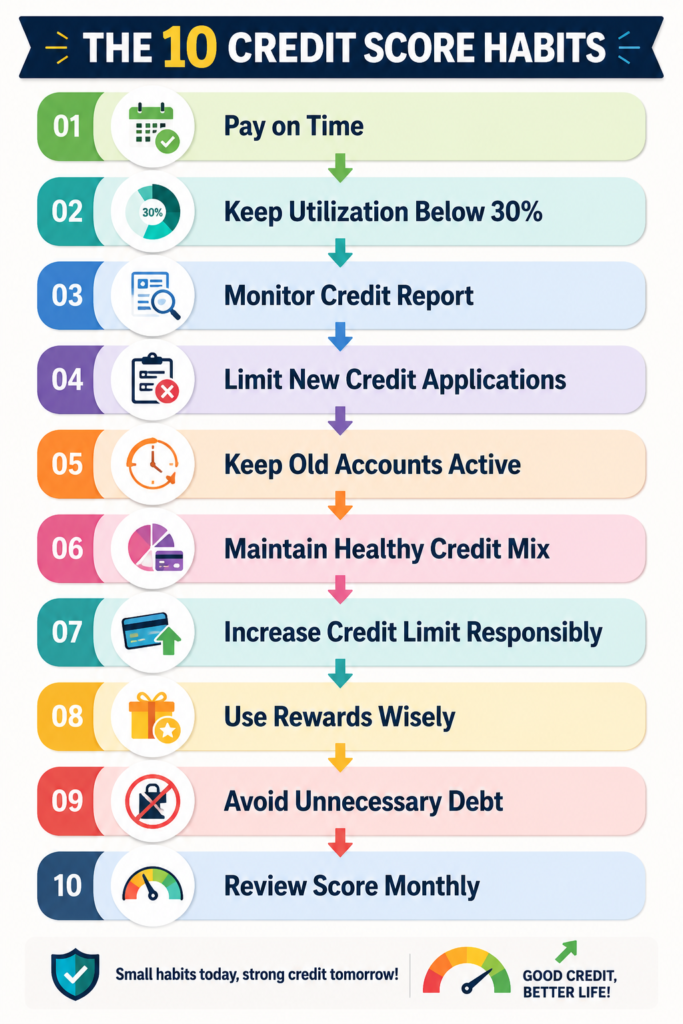
Throughout this guide, we’ve covered 10 powerful credit card habits that can help improve your credit score faster:
- Pay your credit card bill on time.
- Keep your credit utilization below 30%.
- Pay the full outstanding amount whenever possible.
- Keep your old credit cards active.
- Limit new credit card applications.
- Monitor your credit report regularly.
- Avoid cash withdrawals using your credit card.
- Maintain a healthy mix of credit.
- Increase your credit limit responsibly.
- Use reward programs wisely without overspending.
While no one can guarantee an instant increase in your credit score, following these habits consistently can strengthen your credit profile over time. A better credit score can improve your chances of getting loan approvals, lower interest rates, higher credit limits, and access to premium credit cards with attractive rewards and benefits.
Remember, your credit card is a financial tool not free money. Use it responsibly, spend within your means, pay your bills on time, and review your credit report regularly. Small, disciplined actions today can lead to significant financial opportunities in the future.
Whether you’re building your first credit score or working to improve an existing one, every positive financial habit brings you one step closer to achieving your long-term financial goals.
Start with one habit today, stay consistent, and let your credit score grow stronger month after month.
Frequently Asked Questions (Quick Recap)
Before you leave, here’s a quick reminder of the most important points:
- ✔ Always pay your credit card bill before the due date.
- ✔ Keep your credit utilization below 30%.
- ✔ Avoid paying only the minimum due whenever possible.
- ✔ Don’t close your oldest credit card without careful consideration.
- ✔ Apply for new credit only when necessary.
- ✔ Check your credit report at least once or twice a year.
- ✔ Avoid cash withdrawals using your credit card.
- ✔ Build a balanced credit portfolio over time.
- ✔ Request a credit limit increase only if you can manage it responsibly.
- ✔ Use reward points to save money not as an excuse to overspend.
Following these simple habits consistently can help you build a strong credit history and improve your financial future.
Disclaimer
The information provided in this article is for educational and informational purposes only and should not be considered financial, legal, tax, or investment advice. Credit card features, interest rates, annual fees, reward programs, eligibility criteria, and lending policies may vary between banks and financial institutions and are subject to change without prior notice.
Credit scores are calculated using multiple factors, including payment history, credit utilization, credit age, credit mix, and recent credit inquiries. The impact of the habits discussed in this article may vary depending on your individual financial situation and the credit scoring model used by credit bureaus.
Before applying for any credit card or financial product, carefully review the official terms and conditions provided by the issuing bank. If you are unsure about your financial decisions, consult a qualified financial advisor or credit counselor.
Some links on RicherGuide.com may be affiliate links. This means we may earn a small commission if you apply for or purchase a product through those links, at no additional cost to you. These commissions help us maintain the website and continue creating free, high-quality financial education content. However, our reviews and recommendations are based on independent research, practical analysis, and a commitment to providing unbiased information.
While every effort has been made to ensure the accuracy of the information at the time of publication, RicherGuide.com does not guarantee the completeness, accuracy, or suitability of the content for any specific purpose. Readers are encouraged to verify the latest information directly with the respective bank, financial institution, or official credit bureau before making financial decisions.
Enjoyed this guide? Make sure you’ve read the entire series to get the full picture of building and maintaining an excellent credit score:
✅ Part 1: Credit Card Habits That Can Improve Your Credit Score Fast (Part 1)
✅ Part 2: Credit Card Habits That Can Improve Your Credit Score Fast (Part 2)
✅ Part 3: You’re reading it now!
Reading all three parts will help you develop smarter credit habits, avoid costly mistakes, and improve your chances of loan approvals, lower interest rates, and long-term financial success.