Continue reading from Part 1
Introduction
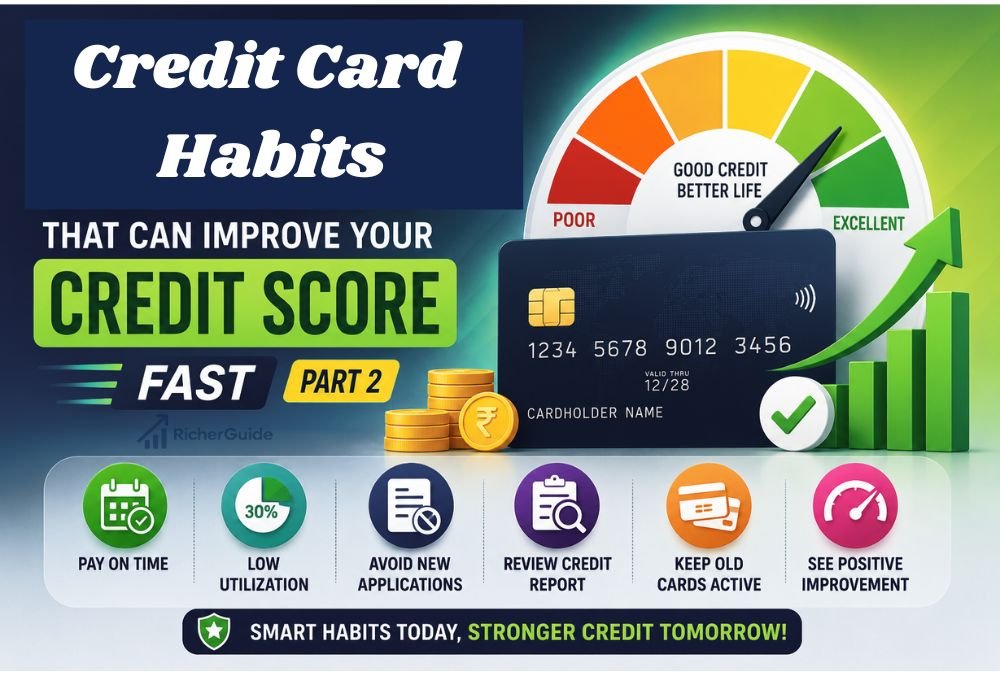
Welcome to Part 2 of our comprehensive guide on “Credit Card Habits That Can Improve Your Credit Score Fast.”
In Part 1, we covered the first five essential habits that lay the foundation for a healthy credit score. You learned why paying your credit card bills on time, keeping your credit utilization below 30%, paying your full outstanding balance, maintaining your oldest credit cards, and limiting unnecessary credit card applications are crucial for building a strong credit profile.
If you haven’t read Part 1 yet, we highly recommend starting there before continuing with this guide, as it covers the fundamental practices every credit card user should know.
Now, it’s time to explore the next five powerful habits that can take your credit management to the next level. These strategies focus on monitoring your credit health, avoiding costly mistakes, managing different types of credit responsibly, increasing your available credit wisely, and maximizing credit card rewards without falling into the trap of overspending.
By the end of this article, you’ll also find practical credit score calculators, easy-to-understand examples, answers to frequently asked questions, and expert recommendations to help you make smarter financial decisions.
Remember, improving your credit score isn’t about finding a shortcut it’s about building consistent financial habits that create long-term success. Let’s continue your journey toward a stronger credit profile and greater financial confidence with the final five credit card habits every cardholder should follow.
Table of Contents
Habit 4: Keep Your Old Credit Cards Active
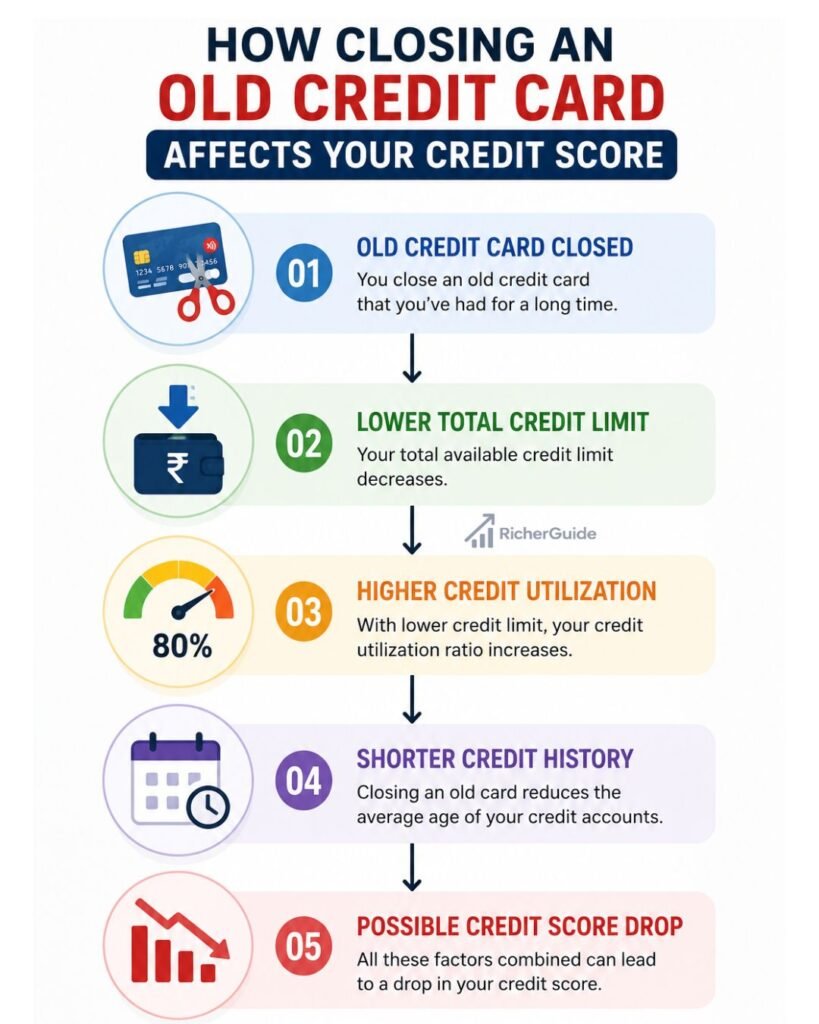
Many people believe closing an old credit card is a smart way to simplify their finances. While this may seem logical, it can actually lower your credit score if not done carefully.
Your oldest credit card contributes to the length of your credit history, which is an important factor in your credit score. A longer and well-managed credit history shows lenders that you’ve handled credit responsibly over time.
If you close your oldest credit card, especially one with no annual fee, you may reduce the average age of your credit accounts and lower your total available credit limit. This can increase your credit utilization ratio and negatively affect your score.
Why Keeping Old Cards Matters
Your old credit cards help by:
- Increasing the average age of your credit history
- Maintaining a higher total credit limit
- Reducing your credit utilization ratio
- Demonstrating long-term responsible credit management
Think of your oldest credit card as your financial resume. The longer your positive credit history, the stronger your profile appears to lenders.
Example
Scenario 1: Closing the Old Card
Amit has:
| Card | Credit Limit | Age |
|---|---|---|
| Card A | ₹2,00,000 | 8 Years |
| Card B | ₹1,00,000 | 2 Years |
Total Credit Limit = ₹3,00,000
Monthly Spending = ₹60,000
Utilization = 20%
Amit closes Card A because he rarely uses it.
New Credit Limit = ₹1,00,000
Utilization becomes:
₹60,000 ÷ ₹1,00,000 = 60%
Although his spending didn’t increase, his utilization ratio tripled, which could negatively affect his credit score.
Scenario 2: Keeping the Card Active
Instead of closing Card A, Amit uses it once every two or three months for a small purchase like:
- Grocery shopping
- Mobile recharge
- OTT subscription
- Fuel purchase
He pays the bill in full every month, keeping the account active and preserving his long credit history.
Tips to Keep Old Cards Active
✔ Use the card for a small purchase every few months.
✔ Enable automatic bill payment.
✔ Avoid closing lifetime free credit cards.
✔ Update your contact information to avoid missing important notifications.
✔ Store the card safely if you don’t use it regularly.
When Should You Close a Credit Card?
Closing a credit card may be reasonable if:
- The annual fee is very high and the benefits no longer justify the cost.
- The card has poor security features.
- You’re unable to manage multiple cards responsibly.
- The issuer discontinues the card.
Before closing any card, consider the potential impact on your credit history and utilization ratio.
Common Mistakes
❌ Closing your oldest card first.
❌ Closing multiple cards at the same time.
❌ Not checking your credit score before closing an account.
❌ Ignoring how reduced credit limits affect utilization.
Quick Tip
If your oldest credit card has no annual fee, keeping it open is often a smart long-term strategy.
Habit 5: Limit New Credit Card Applications
Every time you apply for a new credit card, the lender usually performs a hard inquiry on your credit report.
One or two applications over time are normal. However, applying for several cards within a short period may signal financial stress or a higher dependence on credit.
Lenders may view frequent applications as risky behavior.
Why Too Many Applications Can Hurt
Multiple credit card applications can:
- Lower your credit score temporarily
- Increase the number of hard inquiries
- Reduce your average credit history
- Raise concerns among lenders
If your applications are repeatedly rejected, future lenders may become even more cautious.
Example
Riya’s Situation
Riya wanted to maximize welcome bonuses.
Within one month, she applied for:
- Cashback Card
- Travel Card
- Shopping Card
- Fuel Card
- Premium Rewards Card
Although she was approved for some cards, the multiple hard inquiries and new accounts temporarily reduced her credit score.
A better approach would have been to space out applications over several months and apply only for cards that matched her financial needs.
Best Practices Before Applying
Ask yourself:
- Do I really need another credit card?
- Will I use its benefits regularly?
- Can I manage another payment due date?
- Does this card suit my spending habits?
If the answer is “No,” it may be better to wait.
Recommended Waiting Period
| Situation | Suggested Waiting Time |
|---|---|
| New Credit Card | 6–12 Months |
| Personal Loan | 6 Months |
| Home Loan | Avoid unnecessary applications beforehand |
| Car Loan | Keep inquiries minimal |
Smart Application Strategy
Instead of applying for every new offer:
✔ Compare benefits carefully.
✔ Choose cards that match your lifestyle.
✔ Check eligibility before applying.
✔ Read the terms and conditions.
✔ Apply only when necessary.
Common Mistakes
❌ Applying for every advertised offer.
❌ Applying through multiple banks on the same day.
❌ Ignoring eligibility criteria.
❌ Chasing welcome bonuses without a long-term plan.
Quick Tip
Quality is better than quantity. Two well-managed credit cards are often more valuable than five poorly managed ones.
Real-Life Success Stories
Real examples can help illustrate how consistent habits improve credit health.
Story 1: From 650 to 785
Name: Rahul
Profession: Software Engineer
Rahul frequently missed payment due dates and used almost his entire credit limit.
He made three changes:
- Enabled automatic payments.
- Kept utilization below 25%.
- Stopped applying for unnecessary credit cards.
After about 10 months, his credit score improved from 650 to 785, helping him qualify for a lower-interest home loan.
Story 2: A Small Change, Big Impact
Name: Neha
Neha had only one credit card with a ₹1,00,000 limit.
She regularly used ₹90,000 each month but always paid the full balance.
Although she never missed a payment, her high utilization affected her score.
She requested a credit limit increase to ₹2,00,000.
Without increasing her spending, her utilization dropped to 45%, and her credit score gradually improved over the following months.
Story 3: Avoiding Multiple Applications
Name: Karan
Karan wanted a premium travel credit card but applied for four different cards within two weeks.
Two applications were rejected.
After learning about hard inquiries, he waited several months before applying again. By improving his existing credit habits, he was later approved for a premium card with a better credit limit.
Monthly Credit Card Habit Tracker
Use this checklist every month to stay on top of your credit health.
| Habit | Week 1 | Week 2 | Week 3 | Week 4 |
|---|---|---|---|---|
| Checked Statement | □ | □ | □ | □ |
| Paid Full Bill | □ | □ | □ | □ |
| Utilization Below 30% | □ | □ | □ | □ |
| Monitored Transactions | □ | □ | □ | □ |
| Reviewed Reward Points | □ | □ | □ | □ |
| Verified Due Date | □ | □ | □ | □ |
| Reported Suspicious Activity | □ | □ | □ | □ |
| Reviewed Credit Report | □ | □ | □ | □ |
Pro Tip: Print this tracker or save it digitally and review it monthly.
Monthly Credit Score Improvement Checklist
| Task | Status |
|---|---|
| Paid before due date | □ |
| Paid full outstanding amount | □ |
| Utilization below 30% | □ |
| No unnecessary purchases | □ |
| No new credit applications | □ |
| Reward points reviewed | □ |
| Statement checked | □ |
| Credit report reviewed | □ |
| Budget updated | □ |
| Emergency fund maintained | □ |
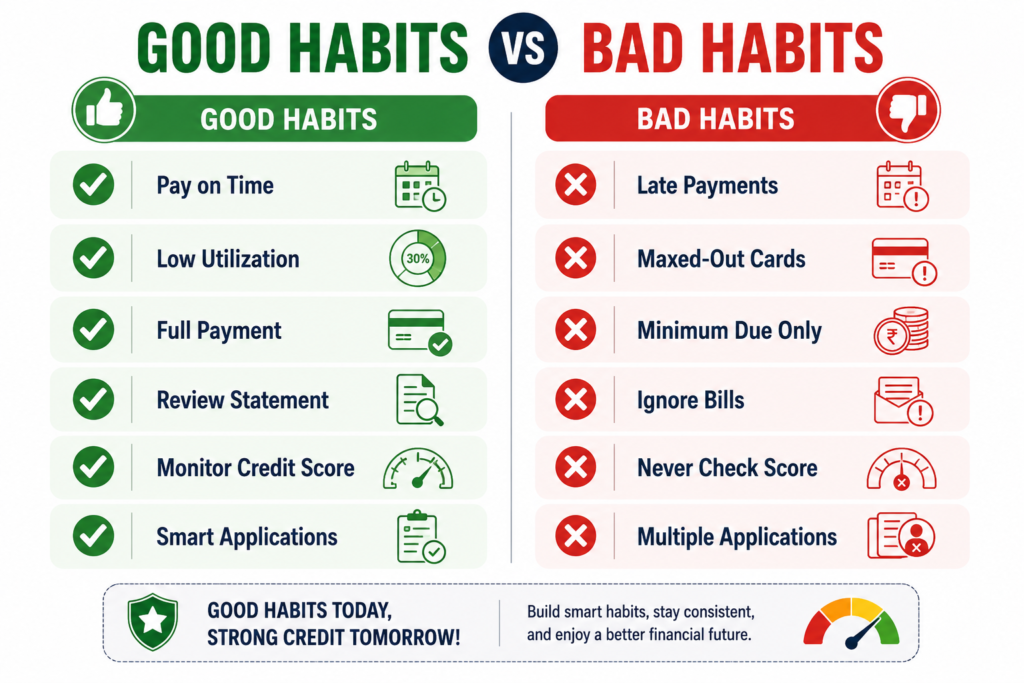
Credit Card Habits Comparison Table
| Good Habits | Bad Habits |
|---|---|
| Paying on time | Missing due dates |
| Paying full balance | Paying only the minimum due |
| Keeping utilization below 30% | Maxing out the credit limit |
| Reviewing statements | Ignoring transactions |
| Monitoring credit score | Never checking credit reports |
| Applying only when needed | Frequent credit applications |
| Keeping old cards active | Closing old cards unnecessarily |
| Using rewards wisely | Overspending for rewards |
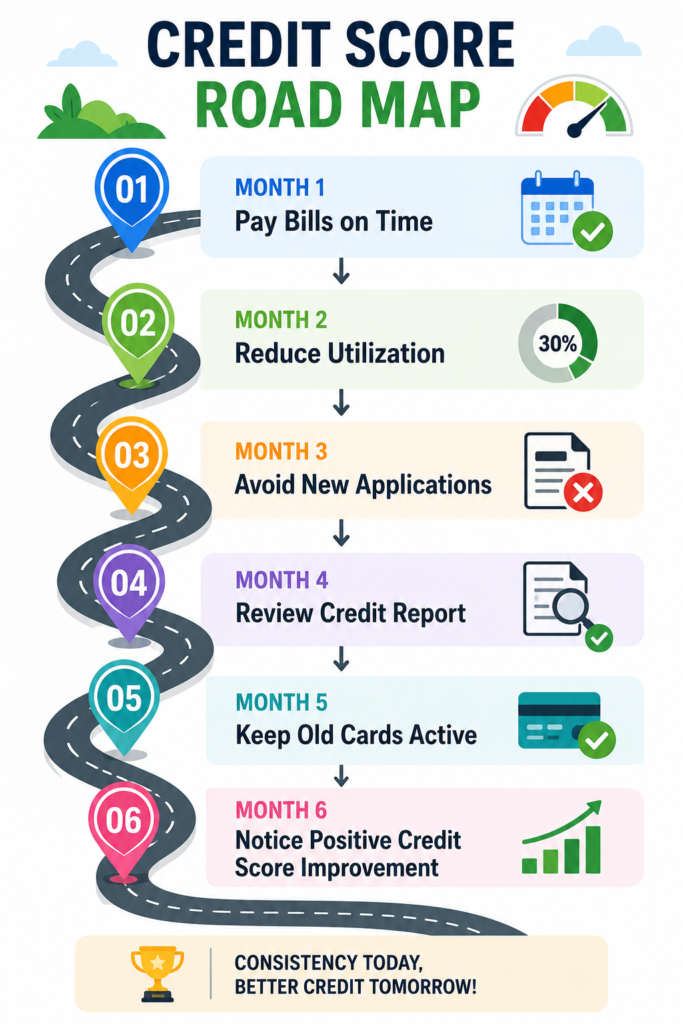
Simple Monthly Credit Score Roadmap
Habit 6: Monitor Your Credit Report Regularly
Your credit report is like a financial report card—it shows how you’ve managed your credit over time. Many people check their credit score only when applying for a loan or credit card, but reviewing your credit report regularly can help you identify errors, detect fraud, and track your progress toward a better credit score.
Even a small mistake, such as an incorrectly reported late payment or an account that doesn’t belong to you, can negatively affect your credit score. By checking your credit report periodically, you can spot these issues early and request corrections before they impact your ability to borrow.
Regular monitoring also helps you understand how your financial habits influence your credit score. If your score drops unexpectedly, your credit report can often reveal the reason, allowing you to take corrective action quickly.
Why It Matters
Monitoring your credit report helps you:
- Detect incorrect personal or account information.
- Identify fraudulent transactions or unauthorized accounts.
- Track improvements in your credit score over time.
- Ensure your payment history is reported accurately.
- Prepare for future loan or credit card applications.
Example
Anjali was planning to apply for a home loan and decided to review her credit report beforehand. She noticed that one of her old credit card accounts was incorrectly marked as having missed several payments, even though she had always paid on time.
She immediately contacted the lender and the credit bureau, submitted proof of her payments, and had the error corrected. Within a few weeks, her credit score improved, increasing her chances of securing a home loan at a better interest rate.
Had Anjali waited until after applying for the loan, the error could have delayed or even affected her loan approval.
Best Practices
- Check your credit report at least once or twice a year.
- Verify your personal details and account information.
- Review your payment history carefully.
- Report any errors or suspicious activity immediately.
- Keep copies of important financial documents for future reference.
Common Mistakes
❌ Never checking your credit report.
❌ Ignoring unexpected changes in your credit score.
❌ Assuming all information reported by lenders is accurate.
❌ Waiting until you need a loan to review your credit report.
Pro Tip: Make it a habit to review your credit report regularly. A few minutes of checking can help you avoid costly mistakes and protect your financial reputation.
Habit 7: Avoid Cash Withdrawals Using Credit Cards
Using your credit card to withdraw cash from an ATM, also known as a cash advance, should generally be avoided unless it’s a genuine emergency. Unlike regular purchases, cash advances often start accruing interest immediately, without the interest-free period that most credit card purchases enjoy.
In addition to higher interest rates, banks typically charge a cash advance fee, making this one of the most expensive ways to borrow money. Frequent cash withdrawals may also signal financial stress to lenders, which could indirectly affect how your credit profile is viewed.
If you need cash, it’s usually more cost-effective to use your debit card or explore other financing options rather than relying on a credit card cash advance.
Why It Matters
Avoiding cash withdrawals can help you:
- Save on high interest charges.
- Avoid cash advance fees.
- Maintain healthier credit card usage.
- Reduce unnecessary debt.
- Build a stronger financial profile.
Example
Rohit urgently needed ₹20,000 and used his credit card to withdraw cash from an ATM.
As a result:
- He was charged a cash withdrawal fee.
- Interest started accumulating from the day of the withdrawal.
- His outstanding balance increased quickly because there was no interest-free period.
If Rohit had used his emergency savings or withdrawn money from his bank account instead, he could have avoided these additional costs.
Best Practices
- Use a debit card for cash withdrawals whenever possible.
- Maintain an emergency fund for unexpected expenses.
- Reserve credit card cash advances only for genuine emergencies.
- Read your credit card’s cash advance terms and charges carefully.
Common Mistakes
❌ Using credit cards to withdraw cash for routine expenses.
❌ Assuming cash withdrawals receive the same interest-free period as purchases.
❌ Ignoring cash advance fees and higher interest rates.
❌ Depending on cash advances because of poor budgeting.
Pro Tip: Your credit card is designed primarily for purchases not cash withdrawals. Avoiding cash advances can save you significant interest charges and help you maintain better financial discipline.
Conclusion
Your credit score is not built overnight, and it isn’t determined by a single financial decision. Instead, it reflects the habits you practice every month. The good news is that improving your credit score doesn’t require complex strategies or a high income it simply requires consistency and responsible credit card usage.
While no one can guarantee an instant increase in your credit score, following these habits consistently can strengthen your credit profile over time. A better credit score can improve your chances of getting loan approvals, lower interest rates, higher credit limits, and access to premium credit cards with attractive rewards and benefits.
Remember, your credit card is a financial tool not free money. Use it responsibly, spend within your means, pay your bills on time, and review your credit report regularly. Small, disciplined actions today can lead to significant financial opportunities in the future.
Whether you’re building your first credit score or working to improve an existing one, every positive financial habit brings you one step closer to achieving your long-term financial goals.
Start with one habit today, stay consistent, and let your credit score grow stronger month after month.
Frequently Asked Questions (Quick Recap)
Before you leave, here’s a quick reminder of the most important points:
- ✔ Always pay your credit card bill before the due date.
- ✔ Keep your credit utilization below 30%.
- ✔ Avoid paying only the minimum due whenever possible.
- ✔ Don’t close your oldest credit card without careful consideration.
- ✔ Apply for new credit only when necessary.
- ✔ Check your credit report at least once or twice a year.
- ✔ Avoid cash withdrawals using your credit card.
- ✔ Build a balanced credit portfolio over time.
- ✔ Request a credit limit increase only if you can manage it responsibly.
- ✔ Use reward points to save money not as an excuse to overspend.
Following these simple habits consistently can help you build a strong credit history and improve your financial future.
Disclaimer
The information provided in this article is for educational and informational purposes only and should not be considered financial, legal, tax, or investment advice. Credit card features, interest rates, annual fees, reward programs, eligibility criteria, and lending policies may vary between banks and financial institutions and are subject to change without prior notice.
Credit scores are calculated using multiple factors, including payment history, credit utilization, credit age, credit mix, and recent credit inquiries. The impact of the habits discussed in this article may vary depending on your individual financial situation and the credit scoring model used by credit bureaus.
Before applying for any credit card or financial product, carefully review the official terms and conditions provided by the issuing bank. If you are unsure about your financial decisions, consult a qualified financial advisor or credit counselor.
Some links on RicherGuide.com may be affiliate links. This means we may earn a small commission if you apply for or purchase a product through those links, at no additional cost to you. These commissions help us maintain the website and continue creating free, high-quality financial education content. However, our reviews and recommendations are based on independent research, practical analysis, and a commitment to providing unbiased information.
While every effort has been made to ensure the accuracy of the information at the time of publication, RicherGuide.com does not guarantee the completeness, accuracy, or suitability of the content for any specific purpose. Readers are encouraged to verify the latest information directly with the respective bank, financial institution, or official credit bureau before making financial decisions.