Introduction
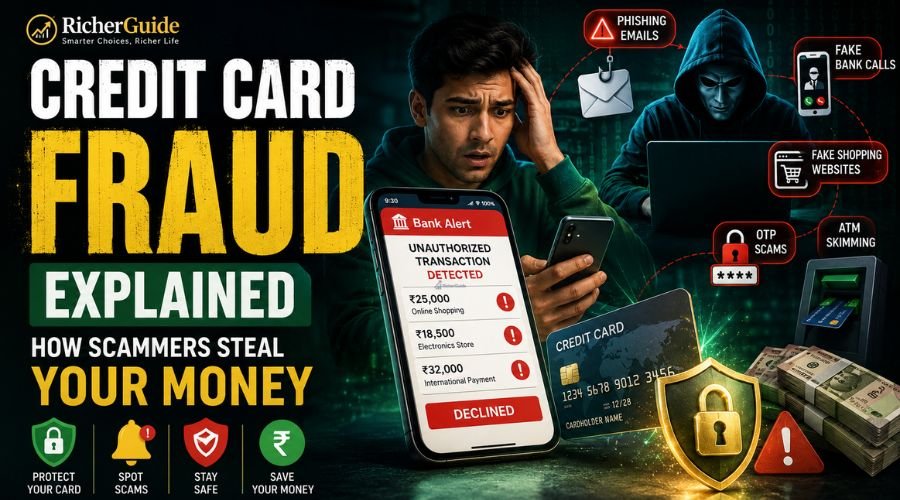
Credit Card Fraud is becoming a serious financial risk as more Indians use credit cards for online shopping, travel bookings, food delivery, subscriptions, EMIs, and everyday payments. Scammers are becoming smarter and can steal card information through fake bank calls, phishing emails, fraudulent websites, fake reward offers, ATM skimming, SIM swap scams, and social engineering.
Imagine receiving a message saying that ₹25,000 has been spent using your credit card even though your card is safely in your wallet. You may immediately wonder: How did the scammer get my card details? Can I get my money back? What should I do first?
The good news is that understanding how credit card scams work can help you avoid becoming a victim. In many cases, scammers do not need your physical card. They may only need your card number, expiry date, CVV, or access to an OTP. A single careless click or an unverified phone call can expose sensitive information.
In this guide, RicherGuide explains how credit card fraud works, how scammers steal your money, the most common credit card scams in India, warning signs to watch for, and practical ways to protect yourself. You will also learn what to do immediately if you notice an unauthorized transaction and where to report financial fraud.
Whether you are a first-time credit card user or have been using credit cards for years, this guide will help you understand the risks and use your credit card more safely.
Table of Contents
The Problem: Why Credit Card Fraud Is Rising
India is rapidly becoming a digital-first economy. Millions of people use credit cards every day for:
- Online shopping
- Food delivery
- Flight and hotel bookings
- UPI-linked credit card payments
- EMI purchases
- Subscription services
While these services are convenient, they also create opportunities for cybercriminals.
Some major reasons why fraud is increasing include:
| Reason | Impact |
|---|---|
| More online shopping | More opportunities for phishing and fake websites |
| Contactless cards | Faster transactions if card is stolen |
| Data breaches | Card details leaked online |
| Social engineering | Users reveal OTPs and CVVs |
| Fake customer care numbers | Victims unknowingly share confidential information |
| Public Wi-Fi usage | Hackers intercept sensitive data |
| Low awareness | Many people don’t recognize scam tactics |
Credit Card Fraud in India at a Glance
| Type | Risk Level |
|---|---|
| Card Skimming | High |
| OTP Scam | Very High |
| Phishing Email | High |
| Fake Shopping Website | High |
| Card Cloning | Medium |
| Lost/Stolen Card | Medium |
| SIM Swap | High |
| Malware Attack | High |
What is Credit Card Fraud?
Credit card fraud is any unauthorized use of your credit card or card details to make purchases, withdraw money, or gain financial benefits without your permission.
The scammer may steal:
- Card number
- Expiry date
- CVV
- OTP
- PIN
- Internet banking credentials
- Mobile banking access
Once they have enough information, they can use your card for online purchases, cash withdrawals (if PIN is compromised), or sell your card details on illegal marketplaces.
Simply put:
Credit card fraud occurs when someone uses your card or card information without your authorization to steal money or make purchases.
Types of Credit Card Fraud
Understanding the different types of fraud can help you identify risks before it’s too late.
| Fraud Type | Description |
|---|---|
| Card Skimming | Card details copied using a hidden device at ATMs or POS machines |
| Card Cloning | Duplicate card created using stolen data |
| Phishing | Fake emails or websites steal your card details |
| Vishing | Fraudsters call pretending to be bank officials |
| Smishing | Fake SMS messages ask for OTPs or card details |
| Fake Shopping Sites | Users enter card details on fraudulent websites |
| SIM Swap | Fraudsters take control of your mobile number to receive OTPs |
| Data Breach | Card details leaked from compromised merchants or services |
| Contactless Fraud | Unauthorized tap-and-pay transactions with a stolen card |
| Malware | Malicious software steals saved card information from devices |
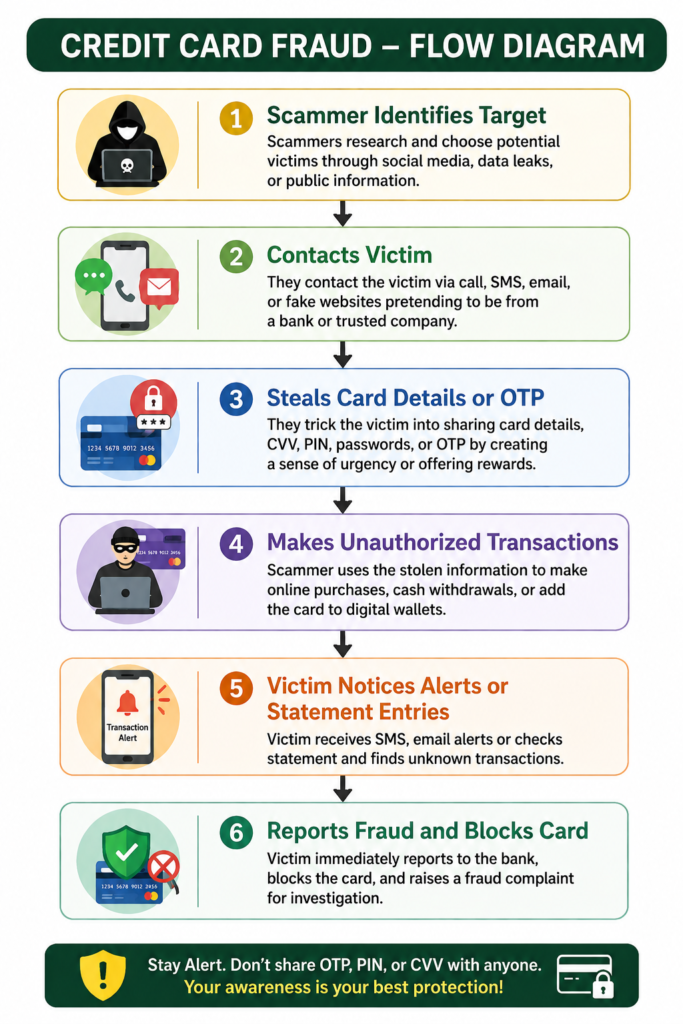
How Credit Card Fraud Works (Step-by-Step)
Step 1 – The Scammer Targets Victims
Scammers may contact you through:
- Fake bank calls
- SMS
- Telegram
- Fake websites
- Search engine ads
Their goal is to gain your trust or trick you into revealing sensitive information.
Step 2 – They Collect Your Information
The scammer attempts to obtain:
- Card number
- CVV
- Expiry date
- OTP
- PIN
- Net banking credentials
- Personal information
Common tactics include fake KYC updates, reward redemption offers, account verification requests, or urgent security alerts.
Step 3 – They Use or Sell the Data
Once they have your information, they may:
- Make unauthorized online purchases
- Add your card to a digital wallet
- Withdraw cash (if they have the PIN)
- Purchase gift cards
- Transfer funds through payment gateways
- Sell your card details on illegal forums
Step 4 – You Discover the Fraud
Many victims realize something is wrong only after receiving transaction alerts, checking their credit card statement, or noticing a sudden drop in their available credit limit.
Real-Life Scenario
Rahul’s Story
Rahul received a call from someone claiming to be from his bank. The caller said Rahul’s credit card would be blocked unless he completed a KYC verification immediately.
The caller already knew Rahul’s name and the last four digits of his card, making the call seem genuine. Rahul was asked to share the OTP sent to his phone.
Within minutes, several online transactions worth ₹48,000 were made using his credit card.
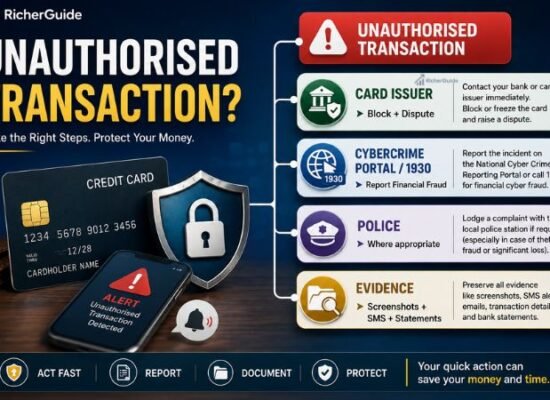
Rahul contacted his bank immediately, blocked the card, and reported the fraud to the National Cyber Crime Portal. Because he acted quickly, the bank was able to stop some pending transactions and begin the dispute process.
Common Credit Card Fraud Methods Used by Scammers
Understanding these scams is the best way to protect yourself. Let’s look at the most common frauds affecting Indian credit card users.
1. Card Skimming Scam
What is Card Skimming?
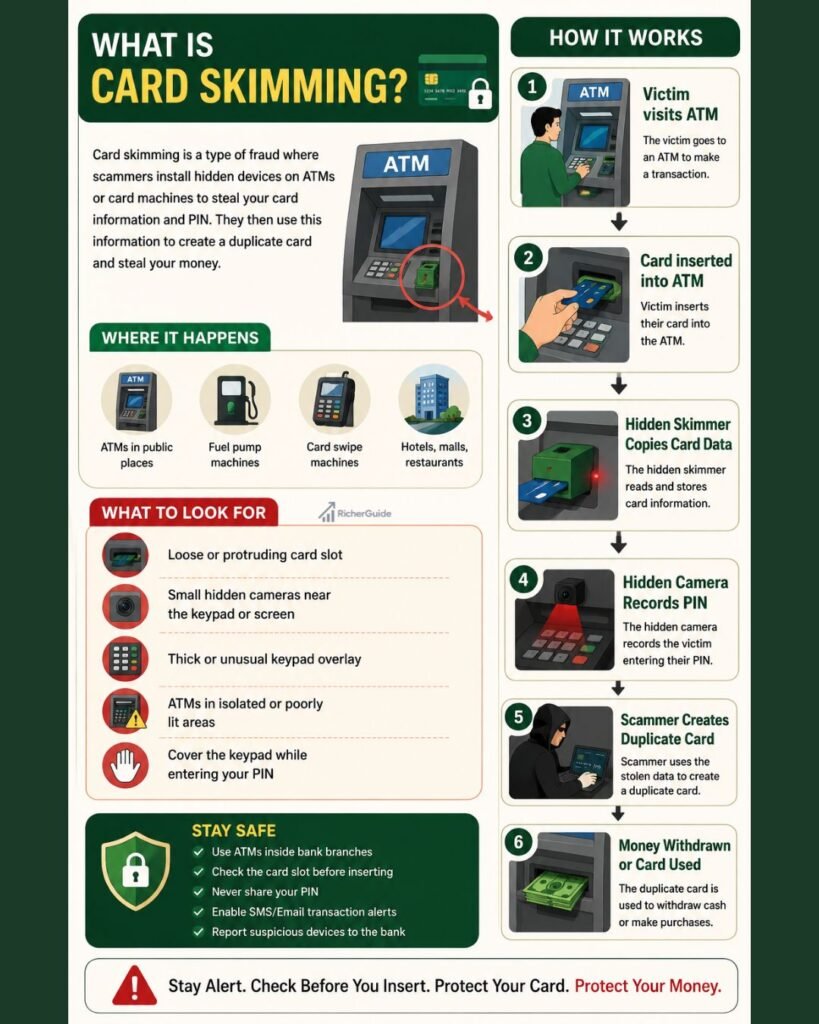
Card skimming happens when criminals secretly install a small device on an ATM or card swipe machine. This device copies your card’s magnetic stripe data.
Sometimes, they also install a hidden camera or fake keypad to capture your PIN.
Warning Signs
✅ Loose card slot
✅ Extra attachment on ATM
✅ Hidden camera
✅ Thick keypad
✅ ATM in isolated area
Protection Tips
- Use ATMs inside bank branches.
- Cover the keypad while entering your PIN.
- Pull the card slot gently before inserting your card.
- Enable instant transaction alerts.
- Prefer chip-enabled transactions.
2. Credit Card Phishing Scam
Phishing is one of the biggest online frauds.
Scammers send fake emails pretending to be:
- Your bank
- Amazon
- Flipkart
- Income Tax Department
- RBI
- Credit card company
The email asks you to click a link and “verify” your account.
Once you enter your card details, scammers steal them instantly.
Example
Fake Email
Dear Customer,
Your Credit Card has been suspended.
Click here to reactivate.
The website looks exactly like your bank.
But it is fake.
Red Flags
❌ Spelling mistakes
❌ Urgent language
❌ Unknown sender
❌ Suspicious links
❌ Asking for OTP
3. Vishing (Fake Bank Call)
Vishing means Voice Phishing.
Scammers call pretending to be:
- SBI
- HDFC Bank
- ICICI Bank
- Axis Bank
- RBI
- Visa
- Mastercard
They say:
- KYC expired
- Card blocked
- Reward points expiring
- Credit limit increase
- EMI cancellation
Then they ask for:
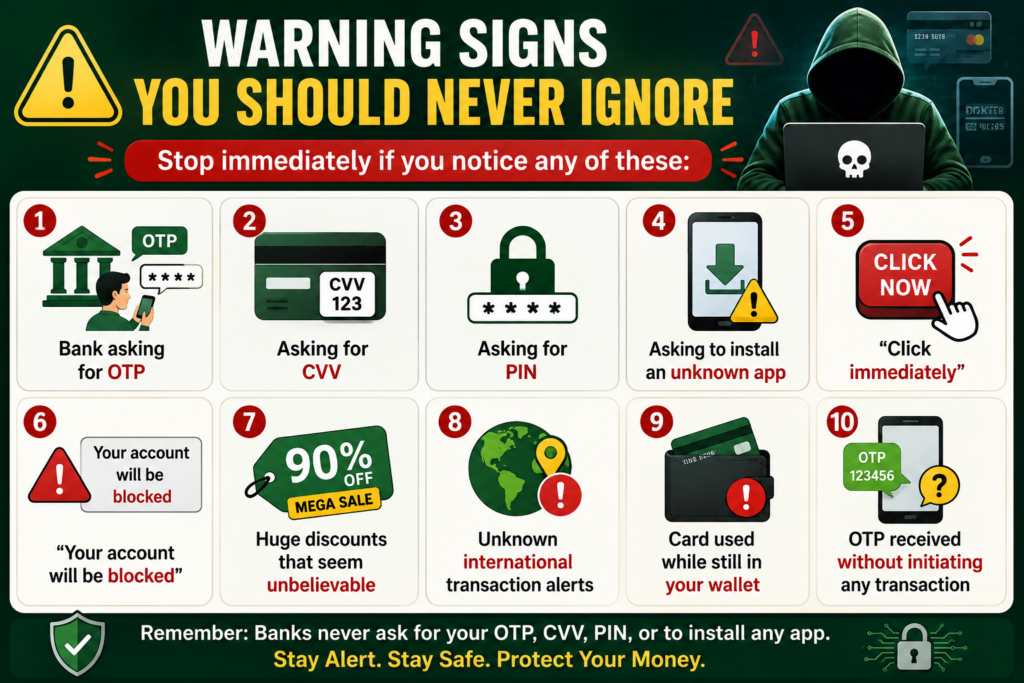
- OTP
- CVV
- Card Number
- PIN
Banks NEVER ask for these.
Example
Caller:
“Sir, I am calling from your bank.
Please tell me the OTP to verify your identity.”
Within minutes your credit card is used online.
4. Smishing Scam (SMS Fraud)
Scammers send fake SMS like:
Your card will be blocked.
Click here.
The link opens a fake banking website.
Victims unknowingly enter:
- Card Number
- CVV
- OTP
Money disappears within minutes.
5. Fake Shopping Website Scam
This scam has increased dramatically.
Scammers create fake versions of:
- Amazon
- Myntra
- Nike
- Apple
- Electronics stores
They advertise huge discounts:
- 90% OFF
- Flash Sale
- Clearance Sale
People enter card details.
Either:
- Money is stolen
OR
- Product never arrives.
How to Identify Fake Websites
| Genuine Website | Fake Website |
|---|---|
| HTTPS | No HTTPS |
| Correct domain | Misspelled domain |
| Customer support | No contact info |
| Reviews available | No reviews |
| Secure payment | Direct card entry |
6. Card Not Present (CNP) Fraud
This happens during online shopping.
The scammer only needs:
- Card Number
- Expiry Date
- CVV
No physical card is required.
This is one of the fastest-growing frauds worldwide.
7. SIM Swap Fraud
This is a dangerous scam.
Step-by-Step
- Scammer gets your mobile number.
- Obtains personal information through phishing or social engineering.
- Requests a replacement SIM from your mobile operator using forged details.
- Your original SIM stops working.
- OTPs now go to the scammer’s SIM.
- They use OTPs to access your accounts and make unauthorized transactions.
Warning Signs
- No network suddenly
- SIM inactive
- Unable to receive OTP
- Calls not working
Contact your telecom operator immediately if this happens unexpectedly.
8. Contactless Payment Fraud
Tap-and-pay cards allow transactions without inserting the card.
If your card is lost or stolen, someone may make small contactless purchases before you notice.
Prevention
✔ Lock card immediately
✔ Enable transaction alerts
✔ Set lower tap-and-pay limits if available
✔ Turn off contactless payments when not needed through your banking app (if supported)
9. Public Wi-Fi Fraud
Never make credit card payments on:
- Railway Wi-Fi
- Airport free Wi-Fi
- Mall Wi-Fi
- Cafe Wi-Fi
Hackers may intercept unprotected network traffic or trick users into connecting to fake hotspots.
10. Malware Attack
Some apps secretly install malware.
The malware can:
- Record keystrokes
- Capture screenshots
- Steal saved passwords
- Access stored card details
Only download apps from trusted sources such as the Google Play Store or Apple App Store.
Comparison Table of Major Credit Card Frauds
| Scam | Risk | Main Target |
|---|---|---|
| Skimming | ⭐⭐⭐⭐⭐ | ATM Users |
| Phishing | ⭐⭐⭐⭐⭐ | Online Users |
| Fake Call | ⭐⭐⭐⭐⭐ | Everyone |
| Fake SMS | ⭐⭐⭐⭐ | Mobile Users |
| Fake Shopping Site | ⭐⭐⭐⭐ | Online Shoppers |
| SIM Swap | ⭐⭐⭐⭐⭐ | Banking Customers |
| Malware | ⭐⭐⭐⭐ | Smartphone Users |
| Contactless Theft | ⭐⭐⭐ | Lost Card Holders |
Credit Card Safety Checklist
| Safety Tip | Status |
|---|---|
| Enable SMS Alerts | ✅ |
| Enable Email Alerts | ✅ |
| Use Strong Banking Password | ✅ |
| Enable App Lock | ✅ |
| Never Share OTP | ✅ |
| Never Share CVV | ✅ |
| Use Secure Websites | ✅ |
| Check Statements Monthly | ✅ |
| Lock Card When Not in Use | ✅ |
| Keep Bank Contact Numbers Handy | ✅ |
Monthly Credit Card Security Self-Check
Use this simple checklist once a month:
| Question | Yes | No |
|---|---|---|
| Reviewed recent transactions? | ☐ | ☐ |
| Verified no unknown subscriptions? | ☐ | ☐ |
| Updated banking app? | ☐ | ☐ |
| Changed banking password recently? | ☐ | ☐ |
| Enabled transaction alerts? | ☐ | ☐ |
| Checked credit card statement? | ☐ | ☐ |
Frequently Asked Questions (FAQs)
1. Can someone use my credit card without an OTP?
Yes. Some international merchants, recurring subscriptions, or card-not-present transactions may not require an OTP, depending on the merchant and payment network.
2. Can a scammer steal money using only my credit card number?
In some cases, yes. If they also obtain your expiry date, CVV, or exploit a merchant that does not require additional authentication, they may attempt unauthorized transactions.
3. Will the bank refund fraudulent transactions?
Banks investigate each case individually. Refunds depend on factors such as how the fraud occurred, whether you reported it promptly, and the applicable RBI guidelines and the bank’s policies.
4. How quickly should I report credit card fraud?
Immediately. Reporting as soon as you notice suspicious activity gives you the best chance of limiting losses and protecting your rights.
5. Can I recover my money?
Many customers recover some or all of their money if the fraud is reported quickly and they have not shared confidential information such as OTPs or PINs. The outcome depends on the investigation.
6. Is it safe to save my credit card on shopping websites?
Only save your card on trusted platforms if you understand the risks. For added security, consider not storing card details and use tokenized payments where available.
7. How do I know if my card has been cloned?
Possible signs include:
- Transactions in places you’ve never visited
- ATM withdrawals you didn’t make
- Purchases made while your physical card is still with you
8. What should I never share?
Never share:
- OTP
- PIN
- CVV
- Full card number
- Net banking password
- Mobile banking login credentials
9. Are contactless cards safe?
Yes, when used responsibly. Keep transaction alerts enabled, report lost cards immediately, and manage contactless settings through your bank if available.
10. What is the safest way to use a credit card online?
- Shop only on trusted websites
- Check for HTTPS
- Avoid public Wi-Fi
- Enable transaction alerts
- Review statements regularly
- Never share OTPs or PINs
Conclusion
Credit card fraud is a growing challenge in India’s digital economy, but it is also largely preventable. By understanding common scam techniques, recognizing warning signs, following safe online practices, and acting quickly if fraud occurs, you can greatly reduce your risk.
Make security a habit, educate your family members, and stay informed about new fraud trends. Responsible credit card usage not only protects your money but also gives you the confidence to enjoy the convenience of digital payments safely.
Disclaimer
The information provided in this article, “Credit Card Fraud Explained How Scammers Steal Your Money,” is for educational and informational purposes only. It is intended to help readers understand common credit card fraud techniques, recognize warning signs, and take basic precautions to protect themselves from financial scams.
While RicherGuide makes reasonable efforts to keep the information accurate and up to date, banking rules, RBI guidelines, card-network policies, reporting procedures, and cybersecurity practices may change over time. Readers should verify the latest information directly with their bank, the Reserve Bank of India (RBI), National Cyber Crime Reporting Portal, or other relevant official authorities before taking action.
RicherGuide does not provide legal, financial, banking, or cybersecurity advice through this article. We do not guarantee that following the suggestions in this article will completely prevent fraud or financial loss.
If you become a victim of credit card fraud, contact your card-issuing bank immediately and report the incident through the appropriate official channels. Do not share your OTP, PIN, CVV, passwords, or other confidential banking information with anyone claiming to represent your bank.