Introduction
Credit Card Lost, Stolen or Misused? Don’t panic, but don’t wait either. A missing credit card can quickly become a financial risk if someone tries to use it for purchases or if your card details have already been compromised. The first few minutes can be important, especially when an Unauthorized transaction has already occurred.
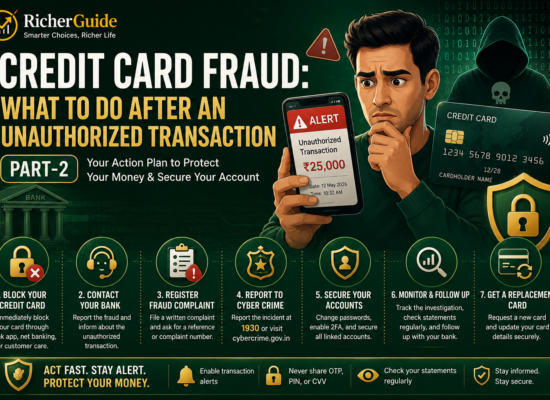
The good news is that you can take several simple steps to protect yourself. Block or freeze the card immediately, check your recent transactions, report any unauthorised payment, save your complaint details, and monitor your account.
In this guide, we will explain exactly what to do if your credit card is lost, stolen or misused, including how to report the incident, when to request a replacement, what evidence to keep, common mistakes to avoid, and how to protect yourself from future credit card fraud.
Whether your card has disappeared from your wallet or you still have the card but notice a transaction you don’t recognise, this Credit Card Masterclass #15 will help you understand the right steps to take.
Table of Contents
Why This Topic Matters
Credit cards are convenient because they allow you to spend first and pay later.
But convenience also creates risk.
Your physical card may be lost, but the bigger danger can be the information associated with the card.
For example, a fraudster may obtain:
- Card number
- Expiry date
- CVV
- OTP through social engineering
- Card credentials stored on compromised websites
- Information through phishing
- Information from a data breach
- Details through a fake customer-care call
Therefore, simply finding your physical card later does not necessarily mean everything is safe.
The most important rule
If your credit card is lost, stolen or misused, report it to the card issuer immediately.
RBI’s financial-awareness guidance specifically advises customers to notify their bank immediately after discovering a fraudulent or unauthorised electronic transaction.
PROBLEM: What Can Happen When Your Card Is Lost or Stolen?
A lost credit card can create several types of risk.
1: Physical card usage
Someone may try to use the card at a merchant.
2: Contactless transactions
Depending on the card and transaction conditions, contactless functionality may create another avenue for misuse.
3: Online transactions
A fraudster who has obtained card details may attempt online purchases.
4: Recurring payments
Your card may already be linked to subscriptions or recurring services.
5: Social engineering
A fraudster may contact you pretending to be:
- Bank employee
- Police officer
- RBI representative
- Card security team
- Customer-care executive
They may say:
“Your card has been compromised. Tell me the OTP to block it.”
This is another scam.
Never share your OTP, PIN, CVV, password or other confidential authentication information with anyone claiming to help you.
SOLUTION: What to Do Immediately If Your Credit Card Is Lost or Stolen
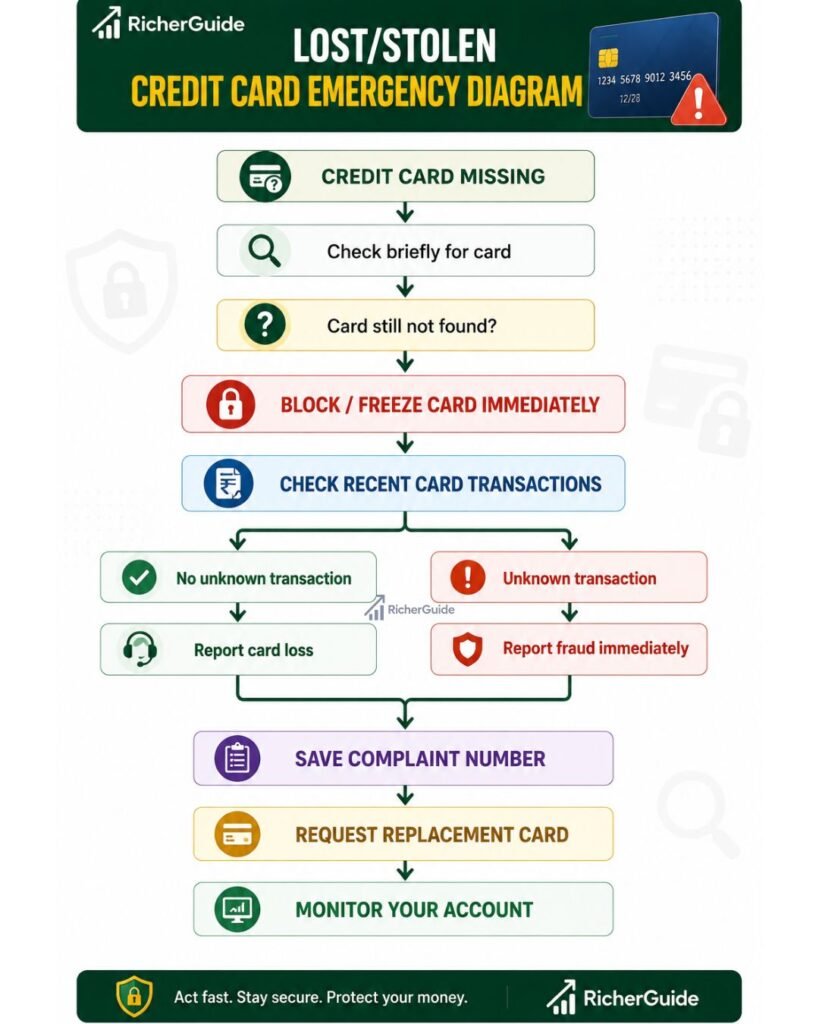
Follow this emergency sequence.
Step 1: Stay Calm
Do not waste time panicking.
Your first objective is to stop further transactions.
Step 2: Block or Freeze the Card
Use your bank’s official:
- Mobile banking app
- Internet banking
- Official customer-care number
- Official bank website
- Branch, if necessary
If your banking app provides a temporary card-lock feature, you can use it immediately.
However, if you believe the card is permanently lost or stolen, follow your issuer’s procedure for reporting it and getting it permanently blocked/replaced.
Important
Do not search for a random customer-care number on Google and call it.
Fraudsters sometimes create fake customer-care websites and phone numbers.
Use the number printed on:
- Your previous card statement
- Official banking app
- Official bank website
- Bank’s verified communication
Step-by-Step Emergency Flow
Check Your Recent Transactions
After blocking the card, immediately review your recent transactions.
Look for:
- Unknown purchases
- Small test transactions
- Online purchases you did not make
- Cash withdrawals, if applicable
- Foreign transactions
- Subscription charges
- Wallet transactions
- Merchant names you do not recognise
Don’t ignore small transactions
Fraudsters may sometimes test a card with a small transaction before attempting a larger payment.
For example:
₹49 → ₹499 → ₹14,999
The first small transaction may look harmless.
But it can be a warning sign.
What If You See an Unauthorized Transaction?
This is where speed becomes extremely important.
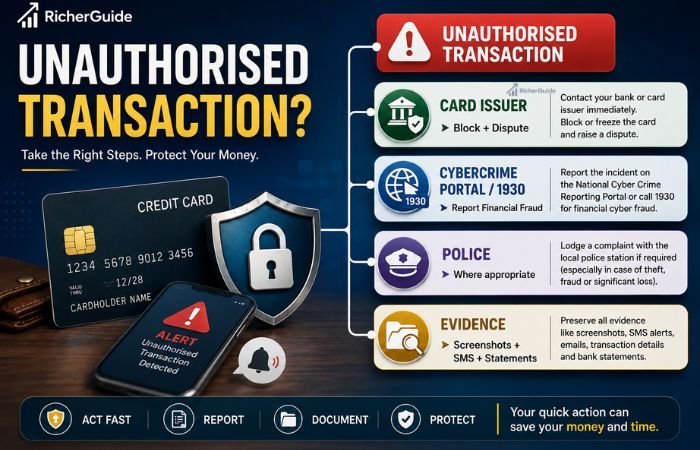
Immediately notify the card issuer and dispute the transaction through the issuer’s official process.
RBI’s customer-protection framework provides different levels of customer liability depending on factors such as whether the customer was negligent and how quickly the transaction was reported. Under the framework, where the customer has no negligence and reports certain unauthorised transactions within three working days of receiving the relevant communication, the customer can have zero liability.
For certain third-party breach situations, reporting within four to seven working days can result in limited liability, while cases reported later may be governed by the bank’s board-approved policy.
Important distinction
Lost card ≠ automatic liability for every transaction.
Your liability depends on the circumstances, the nature of the transaction, your actions, and the applicable rules and issuer policy.
That is why immediate reporting is so important.
RBI Customer Liability: Simple Explanation
The following table provides a simplified explanation of the RBI framework for unauthorised electronic banking transactions.
| Situation | Possible customer liability |
|---|---|
| Bank/issuer negligence or deficiency | Zero liability in applicable cases |
| Third-party breach, no customer negligence, reported within 3 working days | Zero liability |
| Third-party breach, reported within 4–7 working days | Limited liability as prescribed |
| Reported beyond 7 working days | As per applicable bank policy |
| Customer negligence, such as sharing credentials | Customer may bear loss until reporting |
RBI’s guidance states that where the customer has been negligent, such as by sharing payment credentials, the customer can bear the loss until the transaction is reported to the bank.
Remember
These are regulatory principles for applicable unauthorised electronic transactions—not a guarantee that every disputed credit-card transaction will automatically be reversed.
Always follow your card issuer’s dispute process.
A Simple “Report Fast” Calculator
Let’s understand why reporting quickly matters.
Suppose an unauthorised transaction is:
₹25,000
You discover it at 10:00 AM.
Scenario A: Report immediately
You contact the issuer within the applicable reporting period.
Potential exposure: significantly reduced depending on the circumstances and applicable customer-protection rules.
Scenario B: Wait for 5 days
You notice the transaction but think:
“Maybe I made this purchase.”
You investigate for several days.
Now you have delayed reporting.
Scenario C: Wait for several weeks
Your issuer may apply its applicable policy and the regulatory framework based on the circumstances.
Simple formula
Potential risk = Transaction amount × applicable customer liability
For example:
₹25,000 × 100% = ₹25,000
But if applicable customer liability is zero:
₹25,000 × 0% = ₹0
This calculator is only an illustration. Actual liability depends on the facts, transaction type, customer conduct, issuer policy and applicable RBI rules.
What If the Card Was Stolen and You Also Lost Your Phone?
This is more serious.
If your phone and credit card are both missing, immediately consider:
- Block the credit card.
- Contact your mobile operator if your SIM/device is compromised.
- Secure mobile banking.
- Change important passwords from a trusted device.
- Check email and bank alerts.
- Contact your bank through official channels.
- Monitor other financial accounts.
If your phone was unlocked or contains sensitive banking information, do not assume the credit card is the only risk.
What If Your Card Is Still With You But Someone Misused It?
This situation surprises many people.
You may physically have your credit card in your wallet and still become a victim of fraud.
For example:
You have the card → Fraudster has your card information → Online transaction occurs.
This is generally referred to as card-not-present fraud.
Possible sources of compromise include:
- Phishing
- Fake shopping websites
- Malware
- Data breaches
- Fake customer-care calls
- Fake KYC messages
- Social engineering
- Malicious links
- Unsafe websites
What should you do?
Treat the incident seriously.
Immediately:
- Report the transaction.
- Ask the issuer to block/replace the card if appropriate.
- Dispute unauthorised transactions.
- Save evidence.
- Monitor the account.
- Report cyber fraud where applicable.
Real-Life Indian Example
Let’s take a fictional example.
Meet Rahul
Rahul lives in Pune and uses a credit card for shopping, travel and online subscriptions.
One evening, Rahul notices that his wallet is missing.
He thinks:
“Maybe I left it at the office.”
Instead of immediately blocking the card, he waits.
Three hours later, he receives an SMS:
₹7,999 – Online transaction
He then receives another notification:
₹18,499 – Online transaction
Rahul immediately contacts his bank through the official channel.
The bank blocks the card and starts the dispute process.
Rahul also:
- Saves SMS alerts
- Takes screenshots
- Records transaction details
- Obtains the complaint/reference number
- Reports the incident to the cybercrime authorities where appropriate
Lesson
The biggest mistake was not losing the card.
The biggest mistake was waiting to report it.
What Information Should You Keep Ready?
When contacting your issuer, keep these details available:
- Name
- Registered mobile number
- Last four digits of card
- Approximate time card was lost
- Date of suspicious transaction
- Transaction amount
- Merchant name
- Transaction reference number
- SMS/email notification
- Screenshots
- Complaint/dispute details
Do not send unnecessary confidential information to unknown people.
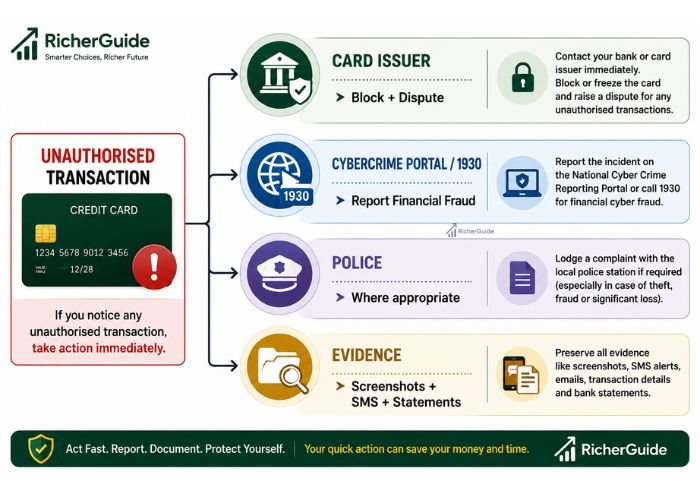
Report Financial Cyber Fraud in India
If you are a victim of online financial fraud, India’s National Cyber Crime Reporting Portal provides a mechanism to report financial cyber fraud.
The official portal advises victims to report financial cyber fraud through 1930 and the National Cyber Crime Reporting Portal.
National Cyber Crime Reporting Portal
The portal indicates that information such as transaction ID/UTR, transaction date, fraud amount, bank/merchant details and supporting evidence can be useful when filing a complaint.
Golden rule
Bank first + Cybercrime reporting where applicable + Evidence preservation
Do not depend on only one step.
Bank Complaint vs Cybercrime Complaint
These are not necessarily the same thing.
| Action | Purpose |
| Contact card issuer | Block card and initiate transaction dispute |
| Bank complaint | Create official complaint record |
| Cybercrime report | Report suspected cyber/financial crime |
| Police complaint | May be appropriate depending on circumstances |
| Evidence collection | Support investigation/dispute |
| Monitoring | Detect further suspicious activity |
Keep the Complaint Number
This is one of the most important practical tips.
Whenever you report:
- Lost card
- Stolen card
- Fraudulent transaction
- Card replacement
- Dispute
ask for a complaint/reference number.
Save it.
Take a screenshot.
If possible, save the confirmation email.
Why?
Because later you may need to prove:
“I reported this on this date and at this time.”
Documentation can make the dispute process easier.
What Happens to Your Old Card?
Once the issuer permanently blocks a lost or stolen card, you should not attempt to use it even if you later find it.
Ask the issuer whether the card is permanently cancelled and whether a replacement has been issued.
Do not assume:
“I found my card, so everything is normal again.”
If the card has been permanently blocked, follow the issuer’s instructions.
Update Recurring Payments After Replacement
Getting a new card creates another problem.
Your new card may have a different:
- Card number
- Expiry date
- CVV
You may therefore need to update legitimate services where you use your card.
Examples:
- Streaming subscriptions
- Cloud storage
- Software subscriptions
- Utility payments
- Travel services
- Memberships
- Insurance-related payments, where applicable
Important
Don’t automatically update every old merchant.
Review your subscriptions first.
Cancel services you no longer use.
This is a good opportunity to clean up recurring expenses.
Common Mistakes to Avoid
1: Waiting to see if the card comes back
Wrong approach: “I’ll wait until tomorrow.”
Better: Report and block immediately.
2: Calling a random customer-care number
Search results can contain fraudulent contact information.
Better: Use official bank channels.
3: Sharing OTP
A legitimate bank representative should not ask you to reveal confidential authentication credentials.
Never share OTP.
4: Sharing CVV
Never disclose your CVV to someone who calls unexpectedly.
5: Ignoring ₹10 or ₹50 transactions
Small unknown transactions can still indicate card misuse.
6: Deleting SMS alerts
Keep evidence.
Take screenshots before deleting anything.
7: Not checking email
Fraudulent transactions may appear through email alerts too.
8: Forgetting subscriptions
After receiving a replacement card, review recurring payments.
9: Assuming the bank will automatically know
The issuer may detect suspicious activity, but you should still report anything you did not authorise.
Practical Tips and Best Practices
1: Save your bank’s official contact information
Store it in your phone.
But also know where to find it through the official banking app or website.
2: Turn on transaction alerts
SMS and app notifications can help you detect fraud quickly.
3: Review statements regularly
Don’t wait until the payment due date.
4: Use card controls when available
Some banking apps allow customers to control:
- Online transactions
- International transactions
- Contactless transactions
- ATM usage
- Merchant categories
Availability varies by issuer.
5: Keep your credit limit appropriate
A very high credit limit can increase potential exposure if credentials are compromised.
However, don’t reduce your limit blindly. Consider your actual spending needs and credit profile.
6: Use virtual/secure payment options where appropriate
Some issuers offer virtual cards or additional controls.
7: Never save card details everywhere
Only use reputable merchants.
Pros and Cons of Freezing a Card
| Pros | Cons |
| Quickly reduces risk | Legitimate transactions may fail |
| Easy through many banking apps | Recurring payments may be affected |
| Useful when card is temporarily misplaced | You may still need permanent replacement |
| Provides quick control | Features differ by issuer |
Best practice
If the card is simply misplaced at home, a temporary freeze can be useful if your issuer provides it.
If it is genuinely lost or stolen, report it according to the issuer’s permanent-block procedure.
Lost Card vs Stolen Card vs Misused Card
| Situation | Immediate Action | Further Action |
| Card misplaced | Freeze/block | Search safely and follow issuer instructions |
| Card permanently lost | Block immediately | Request replacement |
| Card stolen | Block immediately | Consider police/cybercrime reporting |
| Unknown transaction | Report/dispute immediately | Preserve evidence |
| Card still with you but fraud occurred | Contact issuer | Replace card if advised |
| Phone + card stolen | Secure card + mobile access | Change passwords and monitor accounts |
How to Protect Yourself Before a Card Is Lost
Prevention is easier than recovery.
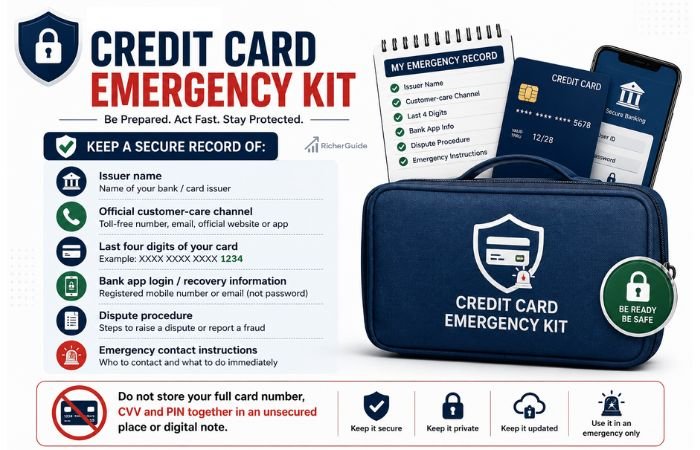
Create a “Credit Card Emergency Kit”
Keep a secure record of:
- Issuer name
- Official customer-care channel
- Last four digits of your card
- Bank app login/recovery information
- Dispute procedure
- Emergency contact instructions
Do not store your full card number, CVV and PIN together in an unsecured note.
A 5-Minute Monthly Credit Card Security Check
Set aside five minutes every month.
Check:
1. Transactions
Do I recognise every transaction?
2. Subscriptions
Am I paying for services I no longer use?
3. Alerts
Are transaction notifications working?
4. Card controls
Are online/international/contactless settings appropriate?
5. Credit report
Do I recognise the credit accounts and activity associated with me?
This small habit can help identify suspicious activity early.
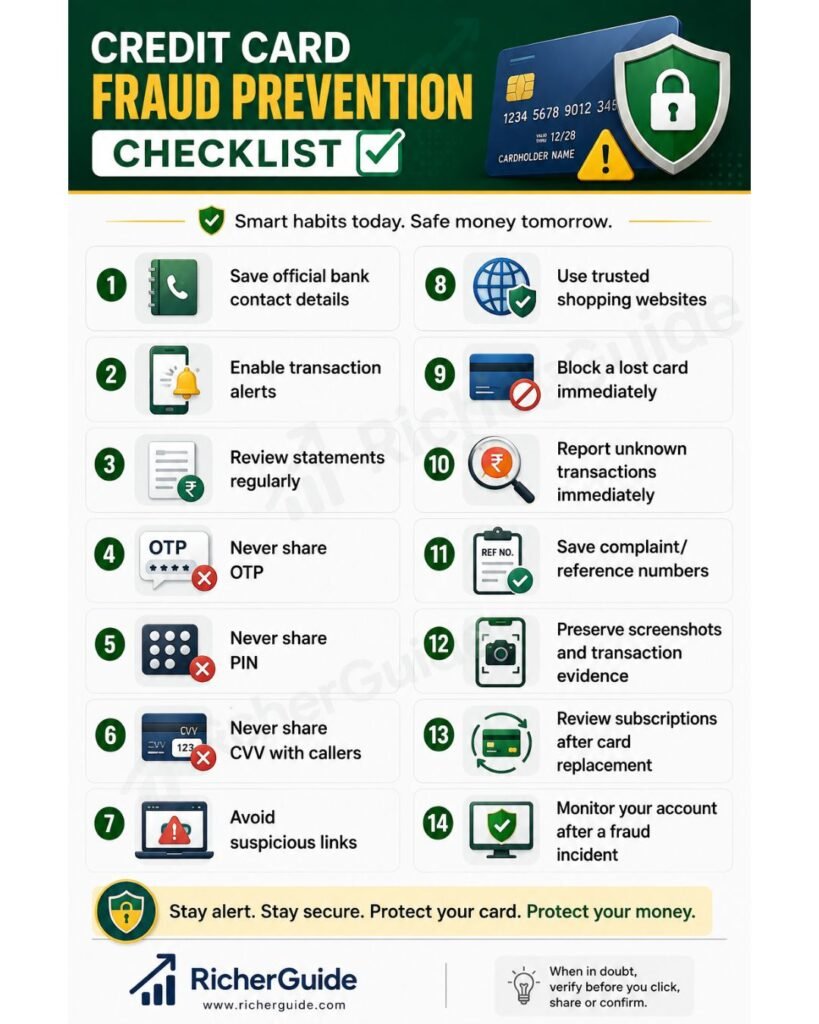
Credit Card Fraud Prevention Checklist
What If the Bank Rejects Your Complaint?
Start with the card issuer’s grievance process.
Keep:
- Complaint number
- Dates
- Emails
- Transaction details
- Screenshots
- Bank responses
- Dispute documents
RBI’s credit-card FAQ states that customers should first approach the concerned card issuer. If the issuer does not respond within 30 days, rejects the complaint wholly or partly, or the customer is dissatisfied with the resolution, the customer may approach the RBI Ombudsman through the applicable complaint process.
RBI Complaint Management System
Important Difference: Lost Card vs Compromised Card
This distinction is extremely useful.
Lost card
You don’t have the physical card.
Stolen card
Someone has intentionally taken the card.
Compromised card
You still have the physical card, but its information may have been exposed.
Misused card
A transaction has occurred without your authorisation.
You can have a compromised or misused card without ever losing the physical card.
Warning Signs That Your Card May Be Compromised
Watch for:
- Unknown merchant names
- Small test payments
- Foreign transactions
- Repeated declined transactions
- Unexpected OTP messages
- New subscription notifications
- Emails about purchases you didn’t make
- Bank alerts for transactions you don’t recognise
- Calls claiming your card is blocked
- Requests to “verify” your card details
If several warning signs appear together, contact your issuer immediately.
Frequently Asked Questions
1. What should I do first if my credit card is lost?
Immediately contact your card issuer through an official channel and block/freeze the card according to the issuer’s procedure.
2. What if I find the card after reporting it lost?
Do not automatically start using it. First confirm with your issuer whether it was temporarily frozen or permanently blocked.
3. Am I responsible for transactions made after my card was stolen?
Not necessarily. Customer liability depends on the circumstances, customer negligence, reporting time and applicable rules and issuer policies. RBI’s framework provides zero or limited liability in certain circumstances.
4. What if I see an unknown ₹50 transaction?
Report it. Do not ignore small transactions simply because the amount is low.
5. What if I still have my card but someone used it online?
Contact your issuer immediately and dispute the unauthorised transaction. The physical presence of your card does not prove that its information has not been compromised.
6. Should I call 1930 for every lost credit card?
1930 is intended for reporting financial cyber fraud. A simple lost card with no fraudulent transaction should primarily be reported to your card issuer. If financial cyber fraud has occurred, 1930 and the National Cyber Crime Reporting Portal can be relevant.
7. Should I give OTP to bank customer care to reverse a transaction?
No.
Never disclose an OTP or other confidential authentication credential to an unexpected caller.
Use the bank’s official process.
8. How quickly should I report an Unauthorized transaction?
Immediately.
Do not wait for the next statement.
RBI’s customer-protection framework makes reporting time an important factor in determining liability in applicable cases.
9. Should I file a police complaint after card theft?
It can be appropriate, particularly when the card was stolen or fraud has occurred. The appropriate reporting route depends on the circumstances.
10. What evidence should I save?
Save:
- SMS alerts
- Emails
- Screenshots
- Transaction details
- Merchant information
- Complaint numbers
- Bank correspondence
- Cybercrime complaint details
11. Can I continue using a replacement card immediately?
Follow the issuer’s activation instructions. Never assume the replacement card works before completing the required activation/security steps.
12. Can a lost credit card affect my credit score?
A lost card itself does not automatically damage your credit score. However, unresolved fraudulent transactions or unpaid legitimate dues can create financial and credit-report problems. Continue monitoring your statements and resolving disputes promptly.
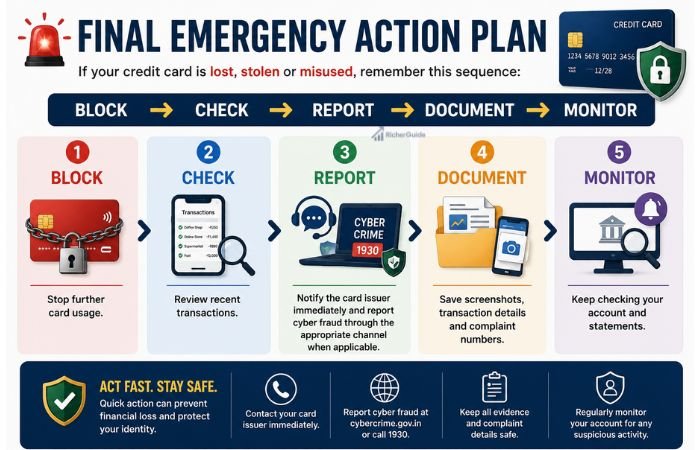
Final Emergency Action Plan
If your credit card is lost, stolen or misused, remember this sequence:
BLOCK → CHECK → REPORT → DOCUMENT → MONITOR
BLOCK
Stop further card usage.
CHECK
Review recent transactions.
REPORT
Notify the card issuer immediately and report cyber fraud through the appropriate channel when applicable.
DOCUMENT
Save screenshots, transaction details and complaint numbers.
MONITOR
Keep checking your account and statements.
Final Takeaway
Losing a credit card can happen to anyone.
The important question is not:
“How could I lose my card?”
The important question is:
“What will I do in the first 10 minutes after discovering it?”
Your response should be fast and organised.
1. Block the card.
2. Check transactions.
3. Report unauthorised transactions.
4. Save evidence.
5. Request replacement when necessary.
6. Monitor your account.
7. Report financial cyber fraud through the appropriate official channel.
RBI customer-protection rules make timely reporting particularly important in unauthorised electronic transactions.
And remember one golden rule:
Your bank will never need your OTP, PIN or CVV from an unexpected caller to “protect” your money.
If someone calls you after your card is lost and asks for confidential credentials, stop the conversation and contact the bank through an official channel yourself.
Disclaimer
This article is for educational and general informational purposes only. It does not constitute financial, legal, banking or investment advice. RBI rules, card-issuer policies, dispute procedures and customer-liability provisions may vary depending on the transaction, circumstances and applicable regulations. Readers should contact their card issuer through official channels and refer to the latest RBI directions and official government resources for current requirements.
RicherGuide does not guarantee reimbursement of any fraudulent transaction. Always verify information directly with your bank/card issuer and use official reporting channels.
For financial cyber fraud in India: use the official National Cyber Crime Reporting Portal and the 1930 financial cyber-fraud helpline where applicable.