Introduction
India’s digital payment revolution has made sending and receiving money easier than ever. Thanks to the Unified Payments Interface (UPI), millions of Indians now use apps like BHIM, PhonePe, Google Pay, Paytm, Amazon Pay, and banking apps for everyday transactions. Whether you’re paying at a local shop, splitting a restaurant bill, shopping online, or transferring money to family, UPI has become an essential part of daily life.
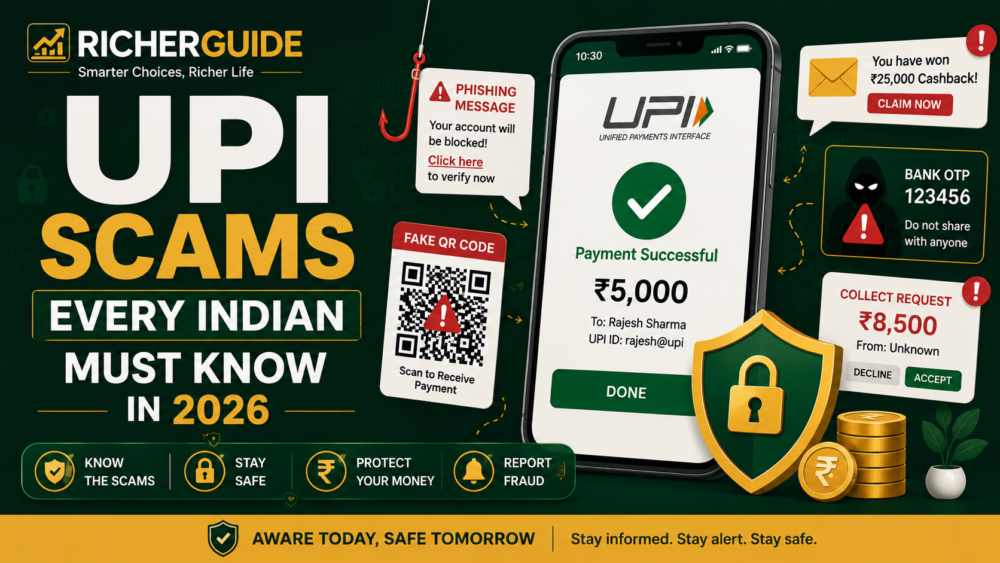
However, as UPI usage continues to grow, so do the number of cybercriminals targeting unsuspecting users. In 2026, scammers are using increasingly sophisticated techniques such as fake QR codes, phishing messages, AI-powered voice calls, fraudulent customer support numbers, fake payment screenshots, and malicious mobile apps to steal money and personal information. Many of these scams succeed because they exploit trust, urgency, or a lack of awareness not weaknesses in the UPI system itself.
The good news is that most UPI scams can be prevented if you understand how they work and know the warning signs. A few seconds of caution before approving a transaction can protect your hard-earned money.
Table of Contents
Don’t Let Scammers Empty Your Bank Account
India has become one of the world’s largest digital payment markets. Millions of people use UPI every day to pay bills, transfer money, shop online, and make business payments.
While UPI is fast and convenient, it has also become one of the biggest targets for cybercriminals. Every day, scammers invent new tricks to steal money from unsuspecting users.
The good news is that most UPI scams can be avoided if you know how they work.
In this guide, you’ll learn the most common UPI scams in India, how scammers operate, warning signs to watch for, and the steps you should take to protect yourself.
Why Are UPI Scams Increasing in 2026?
Several factors have contributed to the rise in digital payment fraud:
- More people rely on UPI for daily transactions.
- Scammers use AI-generated voices, fake websites, and phishing messages.
- Many users are unaware that entering a UPI PIN authorizes a payment.
- Fraudsters exploit urgency and fear to trick victims into acting quickly.
Key takeaway: Technology has made payments easier but it has also given scammers more sophisticated tools.
How UPI Works
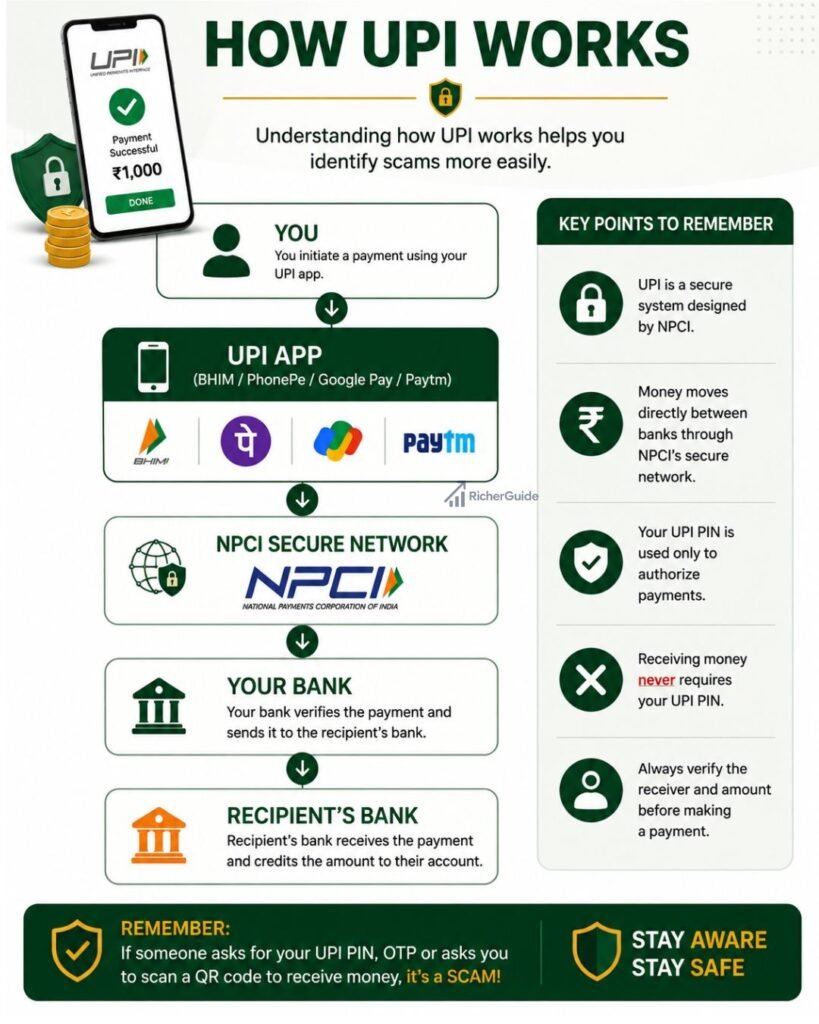
Important Rule:- Receiving money never requires your UPI PIN.
- Entering your UPI PIN always authorizes a payment.
If someone asks you to enter your PIN to receive money, it’s a scam.
Common Warning Signs of UPI Fraud
| Warning Sign | Risk Level |
|---|---|
| Asked to share UPI PIN | 🔴 Very High |
| Asked to scan a QR code to receive money | 🔴 Very High |
| Caller claims to be from your bank | 🔴 Very High |
| Urgent payment request | 🟠 High |
| Fake customer support number | 🔴 Very High |
| Unknown APK/app download | 🔴 Very High |
| Too-good-to-be-true rewards | 🟠 High |
UPI Scam 1 – Fake Payment Screenshot Scam
What Is This Scam?
In this scam, a fraudster pretends to pay you and sends a fake payment screenshot. They hope you’ll hand over goods or services before checking whether the money actually reached your account.
How Scammers Operate (Step by Step)
- They contact a seller.
- They agree to purchase an item.
- They send an edited or fake payment screenshot.
- They pressure the seller to hand over the product immediately.
- The seller later discovers that no payment was received.
Real-Life Example
A person sells a second-hand smartphone for ₹15,000. The buyer sends a convincing screenshot showing “Payment Successful.” Trusting the screenshot, the seller hands over the phone. Later, the bank balance remains unchanged.
Warning Signs
- Payment screenshot without bank confirmation.
- Buyer insists on immediate delivery.
- SMS alert doesn’t arrive.
- Bank balance hasn’t changed.
How to Protect Yourself
- Check your bank account or UPI app before handing over goods.
- Don’t rely solely on screenshots.
- Wait for official payment confirmation.
If You Become a Victim
- Save all chat messages and screenshots.
- Report the fraud to your bank.
- File a complaint on the National Cyber Crime Reporting Portal.
- Inform your local police if necessary.
UPI Scam 2 – QR Code Scam
What Is This Scam?
Scammers send a QR code and claim you must scan it to receive money. In reality, scanning the code initiates a payment request from your account.
How Scammers Operate
- They pose as a buyer or employer.
- They promise to send money.
- They send a QR code.
- You scan it.
- You enter your UPI PIN.
- Your money is debited.
Example
You list a bicycle for sale online. The buyer says, “Scan this QR code to receive ₹8,000.” After scanning and entering your PIN, ₹8,000 is deducted from your account.
Warning Signs
- Asked to scan a QR code to receive money.
- Asked to enter your UPI PIN.
- Pressure to act quickly.
Protection Tips
- Never scan a QR code to receive money.
- Remember: QR codes are generally used to make payments, not receive them.
- Verify the request through trusted channels.
UPI Scam 3 – Fake Customer Care Scam
What Is This Scam?
Fraudsters create fake customer support numbers and websites that appear genuine. Victims searching online may unknowingly contact these fake numbers.
How Scammers Operate
- Victim searches for customer care.
- Fake number appears in search results or social media.
- Fraudster asks for screen sharing or OTPs.
- Victim follows instructions.
- Money is stolen.
Example
After a failed UPI transaction, a user searches for “UPI customer care.” They call a fake number. The scammer requests remote access to the phone and steals funds.
Warning Signs
- Asked to install remote access apps.
- Asked to share OTP or PIN.
- Customer support contacts you first.
- Suspicious social media pages.
Protection Tips
- Use only official customer support within your banking or UPI app.
- Never share OTPs, PINs, or passwords.
- Avoid installing unknown apps.
UPI Scam 4 – Collect Request Scam
What Is This Scam?
Instead of sending you money, scammers send a “Collect Request.” If you approve it and enter your PIN, you authorize a payment from your account.
How It Works
- Fraudster promises to send money.
- Sends a collect request.
- Victim assumes it’s a credit.
- Victim enters the UPI PIN.
- Money is transferred to the scammer.
Example
A freelance designer is told they’ll receive ₹5,000. They receive a collect request, approve it, enter their PIN, and accidentally pay ₹5,000 instead.
Warning Signs
- Unexpected collect requests.
- Requests from unknown users.
- Instructions to enter your PIN to receive money.
Protection Tips
- Read every UPI prompt carefully.
- Decline unknown collect requests.
- Confirm the sender’s identity before approving any request.
Quick Comparison Table
| Scam | Main Trick | What You Should Do |
|---|---|---|
| Fake Screenshot | Edited payment proof | Verify bank credit |
| QR Code Scam | Scan to receive money | Never scan to receive funds |
| Fake Customer Care | Fake support | Contact official support only |
| Collect Request | Fake money request | Decline unknown requests |
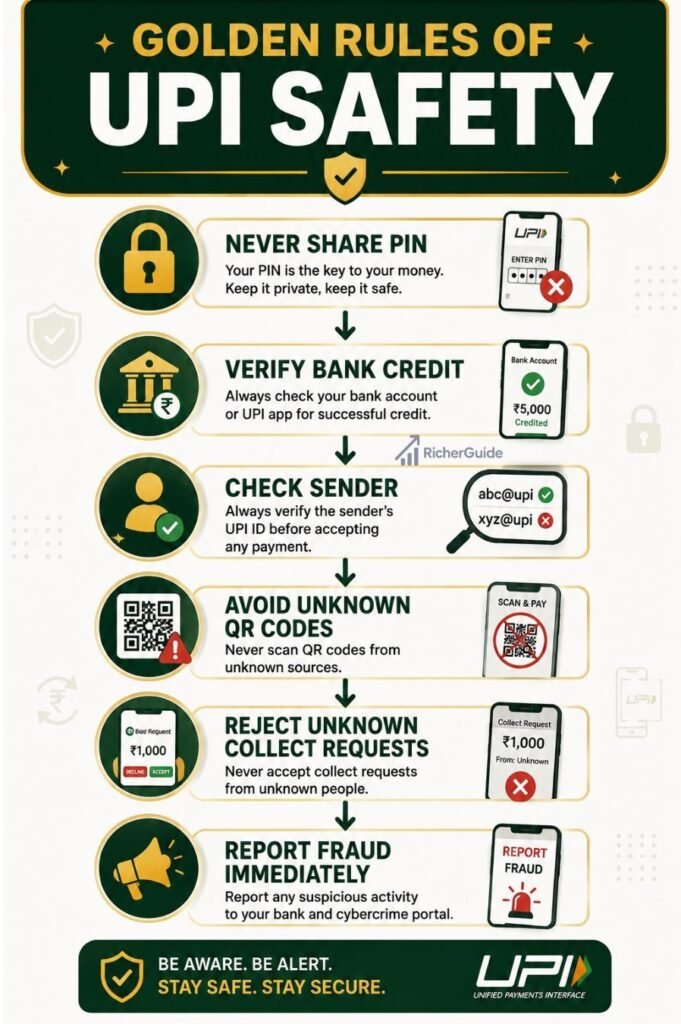
UPI Safety Checklist
✅ Never share your UPI PIN.
✅ Never share OTPs.
✅ Verify credits in your bank account.
✅ Avoid unknown QR codes.
✅ Ignore suspicious collect requests.
✅ Use official banking apps only.
✅ Enable app lock and screen lock.
✅ Keep your apps updated.
Conclusion
UPI has transformed digital payments in India by making money transfers quick, convenient, and secure. However, as digital payments continue to grow, scammers are also developing new ways to trick users. The best defense against UPI fraud is awareness and caution.
Remember these simple rules:
- Never share your UPI PIN, OTP, or banking passwords with anyone.
- Never scan a QR code to receive money.
- Always verify payment confirmations in your bank account instead of trusting screenshots.
- Reject unexpected collect requests from unknown users.
- Use only official banking and UPI apps downloaded from trusted app stores.
- Report suspicious activities immediately to your bank and the cybercrime authorities.
Even a few seconds of careful verification can save you from losing your hard-earned money. Stay informed, educate your family members especially senior citizens and first-time smartphone users and keep yourself updated about the latest scam techniques.
In Part 2, we’ll uncover four more dangerous UPI scams that every Indian should know in 2026, along with practical prevention tips and real-life examples to help you stay one step ahead of cybercriminals.
Disclaimer
The information provided in this article is for educational and awareness purposes only. While every effort has been made to ensure the accuracy of the content, scam techniques and cybersecurity threats continue to evolve over time.
RicherGuide does not provide legal, financial, or cybersecurity advisory services. Readers should always verify information through official sources such as their bank, the National Payments Corporation of India (NPCI), and government cybersecurity agencies before taking any action.
If you suspect that you have been a victim of a UPI or online payment scam:
- Contact your bank immediately and request that the transaction be blocked or investigated.
- Report the incident to the National Cyber Crime Reporting Portal: https://cybercrime.gov.in
- Call the National Cyber Crime Helpline (1930) as soon as possible to improve the chances of recovering your funds.
- Preserve transaction details, screenshots, SMS messages, call records, and any other evidence to assist the investigation.
RicherGuide is not responsible for any financial losses, damages, or actions taken based on the information presented in this article. Always use official banking channels and follow the latest security guidelines issued by your bank and NPCI.