
Introduction
Imagine two people who both invest ₹5,000 every month.
- Rahul starts at 22 years old.
- Amit starts at 35 years old.
Both invest in the same mutual fund with an average annual return of 12%.
Who will have more money at retirement?
The answer is Rahul, and the difference can be several crores of rupees even though both invest the same amount every month.
This is the power of investing according to your age.
Many people think investing is simply about choosing the best mutual fund, buying stocks, or opening a fixed deposit. But the truth is that your age is one of the most important factors in deciding where and how to invest.
Someone in their 20s can afford to take more risks because they have many years to recover from market ups and downs. Someone in their 50s, on the other hand, should focus more on protecting their wealth and generating steady income.
Your investment strategy should change as your:
- Income increases
- Responsibilities grow
- Financial goals change
- Risk tolerance decreases
- Retirement gets closer
A 25-year-old investing for retirement should not have the same portfolio as a 55-year-old preparing to retire in the next few years.
In this complete guide, you’ll learn:
- Why investment strategies should change with age
- The best investment options for every life stage
- Asset allocation recommendations
- Common investment mistakes
- A roadmap to long-term wealth creation
Whether you’re a college graduate starting your first job or someone planning retirement, this guide will help you make smarter financial decisions.
Table of Contents
The Problem: Why Many People Choose the Wrong Investments
One of the biggest mistakes investors make is copying someone else’s investment strategy without considering their own age, income, or goals.
For example:
- A 24-year-old may put all their savings into Fixed Deposits because they are “safe.”
- A 55-year-old may invest heavily in high-risk small-cap stocks hoping for quick returns.
Both decisions can lead to poor financial outcomes.
Common problems include:
- Starting investments too late
- Investing without clear financial goals
- Ignoring inflation
- Taking either too much or too little risk
- Not reviewing investments as life changes
The result?
- Slow wealth creation
- Missed opportunities
- Difficulty achieving financial goals
- Financial stress later in life
The good news is that these mistakes can be avoided with an age-based investment strategy.
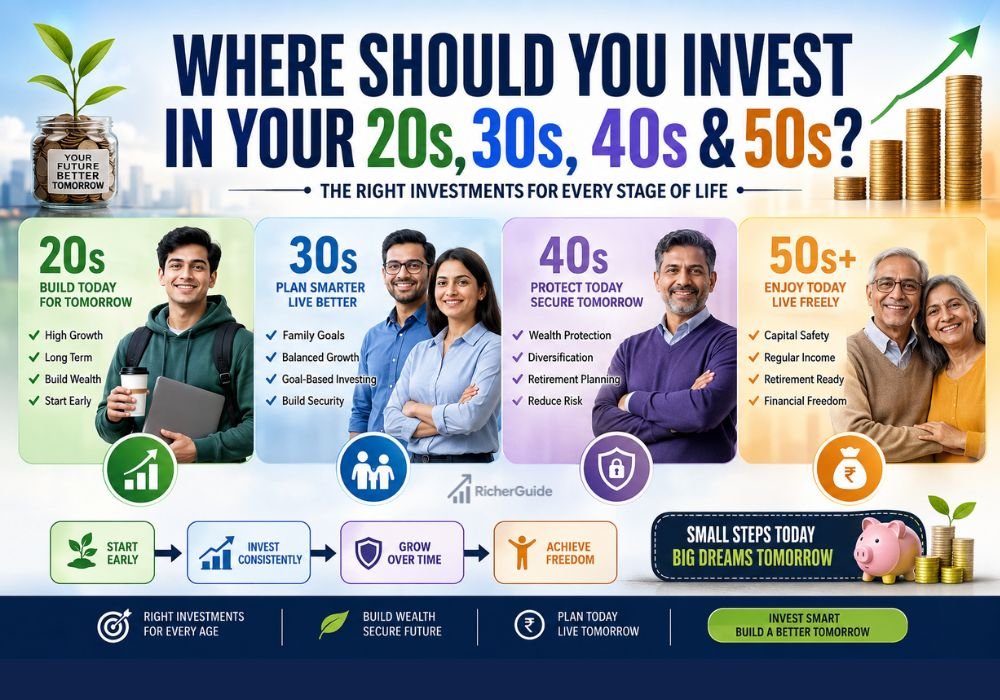
Why Investing Changes with Age
Your financial priorities evolve over time, and your investments should evolve too.
In Your 20s
- Long investment horizon
- Higher risk-taking capacity
- Lower financial responsibilities
- Focus on wealth creation
In Your 30s
- Higher income
- Marriage and family responsibilities
- Buying a house
- Children’s education planning
In Your 40s
- Peak earning years
- Wealth protection becomes important
- Retirement planning accelerates
- Need for portfolio diversification
In Your 50s
- Retirement approaches
- Capital preservation is essential
- Stable income becomes a priority
- Lower risk tolerance
The Investment Lifecycle
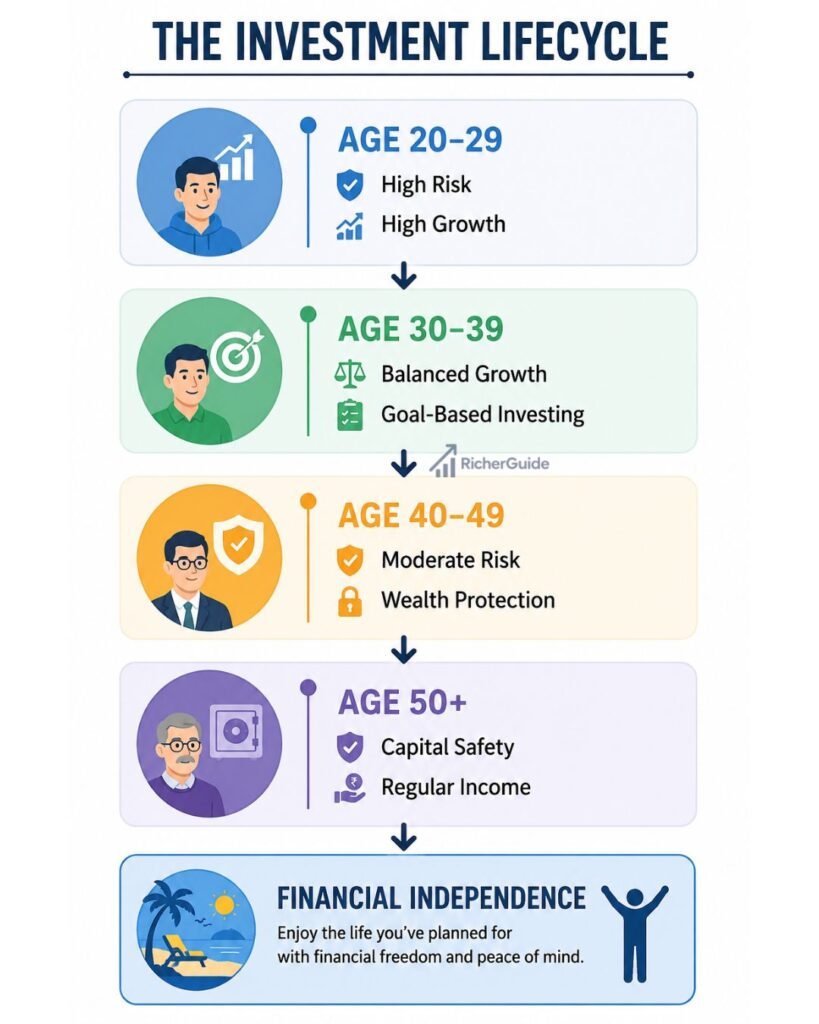
Investment Roadmap Overview
Different ages require different investment priorities.
| Age Group | Primary Goal | Risk Level | Best Investments |
|---|---|---|---|
| 20–29 | Wealth Creation | High | Equity Mutual Funds, Index Funds, Stocks |
| 30–39 | Family Goals | Moderate-High | SIPs, Hybrid Funds, PPF, NPS |
| 40–49 | Wealth Protection | Moderate | Hybrid Funds, Debt Funds, Gold |
| 50+ | Income & Safety | Low-Moderate | Senior Citizen Schemes, Bonds, Debt Funds |
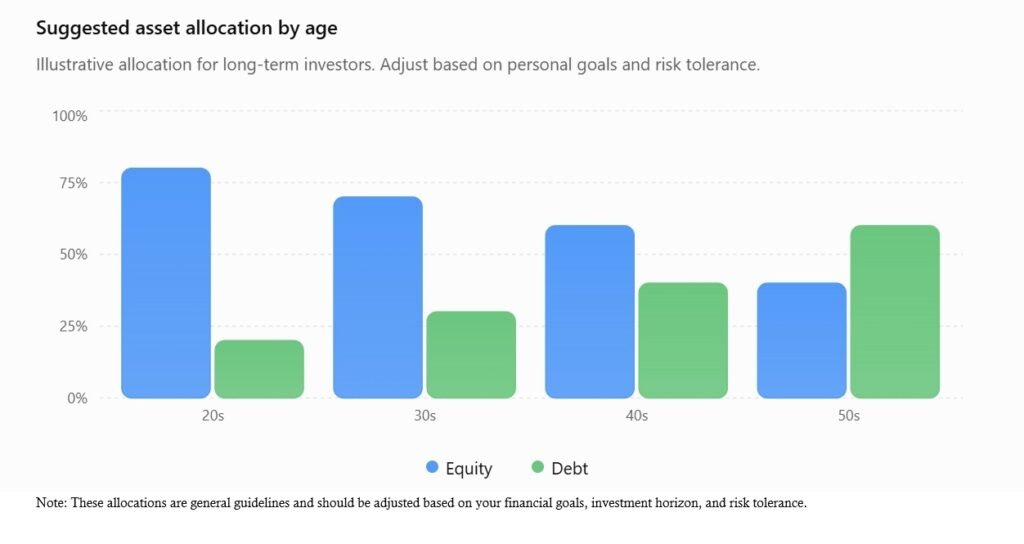
Recommended Asset Allocation by Age
Investing in Your 20s (Age 20–29)
Your twenties are the best decade to build wealth.
Even if you can invest only ₹2,000–₹5,000 per month, time works in your favor because of compound growth.
This decade is not about earning the highest salary.
It is about building the habit of investing consistently.
Financial Goals in Your 20s
- Build an emergency fund
- Start SIP investments
- Buy health insurance
- Learn about investing
- Improve your credit score
- Save for higher education or travel
- Build long-term wealth
Best Investment Options
1. Equity Mutual Funds
One of the easiest ways to start investing.
Benefits:
- Professional management
- Long-term wealth creation
- Suitable for beginners
- SIP option available
Ideal Investment Horizon:
7–20 years
2. Index Funds
Index funds have become one of the most popular investment choices.
Advantages:
- Low expense ratio
- Passive investing
- Diversification
- Consistent long-term returns
Good for:
- Beginners
- Long-term investors
- People who don’t want to actively pick stocks
3. Direct Stocks
If you enjoy learning about businesses, you can allocate a small portion of your portfolio to quality stocks.
Suggested allocation:
- 80–90% Mutual Funds
- 10–20% Direct Stocks
Never invest in stocks without proper research.
4. Public Provident Fund (PPF)
PPF offers:
- Government-backed safety
- Tax benefits (subject to applicable tax rules)
- Long-term savings discipline
Ideal for conservative investors.
5. National Pension System (NPS)
NPS helps build a retirement corpus through market-linked investments with a long-term focus.
Suitable for young professionals who want to start retirement planning early.
Sample Portfolio for a 25-Year-Old
| Investment | Monthly Amount |
|---|---|
| Equity Mutual Fund SIP | ₹3,000 |
| Index Fund SIP | ₹1,000 |
| PPF | ₹500 |
| Gold ETF/SGB Savings | ₹500 |
| Total | ₹5,000 |
Example
Meet Priya, a 24-year-old software engineer.
She starts investing ₹5,000 every month through SIPs.
If she continues for 30 years with an average annual return of 12%, she could accumulate a substantial retirement corpus thanks to the power of compounding.
The biggest advantage isn’t just the monthly amount it’s starting early.
Wealth Growth Journey
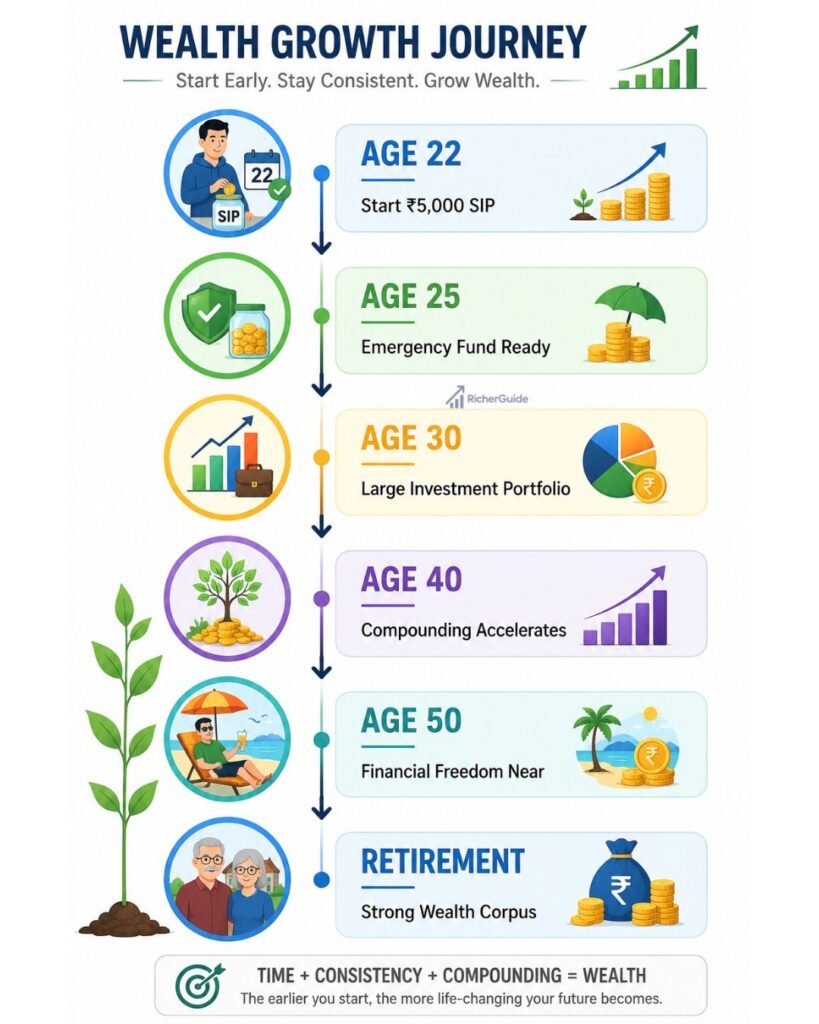
Investment Pyramid for Your 20s
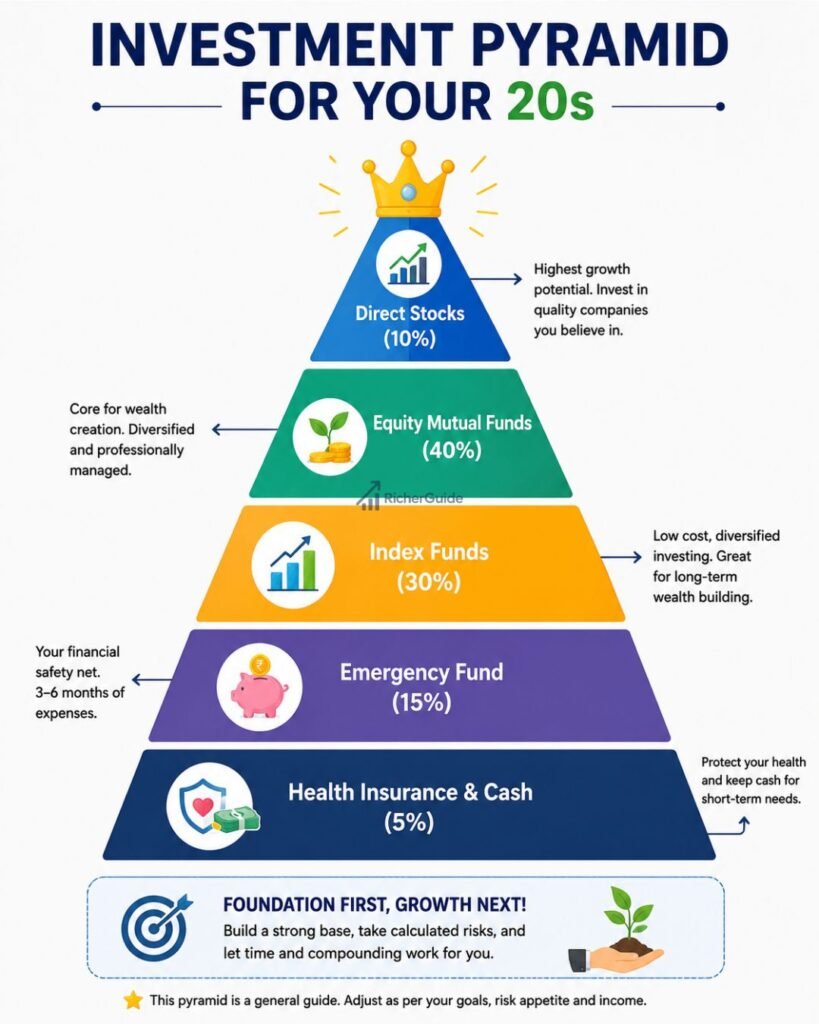
The foundation of your financial life should always be financial security, followed by long-term investments. As your income grows, you can gradually increase your investment amounts and diversify into additional asset classes.
Key Takeaways
- Start investing as early as possible.
- Build an emergency fund before taking high investment risks.
- Focus on long-term growth rather than quick profits.
- Use SIPs to invest consistently every month.
- Review your portfolio at least once a year.
- Avoid chasing market trends or “get rich quick” schemes.
- Let the power of compounding work in your favor.
Conclusion
Your age is one of the most important factors in building a successful investment strategy. The choices you make in your 20s can have a significant impact on your financial future because time allows your money to grow through the power of compounding.
The goal isn’t to find the “perfect” investment it’s to start investing early, stay consistent, and review your portfolio as your life and financial goals change. Whether you can invest ₹2,000 or ₹20,000 each month, disciplined investing is more important than trying to time the market.
Remember, every stage of life requires a different approach. What works in your 20s may not be suitable in your 40s or 50s. By following an age-based investment strategy, you can balance growth, safety, and income while moving closer to financial independence.
Start today, stay invested, and let time become your biggest wealth-building partner.
Continue Reading: Your Investment Strategy After Your 20s
Starting early is a great advantage but what happens when your responsibilities grow?
In your 30s, you may be managing a family, home loan, or children’s education. By your 40s, protecting your wealth becomes just as important as growing it. And in your 50s, preparing for a comfortable retirement takes center stage.
In Part 2 of this guide, you’ll discover:
- Best investment options in your 30s
- Smart investment strategy for your 40s
- How to invest wisely in your 50s
- Recommended asset allocation for every age group
- Real-life investment case studies
- Ready-to-use portfolio suggestions for Indian investors
Don’t miss the next part your investment strategy should grow with you, and the right decisions today can make retirement financially stress-free tomorrow.
Disclaimer
This article is intended for educational and informational purposes only and should not be considered financial, investment, tax, or legal advice. Investment returns are not guaranteed, and all market-linked investments are subject to market risks. Past performance does not guarantee future results.
Before making any investment decisions, evaluate your financial goals, risk tolerance, and investment horizon. Consider consulting a qualified financial advisor or tax professional for personalized guidance. Product features, taxation rules, interest rates, and government regulations may change over time, so always verify the latest information from official sources before investing.
Mutual Fund investments are subject to market risks. Please read all scheme-related documents carefully before investing.