
Managing money feels stressful when you don’t know where your income is going. Many people earn well but still struggle at the end of the month. The reason is simple most budgets are vague. They don’t tell your money exactly what to do.
Zero-based budgeting fixes this problem.
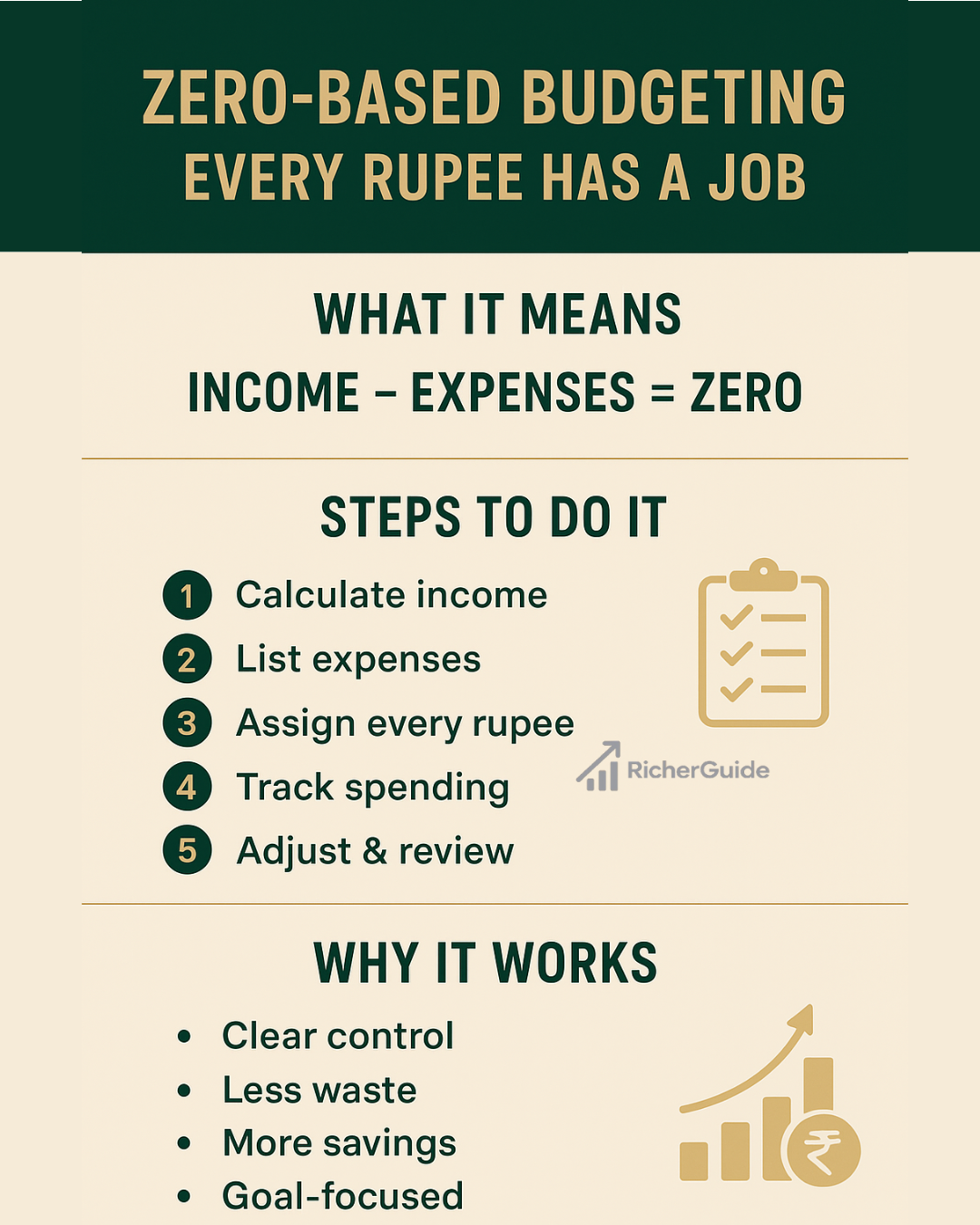
Zero-based budgeting is a simple, smart, and extremely effective method where every rupee you earn is assigned a purpose. Nothing is left floating. Your income minus your expenses equals zero. This doesn’t mean you spend everything. It means your income is fully planned—towards needs, wants, savings, investments, and goals.
Table of Contents
This method gives you full control, reduces anxiety, and helps you build financial discipline even if you’ve never budgeted before.
Let’s break it down in simple words.
What Is Zero-Based Budgeting?
Zero-based budgeting (ZBB) is a method where you plan where every rupee will go before the month begins.
Here’s the formula:
Income – Expenses = Zero
This doesn’t mean you should have zero money left. It means every rupee has a job, such as:
- Saving
- Investing
- Paying bills
- Emergency fund
- Debt repayment
- Daily spending
- Entertainment
- Personal growth
Nothing is left unassigned.
Most people use a traditional budget where they subtract expenses from income and hope money is left over.
But with zero-based budgeting, you plan everything in advance, so there are no surprises.
Why Zero-Based Budgeting Works So Well
1. You stay fully aware of your spending
When you assign every rupee a purpose, you automatically become more conscious of how you spend your money.
2. It eliminates waste
You stop spending on things you don’t need because the budget clearly shows your priorities.
3. It improves savings
Since saving is treated like an expense, you save first—not last.
4. It helps you reach financial goals
Whether it’s buying a house, building an emergency fund, or investing, ZBB ensures you stay on track.
5. It gives you peace of mind
No more end-of-month stress. You know exactly where your money is going.
6. It’s great for all incomes
You don’t need to be rich to follow this method. Zero-based budgeting works whether you earn ₹15,000 or ₹1,50,000.
7. It builds financial discipline
Month after month, you develop smart habits that keep you stable and confident.
How to Create a Zero-Based Budget (Step-by-Step Guide)
Now let’s look at how to build your own zero-based budget in 6 simple steps.
Step 1: Calculate Your Total Monthly Income
Start with understanding how much you actually earn every month.
Include:
- Salary
- Freelance income
- Side business income
- Rental income
- Part-time work
- Bonuses
- Commissions
Use only income that you’re sure about receiving.
Example:
Your monthly income = ₹60,000
Step 2: List All Your Expenses
Write down every expense you have in a month. Categorise them as:
Essential Expenses
- Rent/EMI
- Groceries
- Utility bills
- Transport
- Medical expenses
- School fees
- Insurance
Non-Essential Expenses
- Eating out
- Shopping
- Movies
- Subscriptions
- Personal care
- Holidays
Financial Goals
- Savings
- Investments
- Emergency fund
- Debt repayment
Write everything without skipping a single item. The clearer the list, the better the budget.
Step 3: Assign a Purpose to Every Rupee
Now match your expenses with your income.
Your goal is to make sure:
Income – Expenses = Zero
Let’s use the ₹60,000 example:
| Category | Amount |
|---|---|
| Rent | ₹12,000 |
| Groceries | ₹6,000 |
| Utilities | ₹2,000 |
| Transport | ₹3,000 |
| Eating out | ₹2,500 |
| Phone/Internet | ₹1,000 |
| Subscriptions | ₹500 |
| Emergency Fund | ₹5,000 |
| Investments | ₹8,000 |
| Savings | ₹6,000 |
| Personal Expenses | ₹4,000 |
| Miscellaneous | ₹10,000 |
| Total | ₹60,000 |
Everything is assigned. Nothing is left unplanned.
Step 4: Track Your Spending During the Month
Zero-based budgeting works only when you monitor your spending.
You don’t need fancy tools. Use:
- Google Sheets
- Excel
- A budgeting app
- Notes app on your phone
- A simple notebook
Every time you spend, record it.
This keeps your budget accurate and honest.
Step 5: Adjust Your Budget When Needed
Life changes. Your budget should too.
If groceries cost more some month, reduce eating out.
If you receive a bonus, assign it to savings or investments.
If an unexpected expense appears, move money from non-essential categories.
Zero-based budgeting is flexible it evolves with your life.
Step 6: Review Your Budget at the End of the Month
Ask yourself:
- Did I stick to the plan?
- Where did I overspend?
- Where did I underspend?
- What can I improve next month?
This reflection helps you create a better plan for next month and strengthens your financial habits.
Tips to Make Zero-Based Budgeting Even More Effective
Make savings and investing non-negotiable
Treat them like fixed expenses.
Use cash envelopes for problem areas
For categories like food or shopping, withdraw the money and keep it in envelopes to avoid overspending.
Keep a small buffer
A ₹1,000–₹2,000 buffer helps with unexpected little expenses.
Review your subscriptions
Many people pay for subscriptions they no longer use.
Avoid lifestyle creep
As your income grows, increase savings not unnecessary expenses.
Common Mistakes People Make with Zero-Based Budgeting
Not tracking daily spending
This is the biggest reason budgets fail.
Making the budget too strict
Leave room for fun. A good budget should feel realistic.
Forgetting yearly or quarterly expenses
Plan for:
- Insurance renewals
- Car service
- Festivals
- Big purchases
Giving up after one bad month
Budgeting is a skill. You get better with practice.
Final Thoughts: Zero-Based Budgeting Can Change Your Financial Life
Zero-based budgeting gives you control, clarity, and confidence with your money. It helps you stop overspending, start saving, and move closer to your goals every month.
The best part?
It works for anyone regardless of income, age, or financial habits.
Start today.
Take 20 minutes, write down your income and expenses, and assign every rupee a purpose.
Your future self will thank you.