

Introduction
Imagine you want to invest in a large commercial office building in Bengaluru, Mumbai, Hyderabad or Pune.
Buying the entire building could cost hundreds of crores. Even buying a small commercial property can require a large amount of money, a loan, legal paperwork, maintenance, tenants and property management.
So, is there a simpler way to participate in the income generated by large real estate properties?
Yes. REITs can provide one such route.
A Real Estate Investment Trust (REIT) is a professionally managed investment vehicle that allows investors to own units representing an interest in a portfolio of income-generating real estate assets.
Instead of personally purchasing a ₹2 crore office or a shopping centre, an investor can buy units of a listed REIT through a stock exchange.
This makes REITs particularly interesting for investors who want real-estate exposure without directly becoming a landlord.
In India, REITs operate within a regulatory framework established by the Securities and Exchange Board of India (SEBI). SEBI’s REIT framework requires REITs to invest substantially in completed, revenue-generating real estate and requires distribution of at least 90% of net distributable cash flows to unit holders, subject to applicable rules.
But REITs are not risk-free.
Their unit prices can fall, distributions can change, interest rates can affect valuations, and taxation can be more complicated than simply receiving “rent.”
This guide explains REITs in India in simple English, using Indian examples and calculations.
Table of Contents
Why REITs Matter for Indian Investors
Real estate has traditionally been one of India’s favourite investment choices.
However, direct property investment has several challenges:
- High purchase cost
- Home loans or commercial property loans
- Stamp duty and registration costs
- Maintenance expenses
- Property taxes
- Finding tenants
- Tenant-related problems
- Low liquidity
- Legal and documentation work
- Concentration in one property or location
For example, suppose you have ₹5 lakh available for investment.
Buying a good commercial property directly may be unrealistic.
But a listed REIT can potentially provide exposure to a large portfolio of commercial real estate through exchange-traded units.
This changes the basic idea from:
“I need enough money to buy property.”
to:
“I can invest in units of a professionally managed real-estate portfolio.”
That is the basic attraction of REIT investing.
What Is a REIT?
A Real Estate Investment Trust is a structure designed to own, operate or invest in income-generating real estate assets.
Think of a REIT as a bridge between:
Investors → REIT → Real Estate Properties → Rental/Operating Income
The properties may include:
- Office buildings
- Business parks
- Shopping centres
- Warehouses
- Data centres
- Hospitality-related real estate
- Other eligible real-estate assets
The exact portfolio depends on the REIT.
Simple Example
Suppose a REIT owns several office buildings.
Companies rent space inside those buildings.
The companies pay rent.
The REIT receives cash flows from the properties and distributes a substantial portion of its net distributable cash flow to investors, subject to the applicable regulations.
The investor owns REIT units, not a specific office room or apartment.
How Does a REIT Work?
The structure can look complicated, but the basic idea is simple.
A REIT generally has important participants such as:
- Sponsor
- Trustee
- Manager
- Investors / Unit holders
- SPVs or HoldCos, where applicable
The trustee has an oversight role, while the manager handles operational responsibilities. SEBI’s framework provides the regulatory structure governing these relationships.
What Is the Problem With Direct Real Estate Investing?
Before understanding the solution, let’s understand the problem.
Suppose you purchase a commercial property for ₹1 crore.
You may need to think about:
Purchase cost
₹1 crore property price.
Transaction expenses
Stamp duty, registration, brokerage and other costs may add to your initial investment.
Maintenance
You may have to pay for repairs, maintenance and other expenses.
Vacancy
What happens if the tenant leaves?
You could have several months with little or no rental income.
Liquidity
Selling a property can take weeks or months.
Concentration risk
Your entire investment may depend on one property and one location.
Management
You become responsible for tenant issues, documentation and property-related decisions.
REITs don’t remove all real-estate risks, but they can reduce some of the practical difficulties associated with owning a property directly.
REITs: The Solution for Smaller Investors
A REIT pools money from multiple investors and invests in a portfolio of real estate.
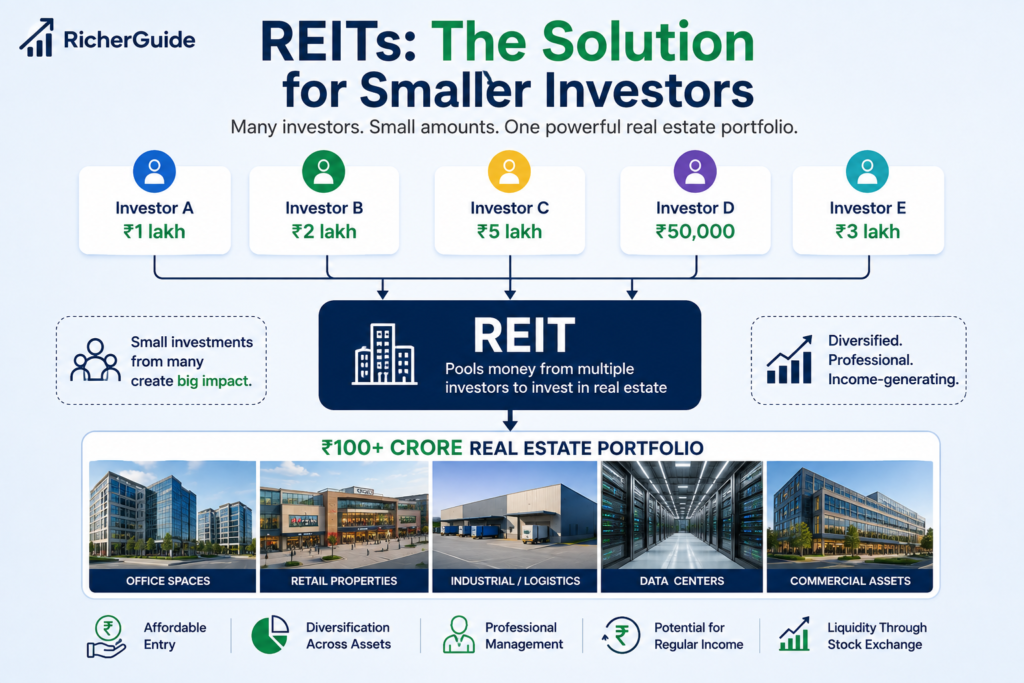
The investor receives units based on the amount invested.
Because listed REIT units trade on stock exchanges, they can generally be bought or sold during market hours, subject to liquidity and market conditions. SEBI’s regulations provide for listed REIT units to be traded on recognised stock exchanges, with the trading lot currently specified as one unit.
How Do REITs Make Money?
A REIT can generate income from its underlying properties and investments.
For an office-focused REIT, the major source could be rental income from companies occupying office space.
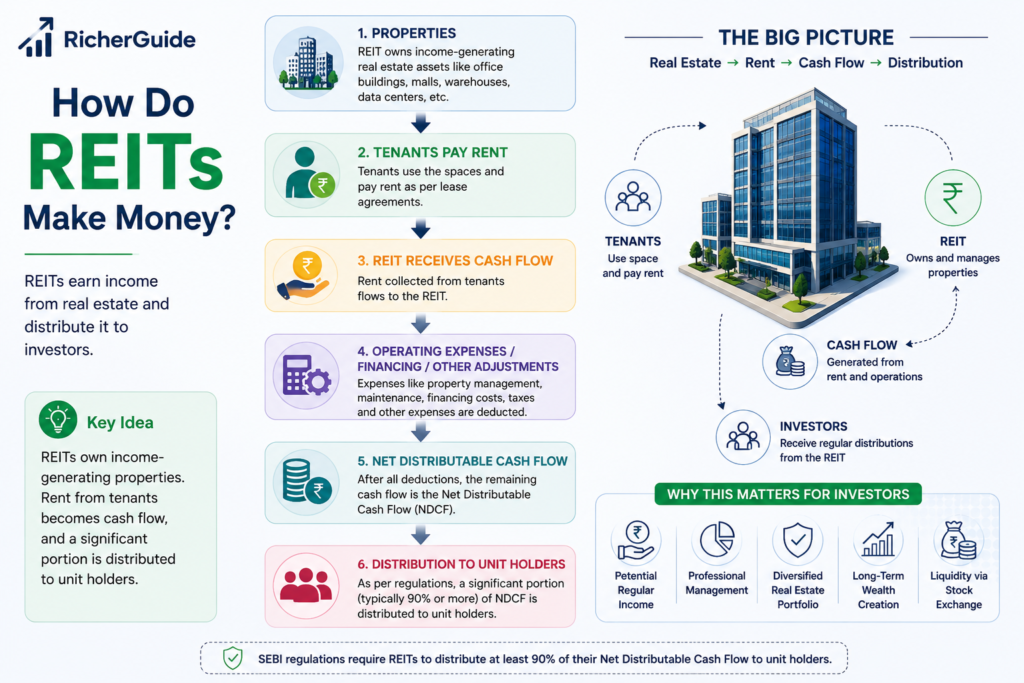
SEBI's framework requires at least 90% of net distributable cash flows to be distributed to unit holders, subject to applicable provisions.Important: This does not mean investors automatically receive a fixed 90% return.
It means the REIT is required to distribute at least 90% of its net distributable cash flow, not 90% of the amount invested and not 90% of property value.
This distinction is extremely important.
What Is REIT Distribution?
When you invest in a REIT, you may receive distributions.
But don’t assume that every distribution is simply “rent.”
The tax character can vary.
A distribution may contain components such as:
- Interest
- Dividend
- Rental/letting-related income
- Other income
- Repayment or return of certain amounts, depending on the structure
The Income Tax Department’s current business-trust reporting framework specifically provides for reporting the income components distributed to unit holders, including interest, rental/leasing/letting income and dividend income.
Therefore, investors should check the distribution statement/Form 64A or other relevant tax information provided by the REIT rather than assuming the entire amount has one tax treatment.
REIT Income Example
Suppose you invest:
₹1,00,000
Assume, purely for illustration, that the REIT’s annual distribution works out to:
₹6,000
Your cash distribution would be:
₹6,000 per year
or approximately:
₹500 per month equivalent
However, REIT distributions are not necessarily monthly.
The frequency depends on the REIT’s distribution policy and applicable regulations.
Also remember:
₹6,000 distribution does not mean your investment earned only ₹6,000.
The market price of your REIT units can rise or fall.
REIT Return = Distribution + Price Movement
One of the biggest mistakes beginners make is looking only at the distribution yield.
A REIT investor can potentially earn from two broad sources:
1. Distribution income
Cash distributed by the REIT.
2. Capital appreciation
Increase in the market price of the REIT units.
A simplified total-return formula is:
Total Return = Distributions Received + Change in Unit Value
Example
Suppose you invest:
₹1,00,000
During the year:
Distribution received = ₹6,000
Value of units increases to = ₹1,08,000
Your approximate gain before taxes and costs is:
₹6,000 + ₹8,000 = ₹14,000
Approximate return:
14%
But if the unit price falls to ₹95,000:
₹6,000 − ₹5,000 = ₹1,000
So your total return would be approximately:
1%
This demonstrates why REITs should not be treated as fixed deposits.
REIT Distribution Yield Calculator
A simple calculation can help you compare distributions.
Formula
Distribution Yield = Annual Distribution ÷ Investment Value × 100
Example
Investment:
₹2,00,000
Annual distribution:
₹12,000
Calculation:
₹12,000 ÷ ₹2,00,000 × 100 = 6%
So the distribution yield is approximately:
6%
Important Warning
Distribution yield is not the same as guaranteed return.
The distribution may change.
The unit price may change.
Your actual total return can be higher or lower.
A Simple REIT Calculator
You can use this basic calculator for educational planning:
| Input | Example |
|---|---|
| Investment | ₹2,00,000 |
| Estimated annual distribution yield | 6% |
| Estimated annual distribution | ₹12,000 |
| Estimated holding period | 5 years |
| Total distributions if unchanged | ₹60,000 |
Formula
Annual Distribution = Investment × Distribution Yield
For ₹2,00,000 at 6%:
₹2,00,000 × 6% = ₹12,000
Over five years, if the distribution stayed exactly the same:
₹12,000 × 5 = ₹60,000
But this is only a mathematical illustration.
Actual REIT distributions can change.
What Are the Main Types of REITs?
REITs can be classified based on the type of real estate they own or focus on.
Office REITs
These focus primarily on commercial office properties.
Their tenants may include:
- IT companies
- Banks
- Consulting firms
- Multinational companies
- Technology companies
- Professional services firms
Retail REITs
These focus on shopping centres and retail properties.
Income may depend on:
- Retail occupancy
- Consumer spending
- Tenant sales
- Rental agreements
Industrial / Logistics REITs
These may focus on:
- Warehouses
- Logistics facilities
- Industrial properties
Specialized REITs
Some REIT strategies can focus on specialised assets such as data centres or other niche real estate.
For beginners, the important point is:
Different properties have different economic risks.
An office REIT and a retail REIT should not automatically be treated as identical investments.
REITs Available in India
India’s listed REIT market has developed significantly since the first listed REIT.
Examples of listed Indian REITs have included:
- Embassy Office Parks REIT
- Mindspace Business Parks REIT
- Brookfield India Real Estate Trust
- Nexus Select Trust
A historical NSE primer listed these four REITs and their respective exchange symbols as Embassy, Mindspace, Brookfield India REIT and Nexus Select Trust.
Important: The listed REIT landscape can change over time. Investors should verify the latest listed securities, prices, financial results and disclosures directly through NSE/BSE and the relevant REIT’s investor-relations website before investing.
Real-Life Indian Example
Let’s create a simple example.
Suppose Rahul, aged 32, lives in Mumbai.
He wants exposure to commercial real estate but does not want to:
- Buy a ₹1–2 crore property
- Take a large loan
- Find tenants
- Handle maintenance
- Wait months to sell
He decides to research listed REITs.
He invests:
₹2,00,000
Suppose his REIT investment produces an illustrative annual distribution of:
6%
Annual distribution:
₹2,00,000 × 6%
= ₹12,000
Now suppose the unit price appreciates by 5% during the year.
Capital appreciation:
₹2,00,000 × 5%
= ₹10,000
Illustrative total gain:
₹12,000 + ₹10,000
= ₹22,000
Approximate return:
11%
But if the unit price falls by 8% instead:
Capital loss:
₹2,00,000 × 8%
= ₹16,000
After ₹12,000 distribution:
₹12,000 − ₹16,000
= −₹4,000
So Rahul would have a negative total return before considering taxes and costs.
Lesson
REITs can provide income and real-estate exposure, but they still carry market risk.
REITs vs Direct Property Investment
| Feature | REIT | Direct Property |
|---|---|---|
| Starting investment | Generally much lower | Usually very high |
| Liquidity | Higher | Low |
| Diversification | Portfolio-based | Often one/few properties |
| Management | Professional manager | Owner |
| Tenant handling | REIT/manager | Owner |
| Maintenance | Handled within structure | Owner responsibility |
| Price visibility | Market price available | Less frequent valuation |
| Leverage | REIT may use debt | Investor may use loan |
| Rental income | Distributed through REIT structure | Direct rent |
| Selling | Exchange transaction | Property sale process |
| Emotional involvement | Usually lower | Often higher |
| Market volatility | High | Price changes less visible day-to-day |
Neither option is automatically better.
The right choice depends on your goals, risk tolerance, capital and investment horizon.
REITs vs Stocks vs Mutual Funds
| Feature | REIT | Stocks | Equity Mutual Funds |
|---|---|---|---|
| Main exposure | Real estate | Companies | Portfolio of securities |
| Income potential | Distributions | Dividends | Fund distributions/returns |
| Market traded | Yes, listed REITs | Yes | Usually through AMC/platform |
| Diversification | Real-estate portfolio | Depends on shares | Usually diversified |
| Property exposure | High | Indirect | Depends on fund |
| Price volatility | Yes | Yes | Yes |
| Professional management | Yes | No portfolio manager for your holdings | Yes |
| Suitable for | Investors wanting real-estate exposure | Equity investors | Diversified investors |
Advantages of REITs
1. Lower entry barrier
You don’t need to purchase an entire building.
2. Professional management
Properties are managed through the REIT structure rather than by each individual investor.
3. Diversification
A REIT may own multiple properties across locations.
4. Potential regular distributions
REITs are designed around distributing a substantial portion of eligible cash flows.
5. Liquidity
Listed units can generally be traded on stock exchanges.
6. Transparency
Listed REITs are subject to disclosure, reporting and regulatory requirements.
7. Real-estate exposure
You can add real-estate exposure to a broader investment portfolio without directly purchasing property.
Disadvantages and Risks of REITs
1. Market price risk
REIT units can fall in value.
2. Interest-rate risk
Higher interest rates can affect borrowing costs and investor demand for income-generating assets.
3. Occupancy risk
If properties become vacant, rental cash flow may decline.
4. Tenant concentration risk
A REIT dependent on a few large tenants may face greater risk if a major tenant leaves.
5. Property-market risk
Commercial real estate conditions can change.
6. Debt risk
REITs can use debt. Higher leverage can increase financial risk.
SEBI’s framework places limits on REIT borrowing and provides additional conditions when leverage crosses specified thresholds.
7. Distribution risk
Past distributions do not guarantee future distributions.
8. Tax complexity
Different components of distributions can receive different tax treatment.
9. Sector concentration
A REIT focused mainly on offices, for example, can be more exposed to office-market conditions.
REIT Taxation in India
Taxation is one of the most important areas to understand before investing.
India’s tax framework for business trusts, including REITs, uses a pass-through approach for specified types of income.
The Income-tax Act, 2025 defines a business trust to include a trust registered as a REIT under SEBI’s REIT regulations.
For FY 2026–27, the new Income-tax Act, 2025 is relevant, so older articles referring only to sections of the Income-tax Act, 1961 can be outdated.
Distribution components can have different tax treatment
A REIT distribution can include:
- Interest
- Dividend
- Rental/letting-related income
- Other income
- Certain capital/repayment components
The Income Tax Department’s Form 76 guidance specifically requires business trusts to report the nature of income distributed to unit holders.
Therefore:
Do not calculate your REIT tax by simply multiplying the total distribution by your income-tax slab.
First identify the nature of the distribution.
Interest Income From REIT
Interest distributed to a resident investor can generally be taxable in the investor’s hands according to the applicable provisions.
For FY 2026–27, for example, Mindspace Business Parks REIT states that interest distributions to resident unitholders are subject to 10% TDS, subject to applicable rules and investor classification.
TDS is not necessarily your final tax liability.
It is a tax deduction/collection mechanism.
Your final tax depends on your overall income and applicable tax rules.
Dividend Component
Dividend income can also have specific treatment depending on the structure and tax regime of the underlying SPV.
For example, Mindspace’s FY 2026–27 tax communication states that no TDS is deducted on its dividend distribution because its SPVs had not opted for the specified beneficial tax regime under section 200 of the Income-tax Act, 2025.
This illustrates an important point:
REIT taxation can depend on the underlying structure and elections made by the SPVs.
So investors should always check the latest distribution tax statement issued by their REIT.
Capital Gains on REIT Units
If you sell REIT units for more than your cost, you may have a capital gain.
If you sell them for less than your cost, you may have a capital loss.
The applicable tax depends on:
- Date of purchase
- Date of sale
- Holding period
- Nature of the security
- Applicable capital-gains provisions
- Tax rules applicable for the relevant tax year
The Income-tax Act, 2025 continues the business-trust framework while reorganising the provisions of the earlier law.
Because capital-gains rules can change and can depend on the transaction date, investors should verify the applicable rate for the relevant tax year before filing their return.
Do REITs Give Fixed Returns?
No.
This is one of the biggest misconceptions.
A REIT is not:
- A fixed deposit
- A guaranteed income product
- A government bond
- A guaranteed monthly pension
The amount distributed can change.
The market value can also change.
Example
Suppose you buy units for:
₹1,00,000
Distribution:
₹6,000
But the market value falls to:
₹90,000
Your investment value has declined by:
₹10,000
After adding the ₹6,000 distribution:
Net position before tax/costs:
−₹4,000
Therefore, always consider total return, not distribution yield alone.
What Should Beginners Check Before Buying a REIT?
Don’t select a REIT only because its distribution yield looks attractive.
Check these factors.
1. Occupancy
Higher occupancy can support rental cash flows, but you should examine how occupancy is measured and whether it is sustainable.
2. Tenant quality
Look at major tenants and concentration.
3. Lease expiry profile
If many major leases expire around the same time, future cash flow may be less predictable.
4. Debt
Check total debt and borrowing costs.
5. Property quality
Location and quality matter significantly in real estate.
6. Distribution history
Look at several periods rather than one distribution.
7. Net Asset Value
Compare market price with reported NAV, while understanding that NAV is not a guarantee of future returns.
8. Management quality
Review the manager’s track record and disclosures.
9. Growth pipeline
Look at acquisitions and development exposure.
10. Valuation
A great property portfolio can still be a poor investment if purchased at an excessive valuation.
Common Mistakes to Avoid
Mistake 1: Thinking REIT = Fixed Income
It isn’t.
Mistake 2: Looking only at yield
High yield can sometimes reflect higher risk or a falling unit price.
Mistake 3: Ignoring debt
Debt can influence financial risk.
Mistake 4: Ignoring occupancy
Empty properties can affect cash flows.
Mistake 5: Ignoring taxes
The distribution amount received in your bank account may not represent your final post-tax return.
Mistake 6: Investing all your money in one REIT
Concentration can increase portfolio risk.
Mistake 7: Chasing the highest distribution
Today’s distribution doesn’t guarantee tomorrow’s.
Mistake 8: Ignoring market price
A REIT can generate good cash flow while its market price falls.
Mistake 9: Treating REITs like residential property
Commercial real estate behaves differently from residential property.
Mistake 10: Not reading disclosures
Listed REITs provide financial and operational information. Investors should use it.
Practical Tips for First-Time REIT Investors
Start small
You don’t need to make a large investment immediately.
Understand the portfolio
Know what properties you are actually buying exposure to.
Compare multiple REITs
Don’t evaluate only one REIT.
Look beyond distribution
Consider:
- NAV
- Occupancy
- Debt
- Rental growth
- Lease expiries
- Tenant concentration
- Property quality
- Management
- Valuation
Think long term
Real estate is generally not an asset class to evaluate based only on a few weeks of price movement.
Maintain diversification
A REIT can complement a portfolio but should not automatically become your entire portfolio.
How Much Should You Invest in REITs?
There is no universal percentage that works for everyone.
Consider:
- Your age
- Income
- Emergency fund
- Existing equity exposure
- Direct property exposure
- Risk tolerance
- Investment horizon
- Financial goals
For example, someone who already owns several properties may not need a very large additional real-estate allocation.
Someone with no real-estate exposure may want to consider REITs as one part of a diversified portfolio.
Asset allocation should be based on your overall financial plan, not simply on the latest REIT yield.
Final Thoughts: Are REITs Worth Considering for Indian Investors?
Real Estate Investment Trusts (REITs) offer Indian investors a convenient way to gain exposure to income-generating commercial real estate without purchasing an entire property. With a relatively lower entry barrier, professional management, portfolio diversification and the potential to receive regular distributions, REITs can be worth exploring as part of a diversified investment portfolio.
However, REITs are not risk-free investments. Their unit prices can fluctuate, distributions may change, interest rates can affect valuations, and taxation can be complex. A high distribution yield does not automatically mean a better investment.
Before investing, compare different REITs, review their property portfolios, occupancy levels, tenant quality, debt, distribution history and valuations. Understand the tax treatment of distributions and capital gains, and consider your financial goals, investment horizon and risk tolerance.
Remember: Successful investing is not just about earning income; it is about understanding risk and making informed decisions.
At RicherGuide, our goal is to help you understand personal finance and investment concepts in simple English so you can make better-informed financial decisions.
Explore more practical money guides at www.richerguide.com and take a step towards improving your financial knowledge.
Disclaimer
This article is intended for educational and informational purposes only. It does not constitute investment advice, financial advice, tax advice or a recommendation to buy, sell or hold any particular REIT or other financial instrument.
REIT investments are subject to market risks, including fluctuations in unit prices, changes in distributions, interest-rate risk, property-market risk, tenant-related risks and other financial risks. Returns and distributions are not guaranteed, and investors may lose some or all of their invested capital.
Examples, calculations, yields and return figures used in this article are illustrative only and do not represent actual or guaranteed future performance. Tax treatment may vary depending on the nature of the distribution, applicable laws, the financial year and the investor’s individual circumstances.
Before making any investment decision, independently verify the latest information and disclosures published by the relevant REIT, NSE, BSE and SEBI. Consider consulting a SEBI-registered investment adviser and a qualified tax professional where appropriate.
RicherGuide is an educational platform and does not guarantee investment returns or accept responsibility for financial decisions made solely on the basis of this article.