
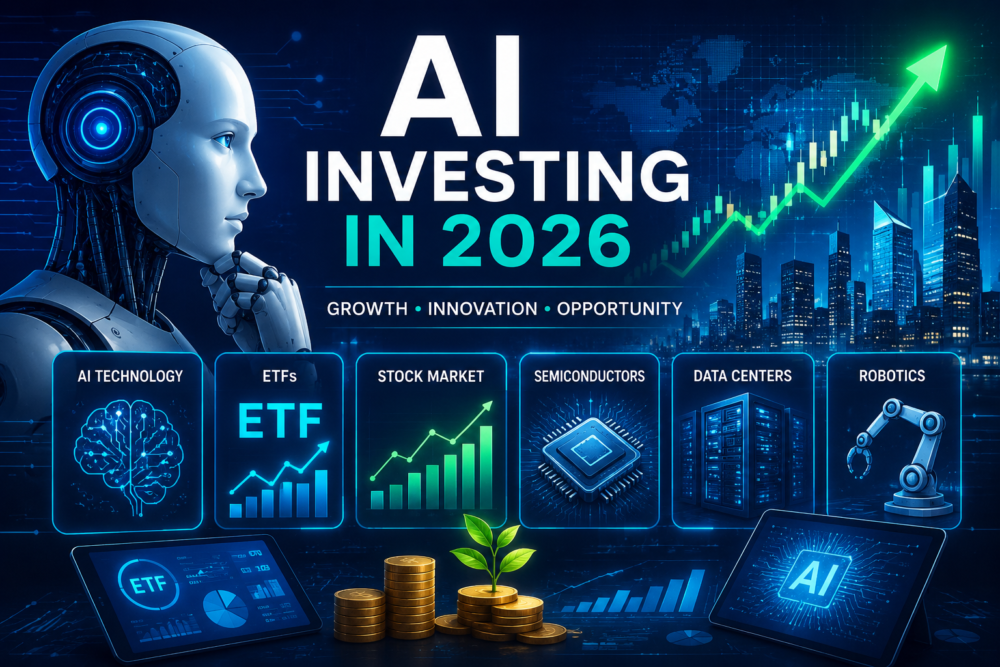
Artificial Intelligence (AI) is no longer a futuristic concept. In 2026, AI is transforming industries, creating new business opportunities, and becoming one of the biggest investment trends in the world.
From healthcare and education to finance and manufacturing, AI is helping companies work faster, reduce costs, and improve customer experiences. As a result, investors are looking for ways to benefit from this powerful trend.
However, many people hesitate to invest in AI because they are unsure which company will become the next big winner. Picking individual stocks can be risky, especially in a rapidly changing industry.
The good news is that you don’t need to choose individual AI stocks to participate in the AI revolution. There are several simple and effective ways to gain exposure to AI while reducing risk.
In this article, we’ll explore seven smart ways to invest in the AI boom without picking individual stocks.
Table of Contents
Why AI Investing Is Trending in 2026
AI remains one of the strongest investment themes in 2026 for several reasons:
- AI adoption is growing across nearly every industry.
- Businesses are increasing spending on AI tools and software.
- Governments worldwide are investing in AI infrastructure.
- AI is creating new markets and revenue opportunities.
- Retail investors want exposure to long-term technology growth.
Many experts compare the AI boom to the rise of the internet in the late 1990s. While no one can predict the future perfectly, AI is expected to remain a major driver of innovation for years to come.
1. Invest in AI-Focused ETFs
One of the easiest ways to invest in AI is through Exchange-Traded Funds (ETFs).
An AI ETF is a basket of stocks that focuses on companies involved in artificial intelligence, machine learning, robotics, and automation.
Benefits of AI ETFs
- Instant diversification
- Lower risk compared to buying one stock
- Professional management
- Easy to buy and sell
Instead of betting on a single company, you own small portions of many businesses involved in AI.
This approach helps reduce the impact if one company performs poorly.
Who Should Consider This?
AI ETFs are ideal for beginners who want simple exposure to the AI sector without researching individual companies.
2. Invest in Broad Technology ETFs
Many of the world’s largest technology companies are heavily involved in AI development.
Broad technology ETFs often include businesses investing billions of dollars into AI research and infrastructure.
Advantages
- Exposure to AI leaders
- Diversification across technology companies
- Lower volatility than pure AI investments
- Long-term growth potential
Since AI is becoming part of many technology businesses, broad tech funds can provide indirect exposure to the AI trend.
3. Invest in Semiconductor Funds
AI systems require powerful computer chips to process enormous amounts of data.
As AI adoption increases, demand for advanced semiconductors continues to grow.
Why Semiconductors Matter
AI models need:
- High-performance processors
- Data center hardware
- Graphics processing units (GPUs)
- Specialized AI chips
Rather than choosing one chip manufacturer, investors can use semiconductor-focused funds to gain diversified exposure.
This strategy allows you to benefit from growing AI infrastructure demand.
4. Invest in Data Center and Infrastructure Funds
AI cannot function without massive computing power.
Data centers are the backbone of AI technology because they provide the storage and processing capabilities needed to run AI systems.
Growth Drivers
- Expansion of cloud computing
- Increased AI workloads
- Growing demand for data storage
- Business digital transformation
As companies invest more in AI, demand for data centers and digital infrastructure is expected to increase significantly.
Investing in infrastructure-related funds can be an effective way to benefit from this trend.
5. Invest Through Index Funds
Many investors overlook a simple fact:
Some of the biggest AI winners are already included in major stock market indexes.
Index funds allow you to own hundreds of companies in a single investment.
Why Index Funds Work
- Extremely diversified
- Low fees
- Suitable for long-term investing
- Less stressful than stock picking
Since many AI-focused companies are already part of major indexes, index funds provide indirect exposure to AI growth while maintaining a balanced portfolio.
This can be one of the safest ways to participate in the AI boom.
6. Invest in Robotics and Automation Funds
AI and automation often work together.
Businesses are increasingly using intelligent machines to improve productivity and reduce costs.
Industries Using Robotics
- Manufacturing
- Logistics
- Healthcare
- Agriculture
- Warehousing
Robotics and automation funds typically invest in companies developing technologies that support AI-powered systems.
As businesses continue automating operations, these investments may benefit from long-term growth trends.
7. Use a Diversified Portfolio Approach
Many successful investors avoid concentrating too much money in one theme.
Instead of putting all your money into AI-related investments, consider building a diversified portfolio.
Example Allocation
You might combine:
- Broad market index funds
- Technology ETFs
- AI-focused ETFs
- Infrastructure funds
- International investments
This approach helps balance risk while still providing exposure to AI opportunities.
Diversification remains one of the most important principles of successful investing.
Benefits of Investing in the AI Boom Without Picking Stocks
Choosing funds instead of individual companies offers several advantages.
Reduced Risk
If one company struggles, other holdings may offset the loss.
Less Research Required
You don’t need to analyze dozens of financial statements or earnings reports.
Better Diversification
Funds spread your investment across many businesses and sectors.
Long-Term Growth Potential
You can benefit from industry-wide growth rather than relying on a single winner.
Lower Emotional Stress
Investors often make mistakes when trying to predict which stock will outperform.
Diversified investments can make investing simpler and more comfortable.
Risks to Consider
Even though AI investing offers exciting opportunities, no investment is risk-free.
Market Volatility
Technology investments can experience large price swings.
Overvaluation Risk
Some AI-related companies may become overpriced during periods of excitement.
Regulatory Changes
Governments may introduce new AI regulations that impact growth.
Economic Slowdowns
Reduced business spending could slow AI adoption temporarily.
Investors should always consider their risk tolerance and investment goals before making decisions.
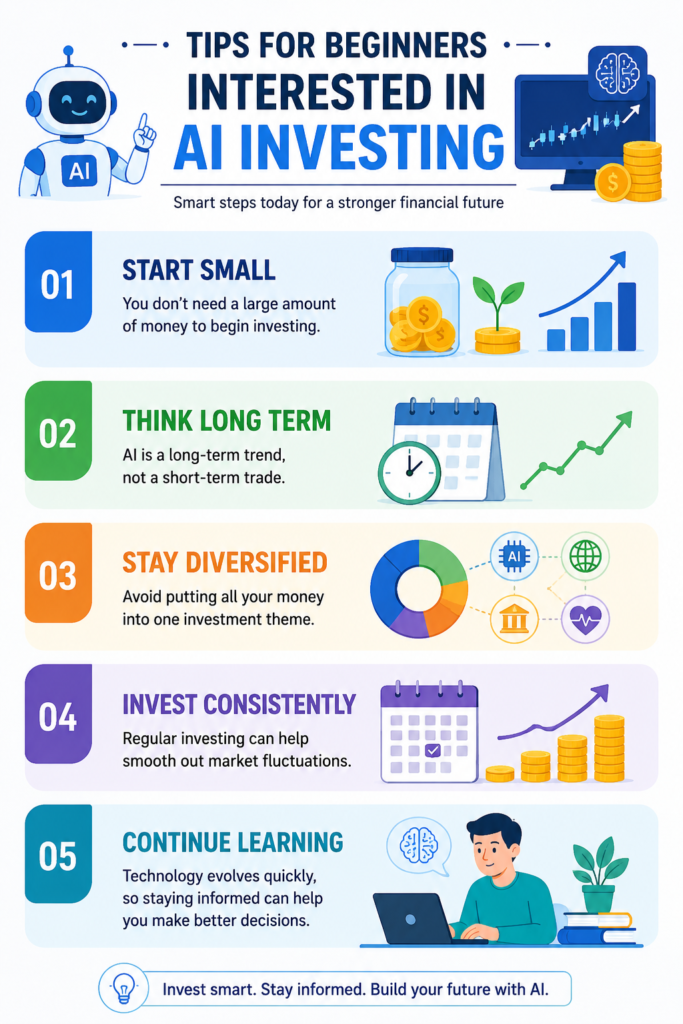
Tips for Beginners Interested in AI Investing
If you’re new to investing, keep these tips in mind:
Start Small
You don’t need a large amount of money to begin investing.
Think Long Term
AI is a long-term trend, not a short-term trade.
Stay Diversified
Avoid putting all your money into one investment theme.
Invest Consistently
Regular investing can help smooth out market fluctuations.
Continue Learning
Technology evolves quickly, so staying informed can help you make better decisions.
The Future of AI Investing
The AI revolution is still in its early stages.
Experts expect AI to continue reshaping industries, creating new products, and improving productivity around the world. As businesses adopt AI technologies, investors will continue searching for ways to participate in this growth.
While individual stock picking can be challenging, diversified investment options make it easier for everyday investors to gain exposure to AI.
The key is to focus on long-term opportunities rather than chasing short-term hype.
Top 5 Frequently Asked Questions (FAQs)
1. What is AI investing?
AI investing uses Artificial Intelligence, machine learning, and data analysis to help investors identify opportunities, analyze market trends, manage portfolios, and make more informed investment decisions.
2. Can AI accurately predict the stock market?
No. While AI can analyze large amounts of historical and real-time data, it cannot predict market movements with complete accuracy. Unexpected economic events, geopolitical developments, and investor sentiment can significantly influence market performance.
3. Is AI investing suitable for beginners?
Yes. Many AI-powered investment platforms and robo-advisors are designed for beginners. They can help with portfolio allocation, risk assessment, and automated investing, but users should still understand the basics of investing before relying on AI tools.
4. What are the risks of AI investing?
Some risks include overreliance on algorithms, inaccurate data, model limitations, cybersecurity concerns, market volatility, and the possibility that AI recommendations may not align with your personal financial goals or risk tolerance.
5. Should I rely entirely on AI for investment decisions?
No. AI should be used as a decision-support tool rather than a replacement for independent research. Combining AI insights with human judgment, diversification, and a long-term investment strategy is generally a more balanced approach.
Conclusion
Artificial Intelligence is transforming the way people invest by making financial analysis faster, more data-driven, and accessible to everyday investors. From AI-powered stock screening and robo-advisors to personalized portfolio recommendations, AI has become a valuable tool for improving investment decisions.
However, AI should be viewed as an assistant not a replacement for human judgment. Markets are influenced by economic events, regulations, and investor sentiment that no algorithm can predict with complete accuracy. Successful investing still requires clear financial goals, proper diversification, disciplined investing, and a long-term perspective.
By combining AI-powered insights with sound financial principles, investors can make more informed decisions and build stronger portfolios for the future.
Final Thoughts
AI investing in 2026 remains one of the most exciting opportunities for long-term investors. However, you don’t need to predict which company will dominate the future.
By investing through AI ETFs, technology funds, semiconductor funds, infrastructure funds, robotics funds, and diversified index funds, you can participate in the AI boom while reducing the risks associated with individual stock selection.
The smartest strategy is often the simplest one: stay diversified, invest consistently, and focus on long-term growth.
As AI continues transforming the global economy, these approaches can help you benefit from one of the biggest investment trends of the decade.
Disclaimer
The information provided in this article is for educational and informational purposes only and should not be considered financial, investment, legal, or tax advice. Artificial Intelligence tools, robo-advisors, and investment platforms can assist with research and portfolio management, but they do not guarantee profits or eliminate investment risks.
All investments are subject to market risks, including the potential loss of capital. Before making investment decisions, evaluate your financial goals, risk tolerance, and investment horizon. If needed, consult a qualified financial advisor.
RicherGuide does not recommend or endorse any specific AI platform, investment app, financial product, or security. Readers should conduct their own research before relying on AI-generated investment insights or making financial decisions.