Introduction
If you’re looking to invest in real estate without buying property directly, Real Estate Investment Trusts (REITs) in India are a compelling option. REITs allow you to own a piece of commercial real-estate assets and earn income via distributions (similar to dividends). For 2026, the Indian REIT landscape is showing strong signs of growth and stability. Let’s break it down in simple terms.
Table of Contents
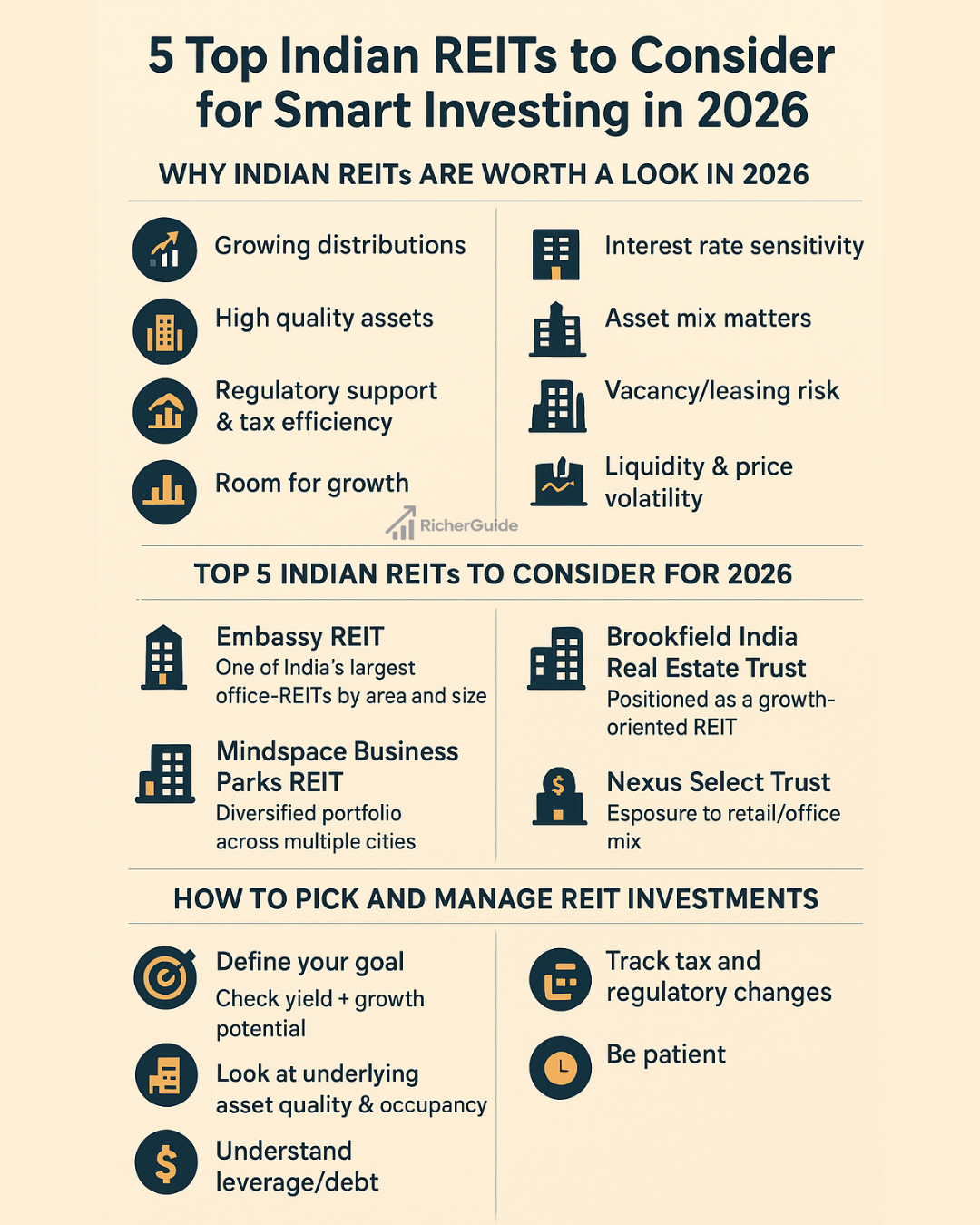
Why Indian REITs are worth a look in 2026
Here are some of the key reasons:
- Growing distributions – India’s four publicly listed REITs together distributed about ₹6,070 crore in FY 2024-25, up around 13% year-on-year. The Week+2ETRealty.com+2
- High quality assets – These REITs manage large portfolios of Grade-A office and retail real-estate across major metros in India. India Brand Equity Foundation+1
- Regulatory support & tax efficiency – Under the rules, REITs must distribute at least 90% of their taxable income to unitholders, making them relatively income‐focused. Business Standard+1
- Room for growth – According to a report, only about 23% of “REIT-worthy” office stock in the top seven Indian cities is listed under REITs, leaving a lot of room for future listings and expansion. Standardpost
Given these points, Indian REITs look like they could be a solid component of a diversified portfolio heading into 2026—especially if you’re focused on income plus moderate growth rather than high-risk speculation.
What to keep in mind (risks & caveats)
Before jumping in, some cautions:
- Interest rate sensitivity: Real estate assets and REITs often borrow money and are sensitive to interest rate changes. Rising rates may hurt profitability or valuations.
- Asset mix matters: Some REITs are heavily concentrated in one city or one property type (e.g., office space). That may expose you to location or sector risk.
- Vacancy/leasing risk: If tenants leave or leases aren’t renewed, income drops and that hurts distributions.
- Liquidity & price volatility: Although listed, REIT units can still fluctuate in value. Distributions help cushion returns, but capital loss is possible.
- Regulatory changes: The REIT sector in India is still evolving; rules/taxation might change and impact returns.
With both the opportunity and the risks in mind, here are five REITs in India that are often mentioned by analysts as good candidates for 2026. (This is not personal financial advice; always do your own research or consult a financial advisor.)
Top 5 Indian REITs to consider for 2026
1. EMBASSY REIT (Embassy Office Parks REIT)
- One of India’s largest office-REITs by area and size. Ghar.tv
- For FY 2025: DPU (distribution per unit) was around ~₹23 with dividend yield near ~6.5%. Ghar.tv
- Pros: Strong passive income play, scale advantages, decent occupancy.
- Things to watch: Office segment under pressure globally; new remote-work trends may persist.
2. BIRET (Brookfield India Real Estate Trust)
- Positioned as a growth‐oriented REIT rather than purely income focused. Ghar.tv
- Smaller market cap compared to some peers, meaning more room for expansion.
- Pros: Growth potential, good leasing momentum in recent years.
- Things to watch: The flip side of growth is more execution risk; need to monitor debt levels and acquisitions.
3. MINDSPACE REIT (Mindspace Business Parks REIT)
- Has a diversified portfolio across multiple cities (Mumbai, Hyderabad, Pune, Chennai). Ghar.tv
- Positioning: Balanced performer with income + moderate growth.
- Pros: Geographic diversification, multiple markets help spread risk.
- Things to watch: Some markets may be more competitive or have rising supply which can pressure rents.
4. NEXUS Select Trust
- A listed REIT in India, part of the core set of four operating listed REITs. ETRealty.com+1
- Pros: Exposure to retail/office mix; may provide a sectorally diversified angle within REITs.
- Things to watch: Retail assets can face different risk dynamics (footfalls, consumer trends) compared to pure office REITs.
5. KRT REIT (Knowledge Realty Trust)
- this REIT has been flagged as India’s largest upcoming REIT in terms of asset value/portfolio.
- Pros: Potential early‐entry opportunity; big size means potential scale benefits.
- Things to watch: As a newer REIT, more uncertainty; early stage risks (pricing, execution) may be higher.
How to pick and manage REIT investments
Here are some practical tips, especially relevant for someone in a role like yours (Digital Marketing Executive) who may be balancing investment with a full-time job:
- Define your goal – Are you chasing income (steady distributions) or capital gain (unit price appreciation)? Different REITs lean one way or another.
- Check yield + growth potential – A high distribution today is nice, but if growth is zero or declining, the future is bleak.
- Look at underlying asset quality & occupancy – Grade-A commercial real estate in good locations usually performs better.
- Understand leverage/debt – High borrowing increases risk (especially if interest rates rise).
- Diversify – Even within REITs, don’t put all your money in one. Also combine REITs with other asset classes (equities, bonds, direct real estate or funds).
- Track tax and regulatory changes – REITs depend on structure and rules; regulatory shifts can impact returns.
- Be patient – Real estate is generally medium to long term. A 3–5 year plus horizon fits better than short-term speculation.
Why 2026 is a timely moment
- The macro environment in India shows strong leasing demand, particularly from global capability centres, BFSI, tech firms wanting quality office space. These trends help support REIT earnings. India Brand Equity Foundation+1
- REIT penetration is still relatively low compared to the total “REIT-worthy” stock in Indian cities. This suggests room for growth in listings, asset acquisitions, and value creation.
- Investors are seeking alternative income streams beyond traditional equities, and REITs provide an avenue for that.
Conclusion
If you’re looking for a relatively stable income-producing investment, and you’re willing to accept moderate growth (rather than sky-high returns), Indian REITs are looking quite attractive as we move into 2026. Among them, Embassy REIT, Brookfield India REIT, Mindspace REIT, Nexus Select Trust and the forthcoming KRT REIT stand out as names worth watching.
Just remember: always do your homework. Check the latest financials (DPU, occupancy, debt), understand the property portfolio, and align the investment with your risk appetite and time horizon. With thoughtful choices, REITs could be a smart addition to your investment portfolio.
Disclaimer: This content is for Educational purposes only and is not financial advice. Please research independently or consult a financial advisor before investing.