
What Are Index Funds and Why Beginners Love Them
If you’ve just started learning about investing, you’ve probably heard the term “index funds” many times. They’re one of the most popular investment options for beginners — and for good reason! Index funds make investing simple, affordable, and stress-free. But what exactly are they, and why do so many new investors love them?
Let’s break it down in the simplest way possible.
Table of Contents
What Is an Index Fund?
An index fund is a type of mutual fund or exchange-traded fund (ETF) that tries to match the performance of a particular market index — like the Nifty 50 or Sensex in India, or the S&P 500 in the U.S.
In other words, instead of choosing individual stocks yourself, the index fund automatically invests in all the companies that make up that index.
For example:
- A Nifty 50 Index Fund invests in the top 50 companies listed on the National Stock Exchange (NSE).
- An S&P 500 Index Fund invests in 500 leading U.S. companies.
So when you buy one index fund, it’s like owning a small piece of hundreds of strong, established companies instantly diversifying your investment!
How Index Funds Work
Think of an index fund as a mirror.
It doesn’t try to beat the market — it simply reflects it.
If the Sensex rises by 10%, your Sensex index fund will also go up by roughly 10%.
If the Sensex falls by 5%, your fund will drop by about the same amount.
This means index funds are passively managed.
Unlike actively managed mutual funds where fund managers buy and sell frequently to “beat the market,” index funds just follow the index — no guessing, no stress.
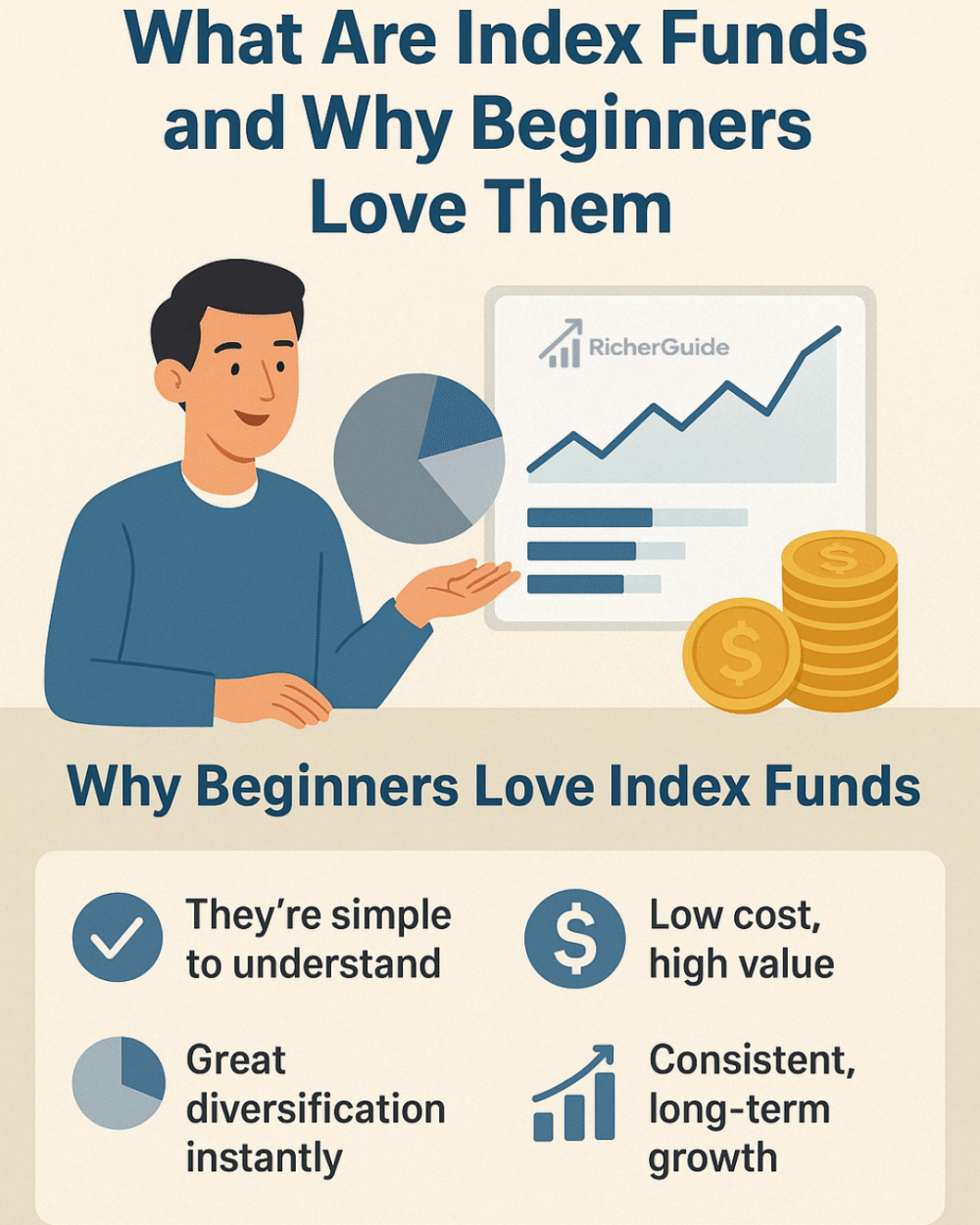
Why Beginners Love Index Funds
Now let’s look at why index funds are such a favorite among first-time investors.
1. They’re Simple to Understand
Many investment options can seem complicated, especially when you’re new.
Index funds, however, are easy to grasp — you invest money, and it tracks a well-known index.
You don’t need to study balance sheets, time the market, or pick the right stocks.
It’s a set-it-and-forget-it approach that helps beginners start investing with confidence.
2. Low Cost, High Value
One of the biggest reasons beginners love index funds is their low cost.
Since they don’t need a team of analysts or fund managers to pick stocks, their expense ratio (management fee) is much lower than other mutual funds.
Lower fees mean more of your money stays invested, which helps your returns grow faster over time.
It’s a smart, cost-effective way to build wealth steadily.
3. Great Diversification Instantly
When you invest in a single stock, your success depends entirely on how that company performs.
But with an index fund, your money is spread across dozens or even hundreds of companies.
This reduces your risk because even if one or two companies perform poorly, others in the index may perform well — balancing out your returns.
Diversification is a key part of smart investing, and index funds offer it automatically.
4. Consistent, Long-Term Growth
Over the long term, stock markets tend to grow — even though they go up and down in the short term.
Since index funds track the market, they generally deliver steady and reliable growth over time.
If you stay invested for 5, 10, or 20 years, you’re likely to see positive returns, especially when you invest regularly.
That’s why index funds are often called a long-term wealth builder for beginners.
5. Perfect for SIP (Systematic Investment Plan)
Index funds work beautifully with SIP investing.
You can start investing with a small amount every month — sometimes as low as ₹500 — and gradually build wealth.
This habit of regular investing helps you take advantage of rupee cost averaging — meaning you buy more units when prices are low and fewer when they’re high, reducing the overall cost over time.
It’s a stress-free and disciplined way to grow your money.
6. Less Emotion, More Logic
Many beginners make emotional decisions when investing — selling when markets fall or chasing “hot” stocks when prices rise.
Index funds take away that emotional stress because they follow a fixed market index.
You don’t have to guess which stock to buy or sell.
This makes your investment journey calm and logical, not emotional.
You simply stay invested and let the market do its work.
7. Proven Performance Over Time
Many studies have shown that, over the long term, most actively managed funds fail to beat their benchmark index.
In simple words, trying to beat the market often fails.
Index funds, on the other hand, match the market — and over time, that often leads to better, more consistent returns for investors, especially after accounting for lower fees.
That’s why even some of the world’s best investors, like Warren Buffett, recommend index funds for beginners.
When Should You Invest in Index Funds?
The best time to start is as early as possible.
Even if you can only invest a small amount now, time and compounding can turn small investments into big wealth.
Here’s a simple approach:
- Choose a reliable index fund (like Nifty 50 or Sensex).
- Set up a monthly SIP.
- Stay invested for at least 5–10 years.
- Review occasionally, but avoid reacting to short-term market ups and downs.
Who Should Consider Index Funds?
Index funds are great for:
- Beginners who want to start investing safely.
- Busy professionals who don’t have time to study the market.
- Long-term investors aiming for steady growth.
- Cost-conscious investors who prefer low fees and transparency.
If you want a simple, low-risk way to grow your wealth, index funds can be your best starting point.
Final Thoughts
Index funds prove that investing doesn’t have to be complicated or expensive.
They’re simple, affordable, diversified, and proven to perform well over time.
For beginners, they offer the perfect balance of safety, growth, and simplicity — helping you take your first confident step toward financial freedom.
Remember, investing is not about timing the market — it’s about time in the market.
Start small, stay consistent, and let index funds do the heavy lifting for your financial future.