
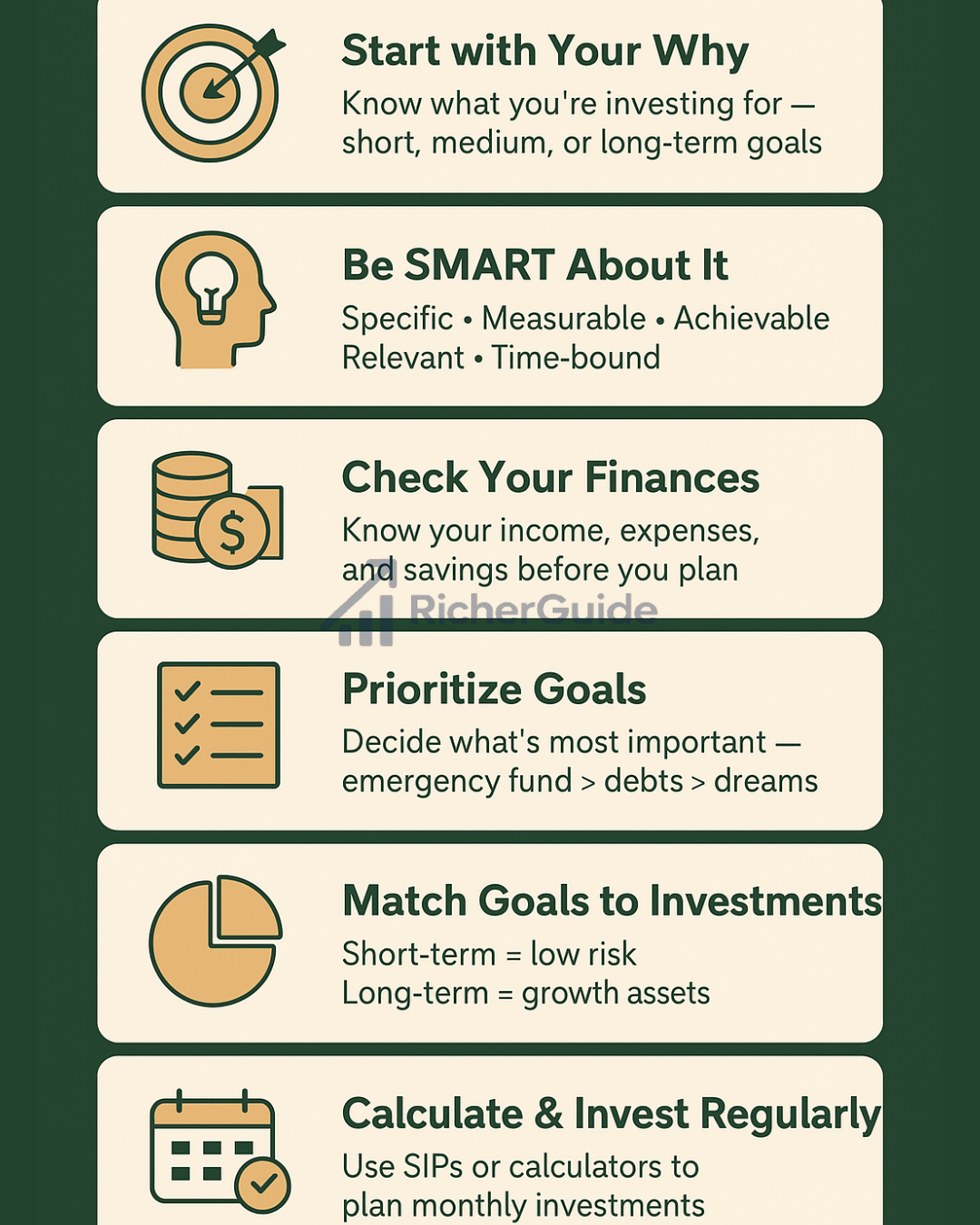
Investing your money is one of the best ways to grow your wealth, achieve financial independence, and secure your future. But before you jump into stocks, mutual funds, or real estate, there’s one crucial step that many people overlook — setting clear financial goals.
Without goals, investing becomes like sailing without a compass — you might move, but you won’t know where you’re heading. Financial goals give your investments direction, purpose, and meaning. They help you make smarter decisions, stay focused, and measure your progress over time.
In this simple guide, let’s understand how to set financial goals before you start investing — step by step.
Table of Contents
1. Why Financial Goals Matter Before Investing
Think of financial goals as the foundation of your investment plan. If you invest without knowing why or for what, you might end up choosing the wrong products, taking unnecessary risks, or getting disappointed with your returns.
Here’s why setting financial goals is important:
- Clarity: You’ll know exactly what you are saving and investing for.
- Motivation: Goals give you a reason to stay consistent with your investments.
- Better Planning: Helps you choose the right investment product based on time frame and risk level.
- Tracking Progress: You can measure how close you are to achieving what you want.
Simply put, your goals turn investing into a purposeful journey rather than a random habit.
2. Identify What You Want to Achieve
Start by asking yourself:
What do I want to achieve with my money?
Your goals could be short-term, medium-term, or long-term. Here’s how they usually break down:
- Short-term goals (1–3 years):
Examples – Building an emergency fund, going on a vacation, or buying a gadget. - Medium-term goals (3–7 years):
Examples – Buying a car, saving for a wedding, or planning for higher education. - Long-term goals (7+ years):
Examples – Buying a home, creating retirement wealth, or building a child’s education fund.
List all your goals and categorize them by time horizon. This will help you plan how much money you need and which investments are suitable for each goal.
3. Be Specific and Realistic
Goals like “I want to be rich” or “I want to invest for my future” are too vague. You need to be specific and realistic.
Use the SMART framework to define your financial goals:
- S – Specific: What exactly do you want? (e.g., Save for a ₹10 lakh down payment on a house)
- M – Measurable: How much money will you need?
- A – Achievable: Can you realistically save and invest that amount with your current income?
- R – Relevant: Does this goal align with your life priorities?
- T – Time-bound: When do you want to achieve it?
Example:
“I want to save ₹5 lakh for my child’s education in 5 years by investing ₹7,000 per month in mutual funds.”
This is specific, measurable, achievable, relevant, and time-bound.
4. Know Your Current Financial Situation
Before setting big goals, understand where you stand today. Take a close look at:
- Your monthly income and expenses
- Existing savings or investments
- Loans or debts you need to clear
- Your emergency fund (ideally 3–6 months of expenses)
This helps you know how much you can realistically invest each month. If your current budget is tight, start small — even ₹500 or ₹1,000 a month is a good start. The key is consistency.
5. Prioritize Your Goals
It’s normal to have multiple financial goals at once. But not all of them can be achieved together. That’s why you need to prioritize them based on urgency and importance.
Ask yourself:
- Which goal is most critical right now?
- What will happen if I delay this goal?
- Can I balance multiple goals with my current income?
For example, an emergency fund should always come before investing for a car or vacation. Similarly, paying off high-interest debt should be a top priority before you start aggressive investments.
6. Match Goals with Investment Options
Once your goals are clear, match them with suitable investment products based on time frame and risk appetite:
| Goal Type | Time Frame | Suggested Investment Options |
|---|---|---|
| Short-term (1–3 yrs) | Low risk | Bank deposits, liquid funds, short-term debt funds |
| Medium-term (3–7 yrs) | Moderate risk | Balanced mutual funds, recurring deposits |
| Long-term (7+ yrs) | Higher risk, higher return | Equity mutual funds, stocks, PPF, NPS, real estate |
Remember, higher returns come with higher risks. So, balance your investments according to your comfort level and time horizon.
7. Calculate How Much You Need to Invest
Once you know your goal amount and time frame, calculate how much you need to invest each month to reach it.
You can use an investment calculator or a SIP calculator online.
For example:
If you want ₹10 lakh in 10 years and expect an 10% annual return, you need to invest around ₹4,800 per month through SIPs.
This step turns your goal into a practical monthly action.
8. Review and Adjust Regularly
Your financial goals may change as life changes — new job, marriage, child, or shifting priorities.
That’s why it’s important to review your goals at least once a year.
Ask yourself:
- Am I on track with my investments?
- Do I need to increase my monthly contribution?
- Have my goals changed in value or importance?
Making small adjustments keeps you aligned with your evolving life goals.
9. Protect Your Goals with Insurance and Emergency Fund
Before you invest aggressively, make sure you have a safety net.
- Health insurance: Covers medical emergencies.
- Life insurance: Protects your family’s financial goals if something unexpected happens.
- Emergency fund: Helps you handle sudden expenses without touching your investments.
These safety layers ensure your financial goals stay on track, even when life throws surprises.
10. Stay Disciplined and Patient
Investing is not a one-time act — it’s a long-term journey.
Stay disciplined, invest regularly, and don’t get distracted by short-term market movements.
Even small, consistent investments can grow big over time through compound interest. The key is to stay patient and focused on your goals.
Final Thoughts
Setting financial goals before investing is the smartest first step toward financial success. It helps you:
- Invest with purpose
- Manage risks better
- Stay motivated
- Achieve your dreams faster
Remember, the right investment is not about timing the market — it’s about aligning your money with your goals. So take a notebook, write down what you truly want, and start planning your journey today.
Your financial goals are the map, and investing is the vehicle — together, they’ll take you where you want to go.